A vehicle sale agreement is a legally binding contract under the Indian Contract Act, 1872 that documents the transfer of a motor vehicle between a seller and a buyer. While it establishes financial closure and civil indemnity, statutory liability remains with the registered owner under the Motor Vehicles Act until the Registration Certificate (RC) is officially updated at the Regional Transport Office (RTO). Before handing over your keys, verifying vehicle owner details ensures you are transacting with the lawful owner.
Key Takeaways
- A vehicle sale agreement establishes civil indemnity but does not replace statutory RC transfer.
- Execute the contract on a ₹100 or ₹200 Non-Judicial Stamp Paper with notary attestation.
- Supreme Court rulings hold the registered owner liable for accidents until RTO records update.
- Include an exact timestamp, an 'as-is' clause, and an unconditional indemnity clause.
- Submitting Form 29 to the RTO and lodging a police diary entry safeguards sellers against delayed transfers.
| Feature | Requirement / Rule | Legal Reference |
|---|
| Applicable Law | Sale of Movable Goods | Sale of Goods Act, 1930 / Indian Contract Act, 1872 |
| Stamp Paper | ₹50 to ₹200 Non-Judicial (State-specific) | Indian Stamp Act, 1899 |
| RC Transfer Window | 14 days (Intra-state), 45 days (Inter-state) | Section 50, Motor Vehicles Act, 1988 |
| Notary Attestation | Recommended with two witness signatures | Section 35, Indian Stamp Act, 1899 |
| Dealer Protection | Form 29C filing grants 'Deemed Owner' status | Rule 55C, CMVR, 1989 (MoRTH G.S.R. 901(E)) |
Why a Vehicle Sale Agreement Is Vital for Indian Sellers
Selling a pre-owned car or two-wheeler involves more than exchanging keys for cash. Under Section 2(30) of the Motor Vehicles Act (MVA), 1988, the legal 'owner' is strictly defined as the person in whose name the vehicle stands registered in government records. The only statutory exceptions apply to hire-purchase, hypothecation, lease agreements, or legal guardians of minors. A regular private buyer does not qualify under these statutory exceptions merely by paying the purchase amount.
The landmark Supreme Court judgment in Naveen Kumar v. Vijay Kumar & Ors. (2018) established the 'Registered Owner Doctrine'. The apex court ruled that the registered owner remains liable to third-party accident victims before a Motor Accident Claims Tribunal (MACT), regardless of any private sales, sale deeds, or physical possession handovers. Claimants cannot be forced to pursue an unregistered chain of successive buyers. This stance was reaffirmed in Prakash Chand Daga v. Saveta Sharma (2018) and Surendra Kumar Bhilawe v. The New India Assurance Co. (2020).
Warning: Private sale deeds and delivery notes create enforceable civil indemnity rights between buyer and seller, but they do not automatically shield you from statutory traffic challans, MACT compensation orders, or police summons.
A properly executed used car sale agreement draft acts as your primary civil shield. While it does not prevent the MACT or police from contacting you initially, it grants you the legal right to recover financial damages from the buyer and serves as exculpatory evidence to prove your lack of physical control over the vehicle.
Stamp Paper for Car Sale Agreement: State-Wise Duty & Validity
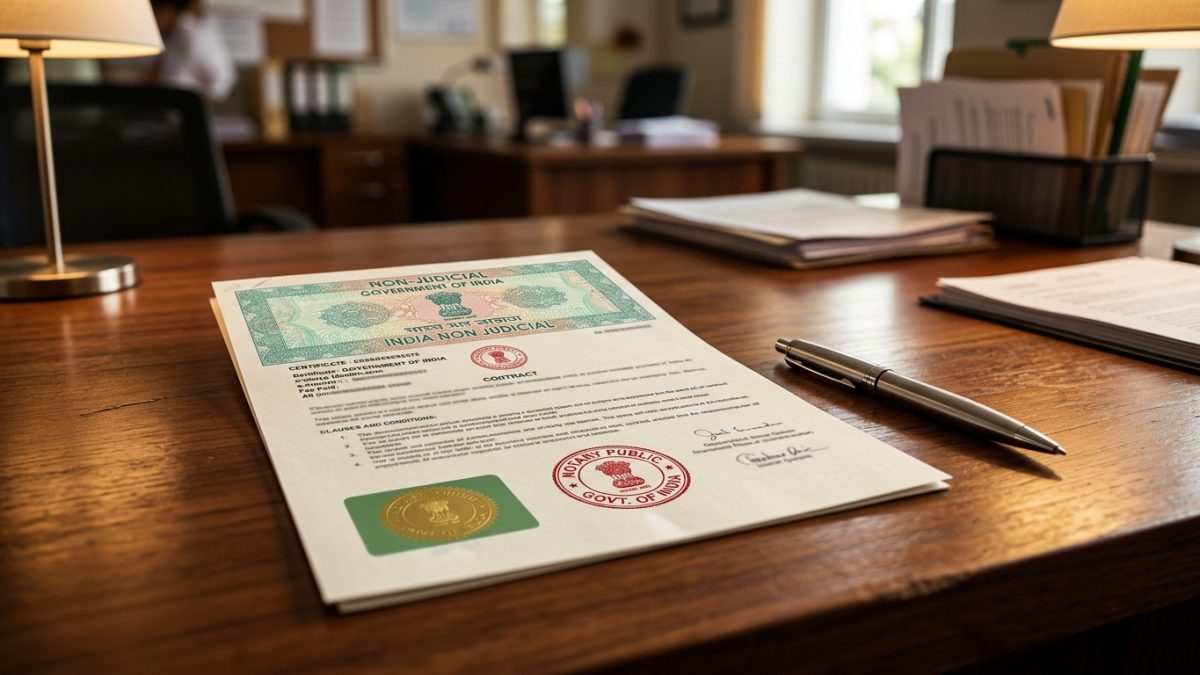
Under the Indian Stamp Act, 1899, a vehicle sale agreement is legally classified as an agreement relating to the sale of movable property. Because motor vehicles are movable assets, these contracts do not attract the high percentage-based (ad valorem) stamp duties associated with immovable real estate.
Stamp duty rates vary by state jurisdiction. Executing the agreement on insufficient stamp duty renders it legally defective. Under Section 35 of the Indian Stamp Act, 1899, an unstamped or under-stamped document is inadmissible as evidence in a court of law. To cure this defect in civil litigation, the deficient duty plus a statutory penalty of up to 10 times the deficit must be paid through an impounding process.
| State / Union Territory | Standard Stamp Paper Value | Governing Stamp Legislation |
|---|
| Delhi / NCR | ₹50 to ₹100 Non-Judicial e-Stamp | Indian Stamp Act (Delhi Schedule) |
| Maharashtra | ₹100 to ₹500 Non-Judicial Stamp Paper | Article 5(h), Maharashtra Stamp Act, 1958 |
| Karnataka | ₹100 to ₹200 Non-Judicial e-Stamp | Karnataka Stamp Act, 1957 |
| Uttar Pradesh | ₹100 Non-Judicial e-Stamp | Indian Stamp Act (UP Amendment) |
| Tamil Nadu / Gujarat / Rajasthan | ₹50 to ₹100 Non-Judicial Stamp Paper | Respective State Stamp Acts |
As a national baseline practice as of October 2026, executing your agreement on a ₹100 or ₹200 Non-Judicial Stamp Paper (or state e-Stamp) ensures solid evidentiary weight across Indian courts. Regarding vehicle sale agreement notary validity, registration with the Sub-Registrar under Section 17 of the Registration Act, 1908 is not mandatory for movable goods. However, having the document signed before a Notary Public with a registered entry serial number and attested by two independent witnesses is essential to verify signature authenticity.
Essential Car Sale Agreement Terms and Conditions to Protect the Seller
A boilerplate receipt is inadequate for shielding a seller from downstream liabilities. Whether you are drafting a bike sale agreement format india or a detailed car contract, the document must contain specific operational clauses enforceable under the Indian Contract Act, 1872 and the Sale of Goods Act, 1930.
1. Comprehensive Party Identification (KYC Clause)
Record the full legal names, parentage, permanent addresses, current residential addresses, contact numbers, email addresses, and verified PAN and Aadhaar details for both buyer and seller. Never sell a vehicle to an individual who refuses to provide address proof.
2. Vehicle Particulars & Odometer Accuracy
State the exact vehicle registration number, chassis/VIN number, engine number, make, model, variant, color, year of manufacture, and the exact odometer reading at the point of physical handover. Cross-reference these with our guide to check vehicle history india before finalizing paperwork.
3. Consideration Realization Clause
Specify the total agreed sale price, advance token money received, outstanding balance, and the exact payment method (including banking transaction IDs). Expressly state that title transfer remains conditional upon the full financial realization of the funds.
4. Timestamped Handover Clause
Record the exact hour, minute, date, and physical location of delivery (for example, 'Physical custody handed over on 07 October 2026 at 11:30 AM IST at Pune'). This timestamp defines when risk passes to the buyer.
5. 'As-Is Where-Is' Inspection Warranty
Document that the buyer conducted a comprehensive mechanical inspection and test drive, accepted the vehicle's aesthetic and operational condition, and that the seller offers no post-sale warranties.
6. Risk and Operational Liability Transfer
Declare that all operational risks, including fuel costs, regular maintenance, roadworthiness, insurance coverage, and vehicle custody, transfer entirely to the buyer immediately following the delivery timestamp.
7. Unconditional Indemnity Clause
This is the seller's core legal protection. The buyer must covenant to defend, indemnify, and hold harmless the seller from all third-party MACT claims, traffic fines, litigation expenses, police investigations, and statutory liabilities arising after the handover timestamp.
8. Statutory RC Transfer Covenant
Mandate that the buyer must apply for ownership transfer at the RTO within 14 days for local sales (or 45 days for inter-state transactions) and bear all transfer fees, road taxes, or late penalties.
9. FASTag and e-Challan Liability
State that all camera-based challans and FASTag tolls accrued prior to the delivery time belong to the seller, while all subsequent traffic violations or toll penalties are the buyer's sole legal responsibility.
10. Seller Right to Intervene
Authorize the seller to notify the RTO, file a police intimation, or request vehicle service blacklisting on the Vahan portal if the buyer fails to complete the ownership transfer within the agreed timeline.
Tip: Always photograph the buyer holding their original Aadhaar card alongside the signed agreement and vehicle keys during handover to prevent identity denial disputes later.
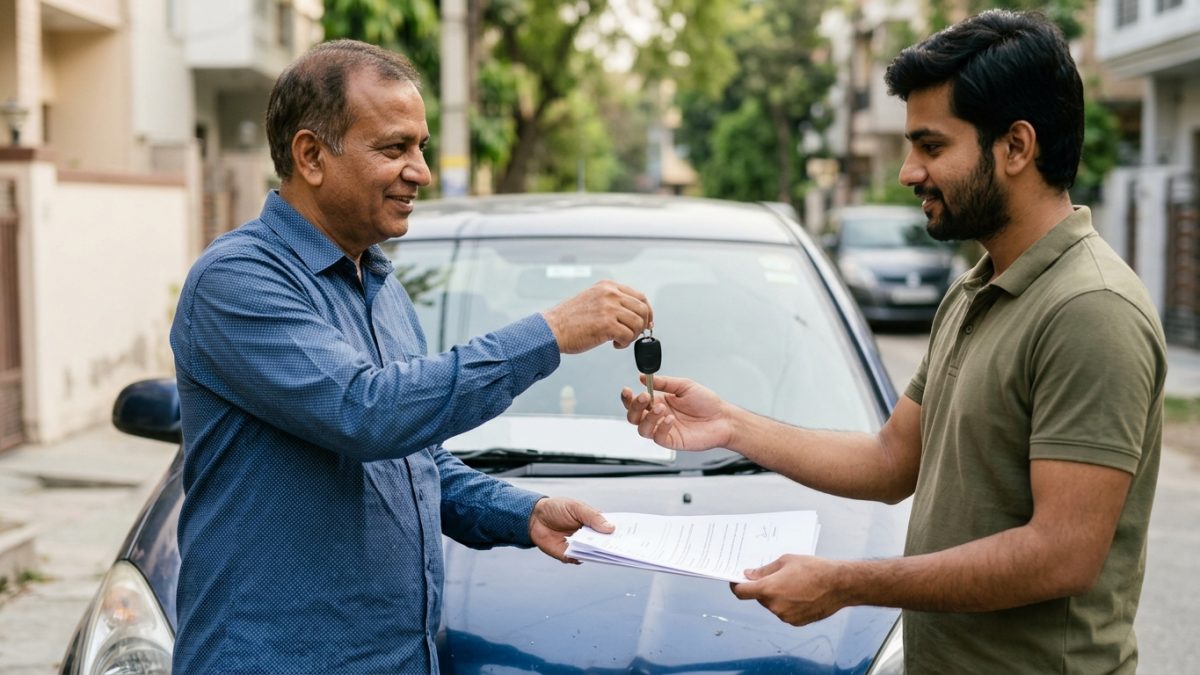
While a vehicle sale agreement contains the broad contractual promises, a vehicle delivery note format serves as contemporary proof of physical transfer. Executed simultaneously on plain paper or affidavit sheet, the delivery note acts as an immediate receipt for physical custody.
A legally sound vehicle delivery note must include the following information:
- Transfer Timing: Precise date, hour, and minute of handover.
- Odometer Reading: The exact mileage reading when the keys are handed over.
- Inventory Checklist: Documentation of handed-over items, including Original RC, valid Insurance Certificate, Pollution Under Control (PUC) Certificate, physical keys, owner's manual, purchase invoice, and signed RTO Forms.
- Signed RTO Forms: Explicit acknowledgment of receiving duplicate signed copies of Form 29 (Notice of Transfer) and Form 30 (Application for Transfer).
- Signatures: Full physical signatures of both seller and buyer, attested by two independent witnesses.
If you need to move the vehicle across state borders, remember that ownership transfer also requires an RTO NOC in Form 28. Review our walkthrough on RC transfer to another state to track inter-state timelines.
Dealer Sales vs Private Sales: MoRTH Rules and Deemed Ownership
Selling to a pre-owned car business differs significantly from selling to an individual buyer. To curb unauthorized vehicle flipping and protect original owners, the Ministry of Road Transport and Highways (MoRTH) implemented Notification G.S.R. 901(E), adding Rules 55A to 55H to the Central Motor Vehicles Rules (CMVR), 1989.
Under these rules, registered pre-owned vehicle dealers holding an authorization certificate in Form 29B can accept vehicles from sellers. Once the seller or dealer uploads Form 29C (Intimation of Delivery of Vehicle to Authorized Dealer) on the Vahan Citizen Services Portal, the dealer becomes the legal 'deemed owner'.
Deemed Owner Advantage: Once Form 29C is accepted on Vahan, the original seller is legally relieved of third-party accident and traffic liabilities during the dealer holding period.
In July 2026, MoRTH proposed draft amendments to tighten dealer inventory norms, barring the transfer of vehicles with active e-challans, lapsed insurance, or pending court superdari cases. However, these dealer-specific protections do not apply to direct peer-to-peer (P2P) individual sales. In private sales, the registered owner remains bound to Section 50 of the MVA and the Supreme Court's Registered Owner Doctrine until the buyer completes the RC transfer.
What to Do if Buyer Delays RC Transfer: 6-Step Escalation

When an individual buyer drives off with your car but fails to update the RC, you remain vulnerable to automated traffic fines and accident liabilities. Follow this structured 6-step escalation procedure to safeguard your legal standing:
- Monitor Portal Status: Track the ownership status on the Parivahan Transfer of Ownership Portal. Simultaneously inspect pending traffic challans using your registration number to catch camera-based speeding or red-light violations before they escalate to a Virtual Court.
- Serve a Formal Legal Notice: Engage an advocate to dispatch a legal notice via Registered Post AD or Speed Post to the buyer's verified address. Demand completion of the Form 30 submission within 7 to 15 days, enclosing copies of your vehicle sale agreement and delivery note. Retain the postal tracking receipt as evidence.
- Self-Intimate the RTO under Section 50(1)(a): Under Rule 55 of the CMVR, 1989, you are legally obligated to report the transfer. Submit the duplicate copy of Form 29 directly to your local RTO. Attach a cover letter, notarized sale agreement copy, delivery note, buyer KYC, and the postal receipt. Ensure you secure an official Inward Number or stamped acknowledgment from the RTO desk.
- Lodge a Police General Diary (GD) Entry: Visit your local police station having jurisdiction over your residence or vehicle handover location. File a written intimation (a Station Diary or General Diary entry, not an FIR) stating that physical custody was transferred to the buyer on the specified date and time. Keep the stamped police acknowledgment safe. If the vehicle is later involved in a hit-and-run, smuggling, or illegal activity, this GD entry acts as crucial exculpatory evidence.
- Submit a Vahan Blacklisting Petition: Submit a formal written application to the Registering Authority at the RTO requesting that the vehicle record be marked as 'Intimated Sold / Pending Transfer' or placed under service restriction in the Vahan database. This prevents the vehicle from undergoing fitness renewals, duplicate RC issuance, or hypothecation changes without addressing ownership.
- File a Civil Suit for Mandatory Injunction: If the buyer remains unresponsive, file a suit for Mandatory Injunction and Specific Performance before a Civil Court. This legal remedy compels the buyer to complete RTO transfer procedures and allows you to claim compensation for any traffic fines or legal costs incurred due to their default.
| Escalation Stage | Primary Authority | Core Document Required | Protective Outcome |
|---|
| Stage 1: Self-Intimation | Jurisdictional RTO | Form 29 + Stamped Inward Receipt | Proves statutory notice of sale |
| Stage 2: Police Record | Local Police Station | General Diary (GD) Intimation Copy | Exculpatory defense against crimes |
| Stage 3: Legal Warning | Buyer Address | Advocate Notice via Speed Post | Establishes contractual default |
| Stage 4: Database Flag | RTO Registering Authority | Service Hold Request Petition | Freezes further RTO services on Vahan |
Checklist: Pre-Handover vs Post-Handover Duties
To avoid legal entanglements when selling your vehicle, balance your responsibilities between the commercial transaction and statutory RTO filings. Never rely on verbal assurances from the buyer.
- Clear Pending Challans: Visit the official e-Challan Parivahan Portal to inspect and settle any pending fines before executing the agreement.
- Collect Identification Documents: Obtain self-attested photocopies of the buyer's Aadhaar card, PAN card, and current address proof.
- Execute Notarized Documentation: Draft your vehicle sale agreement on appropriate non-judicial stamp paper and execute it along with the vehicle delivery note.
- Sign Statutory Forms: Sign two sets of RTO Form 29 and Form 30. Retain one original signed copy of Form 29 for your own RTO submission.
- Deactivate FASTag: Close or surrender your FASTag wallet linked to the vehicle to prevent automated toll deductions after custody handover.
- Track Registration Changes: Monitor the vehicle's transfer progress weekly using the Vahan portal until the buyer's name reflects on the RC.
By following these legal steps, maintaining timestamped paperwork, and tracking updates on the Parivahan network, you ensure that selling your pre-owned vehicle does not lead to unexpected administrative or legal complications.
Conclusion
A well-drafted vehicle sale agreement backed by adequate stamp duty, a signed delivery note, and prompt submission of Form 29 protects you from post-sale legal liabilities. Never rely solely on verbal agreements or unsigned paper receipts when transferring custody of a motor vehicle.
Protect your rights by confirming that the buyer completes statutory RTO formalities within the mandated timeframe. Use VahanX to verify vehicle owner details and confirm that ownership records have been updated in government databases.