Key Takeaways
- Standard traffic challans provide a 60-day compounding window (45 days in Delhi) for direct police settlement.
- Once expired, traffic police transfer jurisdiction to the judiciary, routing the fine to Virtual Courts.
- Indian law does not charge daily interest, but judges can levy maximum statutory penalties.
- Unpaid challans trigger vehicle blacklisting on VAHAN 4.0, blocking RC transfers, renewals, and PUC tests.
To pay challan online after due date, vehicle owners cannot use the regular police payment window. Once the voluntary 60-day compounding period expires, the challan moves to the judiciary. You must settle the fine online through the official e-Courts Virtual Court portal (vcourts.gov.in) by pleading guilty and completing digital payment.
Before attempting any payment, check your current violation record on VahanX challan search to confirm whether your pending case remains with the enforcement wing or has been forwarded to a virtual magistrate.
| Feature | Police Portal (Within Due Date) | Virtual Court (After Due Date) |
|---|
| Portal URL | echallan.parivahan.gov.in | vcourts.gov.in |
| Compounding Window | First 60 days (45 days in Delhi) | After 60-day expiry |
| Statutory Baseline | Compounded administrative fine | Magistrate adjudicated penalty |
| Settlement Method | Direct card/UPI payment | Plea of guilty + state treasury gateway |
| Payment Button Status | Active ("Pay Now") | Disabled on Parivahan ("Sent to Court") |
Understanding the 60-Day Compounding Window and Legal Shift
When an automated speed camera or traffic police officer issues a violation notice, it operates under Section 200 of the Motor Vehicles Act, 1988. This provision grants an administrative compounding window, allowing vehicle owners to settle penalties without entering a courtroom. Across most of India, this compounding window lasts 60 days from the violation date, though specific regions like Delhi enforce a shorter 45-day window.
Compounding is entirely voluntary. If you fail to clear the fine within this statutory window, the traffic enforcement agency loses its legal authority to accept your payment directly. The enforcement branch compiles the digital case file and forwards it directly to the judicial system, either to an online Virtual Court or a local Chief Judicial Magistrate.
Legal Note: As of October 2026, traffic police cannot accept administrative compounding fines once the statutory window closes; all overdue notices become pending court matters.
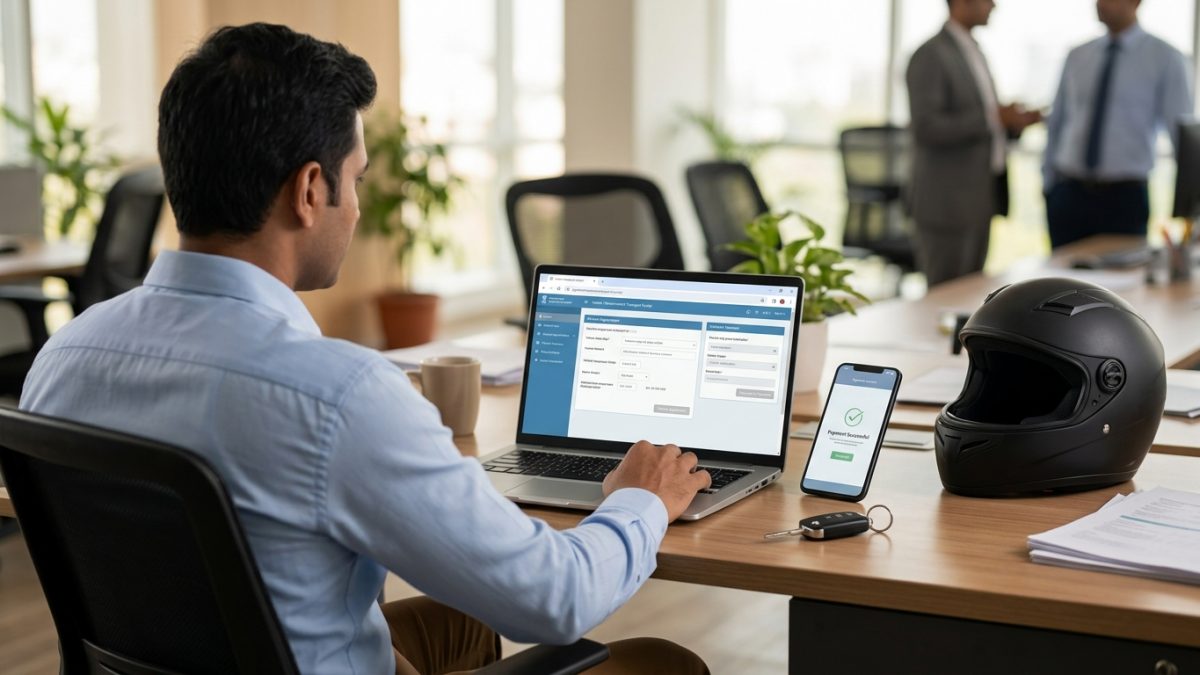
Many motorists logging into the Parivahan portal to clear an overdue traffic fine payment online find that the "Pay Now" button is greyed out or completely missing. This is a common point of confusion, but the portal disables the button for specific procedural reasons.
| Portal Status | Primary Reason | Immediate Action Required |
|---|
| "Sent to Virtual Court" | 60-day compounding period lapsed | Proceed to vcourts.gov.in to plead guilty |
| "Forwarded to Regular Court" | Non-compoundable offence or contested case | Appear physically before the local magistrate |
| "Payment Pending / Processing" | Failed or interrupted online transaction | Click "Verify" to reconcile bank status |
| "Court Case Disposed" | Fine paid via judicial portal | Download clearance receipt from e-Courts |
1. Case Forwarded to Virtual Court or Regular Court
The most frequent reason for a disabled payment button is the expiration of the compounding window. When the case transitions to the judiciary, the status updates to "Sent to Virtual Court" or "Forwarded to Court". Because the police department can no longer collect the money, Parivahan disables the collection gateway.
2. Non-Compoundable Offences
Certain severe traffic violations cannot be settled out of court under Section 200. These serious infractions bypass the compounding process entirely from day one:
- Driving under the influence of alcohol or narcotics (Section 185).
- Dangerous or reckless driving involving repeat offences or public injury (Section 184).
- Engaging in unauthorized speed trials or street racing (Section 189).
- Driving without a valid licence where vehicle impoundment occurred (Section 207).
3. Contested Violations and Pending Reconciliations
If you previously used the portal to dispute a notice, the system transfers the case to a regular Metropolitan Magistrate court for a physical hearing, removing the instant settlement button. Additionally, if an earlier payment attempt failed midway, Parivahan locks the "Pay Now" button for 24 to 48 hours to avoid duplicate debits. Clicking the "Verify" or "Check Pending Transaction" option initiates a manual bank reconciliation that re-enables the button if no funds were deducted.
Payment Tip: Never re-attempt a payment immediately if your account was debited; wait 48 hours for the reconciliation engine to confirm the status.
How to Pay Challan Online Sent to Court via Virtual Courts
The Supreme Court e-Courts project operates the Virtual Court platform (vcourts.gov.in) to resolve petty traffic offences without physical court appearances. If you need to complete a traffic challan payment after 60 days, this digital judicial bench handles proceedings for major states, including Delhi, Maharashtra, Uttar Pradesh, Tamil Nadu, Karnataka, Kerala, Haryana, West Bengal, Assam, Odisha, Chhattisgarh, Himachal Pradesh, and Tripura.
Follow this exact process explaining how to pay challan after due date online through the judicial gateway:
- Visit the official e-Courts portal: Open vcourts.gov.in on your web browser.
- Select your jurisdiction: Pick your state and designated department from the dropdown list, such as "Delhi (Traffic Department)" or "Maharashtra (Transport Department)".
- Search your case: Locate your violation using your Challan Number, Vehicle Registration Number, Registered Mobile Number, or CNR (Case Number Record).
- Review the violation record: Click "View" to review the photographic evidence, the date, the location, and the judicial fine proposed by the virtual magistrate.
- Submit your plea: Choose "I Plead Guilty & Pay Fine" to settle immediately. If you choose "I Wish to Contest", your file transfers to a physical court for full trial.
- Verify via OTP: Input your registered mobile number and enter the one-time verification password sent to your device.
- Complete the payment: The portal redirects you to the state treasury ePay gateway. Pay the fine using UPI, net banking, or debit card.
- Download disposal receipt: Save the judicial Disposal Order and digital receipt. The system marks the violation as "Disposed" and sends a digital release signal to VAHAN.
You can verify that the violation record has been cleared by cross-checking our guide on e-challan status tracking, or save a hard copy using the instructions in challan receipt download steps.
Crucial Step: Always print the judicial Disposal Order; this document serves as legal proof of resolution if an RTO database lock fails to lift automatically.
Alternative Resolution Methods: Lok Adalat and Physical Courts
While the Virtual Court handles the majority of routine overdue matters, certain situations require alternative dispute resolution or physical court appearances.
Settling Multiple Fines at National Lok Adalat
Organised quarterly across India by the National Legal Services Authority (NALSA) alongside State and District Legal Services Authorities, Lok Adalats provide an effective way to resolve accumulated or disputed traffic violations. Lok Adalat benches possess the authority to offer amicable settlements, frequently providing discretionary fine reductions or batch dismissals for procedural notices.
- Monitor the schedule: Check upcoming National Lok Adalat dates on nalsa.gov.in or your local traffic police portal.
- Secure an appointment token: In high-volume jurisdictions like Delhi, book a mandatory online entry token via the state traffic police portal.
- Gather documentation: Print your pending challan notices, vehicle Registration Certificate (RC), driving licence, and photo identity proof.
- Present your case: Attend the designated Lok Adalat bench on the scheduled date and discuss an amicable settlement with the presiding officers.
- Pay and collect final decree: Pay the agreed amount at the counter to obtain a signed Lok Adalat award, which acts as a final decree with no further appeal.
Appearing Before a Regular Physical Court
If you commit a non-compoundable offence, if your area lacks Virtual Court integration, or if formal judicial summons have been delivered, you must resolve the matter through a regular Metropolitan Magistrate or Chief Judicial Magistrate court.
- Locate the designated court: Check your summons or the Parivahan portal for the specific physical court handling your case.
- Attend the hearing: Appear in person or send an authorized advocate on the scheduled date.
- Plead or contest: The magistrate reviews the charge-sheet filed under the Motor Vehicles Act, after which you enter a formal plea.
- Pay the Nazarat counter: Settle the penalty at the court cash counter and obtain an official stamped payment receipt.
- Clear transport holds: Present the stamped court clearance to your local enforcement branch or RTO to clear any manual impoundments.
Late Fee on Traffic Challan India: Monetary Penalties Explained
A widespread misconception among motorists is that pending traffic fines accrue daily interest or compound percentage penalties over time. Under the Motor Vehicles Act, 1988, there is no statutory daily late fee or interest structure applied to traffic violations.
However, letting a notice lapse past the compounding window carries notable financial and legal risks:
- Loss of the Compounding Baseline: The compounding fee offered by police is typically pegged to statutory minimums. Once referred to a judicial magistrate, the court holds discretion to impose fines up to the maximum legal limit.
- Court Summons Costs: If cases drag on without settlement, courts may levy administrative processing expenses alongside the principal penalty.
- Legal Expenses from Warrants: Continued failure to respond to judicial summons can prompt the magistrate to issue bailable or non-bailable warrants under criminal procedure laws, requiring formal bail bonds and legal representation.
| Offence Category | Standard Compounded Baseline | Maximum Judicial Penalty |
|---|
| General Offence (Sec 177) | ₹500 | Up to ₹500 (repeat: ₹1,500) |
| Speed Violation (Sec 183 - LMV) | ₹1,000 - ₹2,000 | Up to ₹2,000 (repeat: licence impound) |
| Dangerous Driving (Sec 184) | Court discretion / Non-compounded | Up to ₹5,000 and/or imprisonment |
| Drunken Driving (Sec 185) | Non-compounded (Mandatory Court) | Up to ₹10,000 and/or 6 months jail |
To inspect standard statutory fine bands across vehicle categories, consult the comprehensive traffic fine list and penalties chart.
Vehicle Blacklisting on VAHAN 4.0: What Happens If You Do Not Pay?

Ignoring overdue traffic fines leads to severe administrative restrictions. On 28 September 2026, the Supreme Court of India issued strict directives in S. Rajaseekaran v. Union of India (Justices J.B. Pardiwala and K.V. Viswanathan). The bench instructed all States and Union Territories to enforce stringent recovery mechanisms after discovering that out of approximately ₹49,194 crore generated in electronic challans, over ₹23,019 crore remained uncollected nationwide.
Following these judicial orders, enforcement wings actively place digital locks on vehicles with persistent unpaid challans within the central VAHAN 4.0 database under Sections 133 and 207 of the Act.
Strict Consequences of Parivahan Blacklisting
Once your registration number is flagged with an active blacklist marker on the national transport database, several key services are automatically blocked:
- Ownership Transfer Prohibited: The system denies the issuance of an RTO No Objection Certificate (NOC) and blocks Form 29 and 30 processing, preventing vehicle resale.
- RC and Fitness Renewal Freezes: You cannot renew vehicle registration, obtain fitness certificates for commercial transport, or request a duplicate RC card.
- PUC Certificate Withholding: Under Supreme Court mandates, authorized testing centres cannot issue a valid Pollution Under Control certificate for blacklisted vehicles.
- Driving Licence Suspension: Under Central Motor Vehicles Rules (CMVR) Rule 167A, vehicle owners who accumulate 5 or more unpaid traffic violations within a calendar year face automatic licence suspension or cancellation.
- On-Road Seizure: Enforcement units equipped with Automatic Number Plate Recognition (ANPR) systems can instantly flag and impound blacklisted vehicles during routine checks.
Judicial Note: While recovery options like power-bill deductions were explored during Supreme Court hearings, the Court issued no enforceable directives for electricity disconnections; enforcement remains focused on transport services.
How to Check Blacklist Status Online
- Open VAHAN portal: Visit the official Citizen Services page at vahan.parivahan.gov.in.
- Access vehicle records: Select "Know Your Vehicle Details" or look for "Know Your Pending eChallan / Blacklist Details".
- Input registration details: Type your vehicle registration number alongside your Chassis Number and Engine Number.
- Review enforcement status: Check the record for any active judicial locks, enforcement complaints, or pending challan flags.
If you are planning to purchase a pre-owned vehicle, run a detailed verification through the VahanX RC search tool to ensure the vehicle is clear of pending court cases or active blacklist flags before completing any payment.
Conclusion
Knowing how to pay challan online after due date helps you settle overdue traffic fines smoothly and prevents strict enforcement measures under current transport regulations. Delaying payment beyond the statutory 60-day window transfers your case from the traffic police to the judiciary, where unresolved notices can quickly escalate into higher penalties and administrative freezes.
Avoid blocked PUC certificates, vehicle impoundments, or driving licence suspensions by staying proactive. Check your vehicle status immediately using VahanX challan search, identify any overdue court notices, and resolve them through the official Virtual Court platform today.