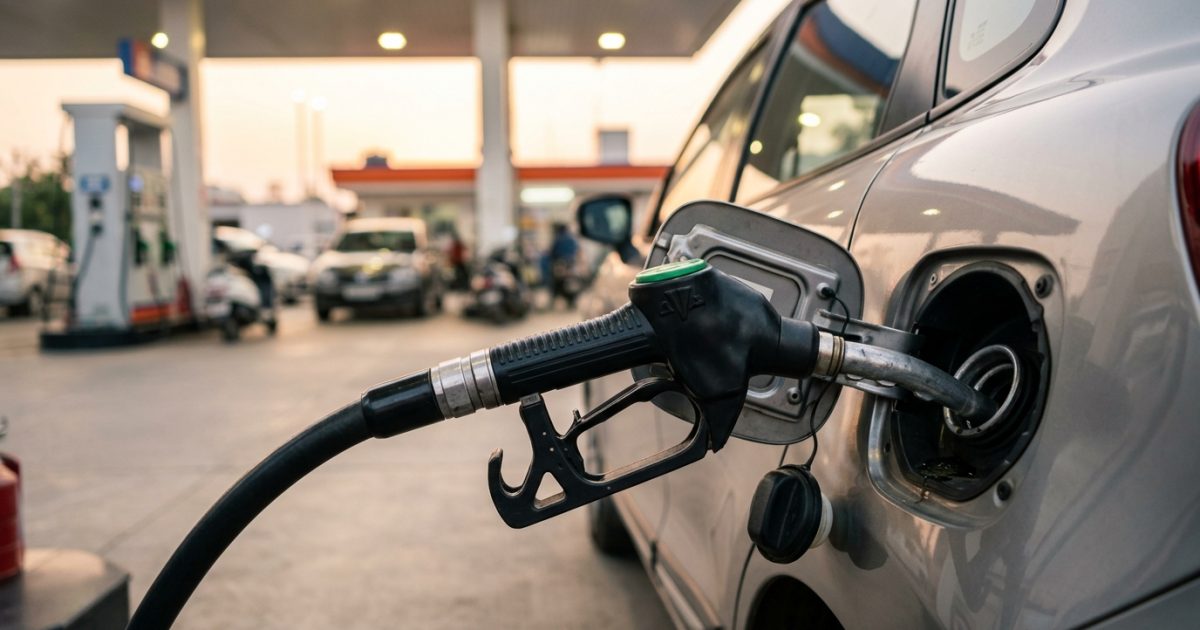
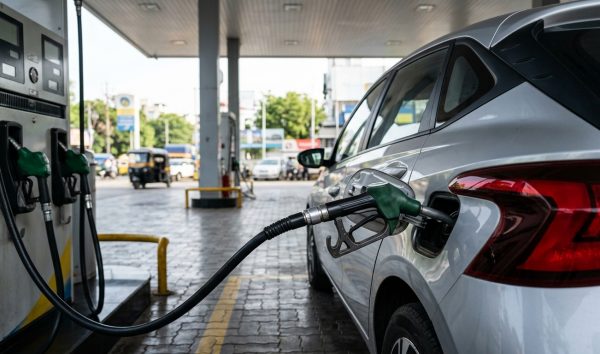
The petrol price today in India is determined by dynamic fuel pricing, which updates daily at 06:00 AM IST based on a 15-day rolling average of international benchmark refined fuel rates and currency exchange movements. The final pump price combines base refinery costs, freight charges, central excise duty, dealer commissions, and state-level Value Added Tax (VAT).
Key Takeaways
- Fuel prices in India undergo daily revision at 06:00 AM across all OMC retail outlets.
- Central excise duty remains uniform across India, while state VAT varies significantly by state.
- Retail Selling Price (RSP) includes refinery costs, central taxes, dealer commission, and state VAT.
- Taxes account for approximately 35% to 50% of the total retail cost per litre.
- Vehicle owners can check live station rates by sending an SMS to their OMC.
| Metric | Details as of October 2026 |
|---|
| Daily Revision Schedule | Every morning at 06:00 AM IST |
| Pricing Mechanism | Dynamic Fuel Pricing (Trade-Parity / Platts Arab Gulf) |
| Central Tax Authority | Central Board of Indirect Taxes and Customs (CBIC) |
| State Tax Components | State VAT / Sales Tax and Local Pollution or Road Cesses |
| Official Verification Channels | OMC SMS Gateways, Dedicated Apps, and PPAC Portals |
Understanding Daily Fuel Price Revision India: The 6 AM Rule
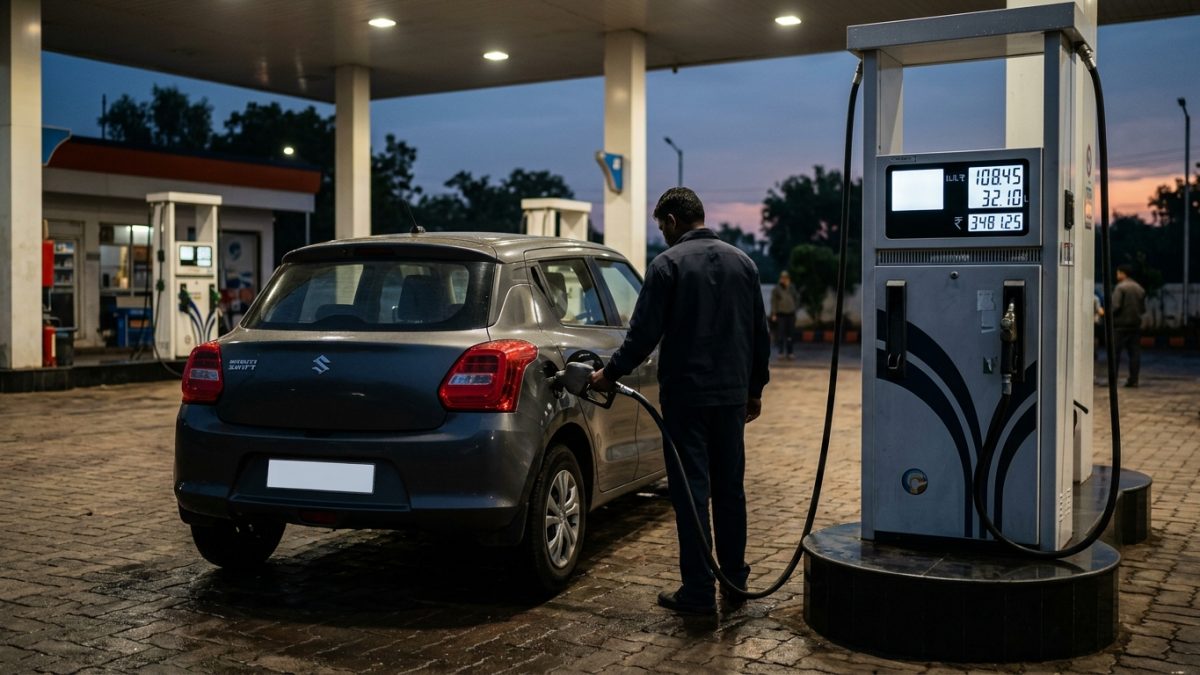
India transitioned to a market-linked fuel pricing structure over multiple regulatory milestones. Petrol pricing was formally de-regulated from government oversight on June 26, 2010, empowering state-run Oil Marketing Companies (OMCs) to set consumer prices. Diesel pricing followed deregulation on October 19, 2014, shifting commercial fuel economics entirely to market benchmarks.
Before 2017, OMCs revised fuel prices fortnightly on the 1st and 16th day of every calendar month. To minimise sudden retail price shocks and reflect global crude shifts transparently, the government implemented daily fuel price revision india nationwide on June 16, 2017. Under this dynamic pricing model, retail fuel dispensers reset pump rates every morning at 06:00 AM IST.
Automated fuel retail stations receive price configurations digitally via centralized OMC networks, updating pump totems and electronic dispensers automatically at 06:00 AM. Non-automated rural or remote pumps receive pricing updates overnight through digital OMC portals or automated communications, requiring pump supervisors to configure physical dispenser meters manually before opening sales for the day.
Automated petrol pumps lock fuel delivery momentarily at 05:59 AM to recalibrate meters. Dispensing resumes automatically at 06:00 AM under updated daily rates.
Petrol Price Tax Breakup India: How Retail Rates Are Calculated
The calculation of retail fuel rates in India adheres strictly to guidelines set by the Petroleum Planning & Analysis Cell (PPAC) under the Ministry of Petroleum and Natural Gas (MoPNG). The formula translates international bulk refining benchmarks into the final Retail Selling Price (RSP) seen at neighborhood pumps.
$$\text{Retail Selling Price (RSP)} = \text{Price Charged to Dealers} + \text{Central Excise Duty} + \text{Dealer Commission} + \text{State VAT/Cess}$$
The build-up structure moves through four distinct financial layers before reaching the consumer nozzle:
- Refinery Transfer Price (RTP): The trade-parity price (TPP) paid by marketing companies to domestic refiners. It factors in international refined motor spirit prices (Platts Arab Gulf benchmark), marine insurance, ocean shipping freight, and basic customs duties.
- Inland Freight and Marketing Costs: Terminal handling, inland pipeline or railway tanker transport (costing roughly ₹0.20 to ₹0.40 per litre), ethanol blending overheads, and OMC operating margins.
- Central Excise Duty: A static, non-ad-valorem tax assessed uniformly by the Union Government on every litre of fuel sold within Indian territory.
- Dealer Commission: The statutory payout given to petrol pump operators for handling infrastructure, manpower wages, and operational evaporation losses.
- State Value Added Tax (VAT): A percentage-based levy applied by individual state commercial tax departments onto the subtotal of base costs, excise, and dealer commission.
Understanding this structure helps motorists realize that global crude movements represent only one part of the pump price equation. For budget-conscious motorists, exploring alternatives through our guide on CNG price today highlights how taxation variations directly influence total monthly operating expenses.
Petrol Excise Duty vs VAT: Central vs State Taxes Explained
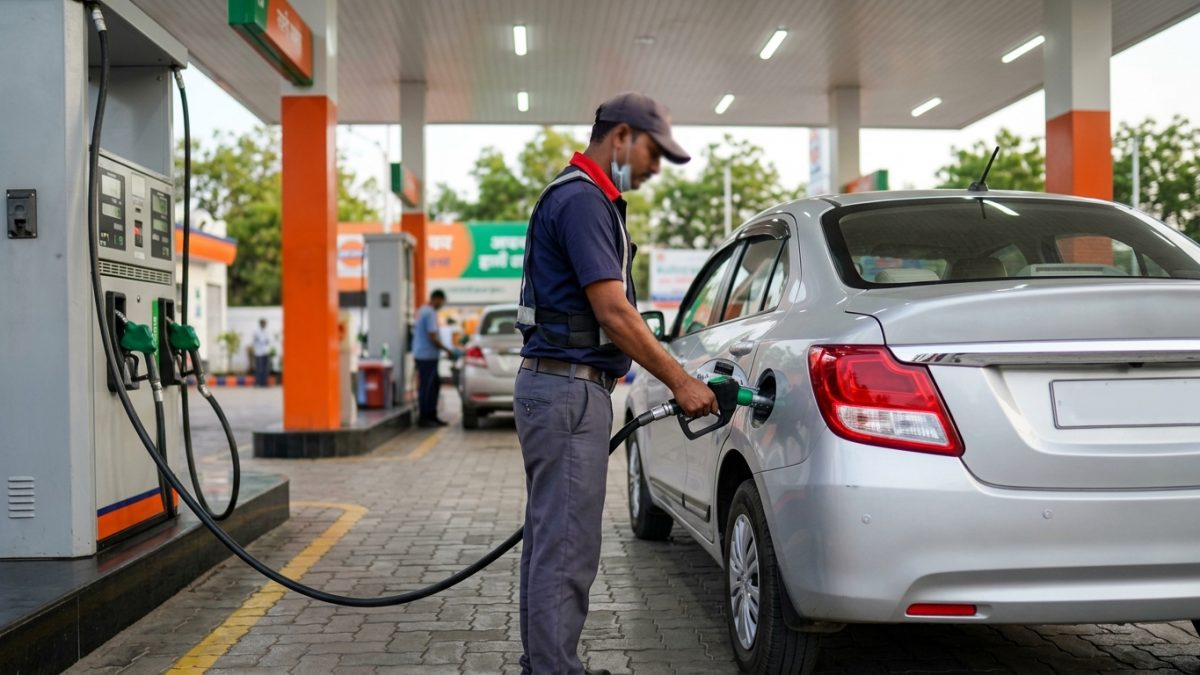
Evaluating petrol excise duty vs vat reveals the primary difference between central and state revenue mechanisms. Central excise duty is levied as a fixed rupee amount per litre, remaining identical regardless of which Indian state or Union Territory you fuel up in. This excise duty combines several specific components under Union finance acts:
- Basic Excise Duty (BED)
- Special Additional Excise Duty (SAED)
- Road and Infrastructure Cess (RIC)
- Agriculture Infrastructure and Development Cess (AIDC)
In contrast, State VAT is predominantly an ad valorem levy, meaning it is assessed as a percentage rather than a fixed rupee figure. State finance departments calculate this percentage on top of the dealer price, central excise, and pump dealer commissions combined. This sequential calculation creates a cascading tax-on-tax impact across retail forecourts.
| Build-Up Component | Typical Delhi Benchmark (₹/Litre) | Approximate Share of RSP |
|---|
| Base Price & Freight (Price to Dealers) | ₹52.00 – ₹57.50 | 50% – 55% |
| Central Excise Duty | ₹19.90 – ₹21.90 | 20% – 22% |
| Dealer Commission (Average) | ₹3.80 – ₹4.45 | 3.5% – 4.5% |
| State VAT (Delhi @ 19.40%) | ₹15.40 – ₹16.60 | 15% – 17% |
| Indicative Retail Selling Price (RSP) | ₹94.00 – ₹102.00+ | 100% |
Because the state percentage applies directly to the post-excise subtotal, any minor shift in dealer rates or central excise duties compounds the final state VAT charge. While evaluating a vehicle's running budget, ensure your registration documents remain current by using our RC details portal to prevent administrative penalties alongside fuel expenses.
State VAT is calculated on top of central excise duty and dealer commission, producing an unavoidable tax-on-tax effect on every litre of petrol.
Why Petrol Price is Different in States Across India
Vehicle owners frequently question why petrol price different in states exists when driving across interstate borders. The primary explanation is that automotive fuels (Petrol, Diesel, ATF, Natural Gas, and Crude Oil) remain outside the preview of the unified Goods and Services Tax (GST) framework. As a result, states retain constitutional authority to fix independent sales taxes.
States establish VAT schedules reflecting their specific budgetary targets, geographical challenges, and local welfare programs. For example, Union Territories such as Andaman & Nicobar enforce relatively modest VAT rates under 15%. Conversely, states such as Telangana, Andhra Pradesh, Maharashtra, Rajasthan, and Kerala impose VAT rates exceeding 30% alongside supplemental road development surcharges.
| Pricing Factor | Low-Tax States / UTs | High-Tax States |
|---|
| Applicable VAT Bracket | Under 15% to 18% | 28% to 32%+ |
| Additional Surcharges | Minimal or zero local cesses | Pollution cess, road infra cesses |
| Inland Freight Costs | Low if adjacent to coastal depots | Higher for mountainous or interior regions |
| Average RSP Impact | Lower overall pump price | ₹10 to ₹15 higher per litre |
Logistical realities also drive regional pricing variance. Transporting refined fuel from coastal refineries or major marketing pipeline terminals to landlocked or high-altitude regions adds extra inland freight tariffs. These transport surcharges, though usually ranging between ₹0.20 and ₹0.80 per litre, incrementally widen the interstate price divide.
How to Check Petrol Price by SMS and Mobile Apps
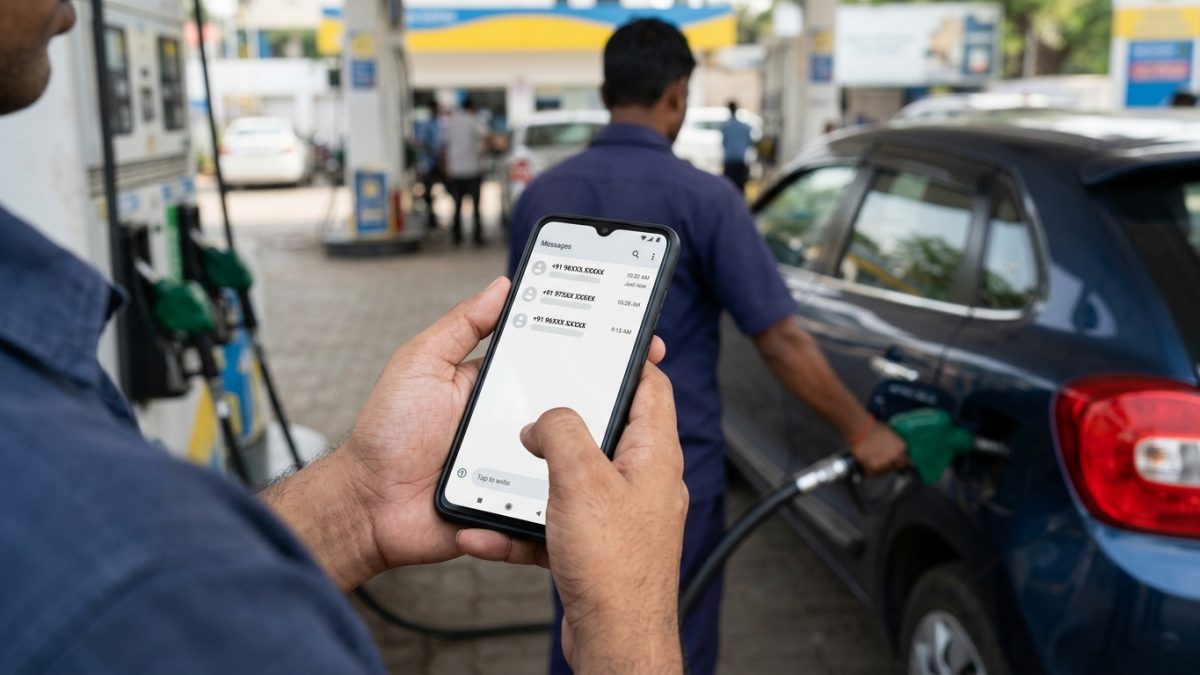
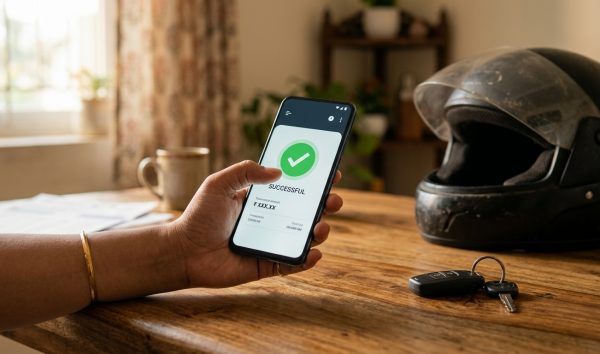
Motorists can check petrol price by sms directly without depending on third-party aggregators. Public sector oil marketing companies—Indian Oil, Bharat Petroleum, and Hindustan Petroleum—operate automated short-code SMS verification systems linked to individual retail outlets. Every fuel pump features a unique 6-digit dealer code on fuel dispensers, receipt printouts, or manager office fronts.
1. Indian Oil Corporation Limited (IOCL)
- Locate the dealer code: Check the pump pillar or your previous refuelling receipt for the station's 6-digit IOCL code.
- Compose the SMS: Open your smartphone messaging app and type RSP <Dealer Code> (for example, RSP 102072).
- Send the query: Dispatch the message to 9224992249.
- Receive real-time rates: An automated confirmation message will deliver the exact iocl petrol price today and current diesel price today for that specific outlet.
2. Bharat Petroleum Corporation Limited (BPCL)
- Identify the pump code: Note the 6-digit retail outlet code from the BPCL forecourt totem.
- Prepare the text: Type RSP <Dealer Code> with a single space between terms.
- Transmit to gateway: Send the SMS to 9223112222 to retrieve instant pump figures.
3. Hindustan Petroleum Corporation Limited (HPCL)
- Find the outlet code: Check the HPCL fuel bill receipt for the dealer identification digits.
- Format the SMS: Type HPPRICE <Dealer Code> into your messaging app.
- Send to HPCL server: Forward the inquiry to 9222201122 to receive current petrol and diesel rates.
Drivers can also use official smartphone applications such as IndianOil ONE, Hello BPCL, and HP Pay. In addition to fuel calculations, motorists should regularly verify their legal compliance using the e-challan status tracker to resolve pending traffic fines promptly.
Keep a clear space between RSP and your 6-digit dealer code; entering your PIN code or city name instead of the pump code will trigger a delivery error.
Common SMS Inquiry Errors and Troubleshooting
While the automated SMS fuel verification system functions 24/7, inquiries occasionally fail due to simple transmission mistakes. Understanding these common technical issues helps you retrieve accurate daily fuel updates without delay:
- Invalid Identification Codes: Motorists often mistakenly text their postal PIN code, city name, or station number instead of the verified 6-digit OMC dealer code. Always check previous fuel receipts to locate the official pump identification.
- Text Spacing and Syntax Errors: Adding multiple spaces or omitting the space between RSP and the dealer code causes automated gateway servers to reject the query.
- Telecom SMS Limitations: Standard outgoing SMS charges apply according to your telecom provider. Accounts with strict Do-Not-Disturb (DND) configurations or zero SMS balance will fail to send query texts.
- Remote Location Adjustments: While SMS portals return standard city rates, pumps in hilly or remote areas may charge minor local terminal surcharges, leading to small paise-level variations on physical dispensers.
If automated SMS services face carrier network congestion, access the live station locator directly on official portals like IOCL or BPCL to verify current retail pricing.
Managing Fuel Costs: Daily Driving Habits and Vehicle Health
With retail fuel prices subject to daily market movements, vehicle upkeep and driver behavior directly affect your household transportation budget. Practicing proactive vehicle maintenance ensures maximum fuel efficiency regardless of short-term pump rate adjustments:
- Maintain Optimal Tyre Pressure: Under-inflated tyres increase rolling resistance, forcing your engine to consume 3% to 5% more fuel per trip.
- Adopt Progressive Throttle Control: Sudden acceleration and aggressive braking in city traffic significantly reduce fuel efficiency compared to smooth, steady throttle inputs.
- Eliminate Unnecessary Deadweight: Carrying heavy gear in your boot increases curb weight, directly elevating fuel consumption during stop-and-go commuting.
- Service Air Filters and Spark Plugs: Clogged air filters starve the engine combustion chamber of oxygen, causing incomplete combustion and elevated fuel usage.
Two-wheeler owners can learn practical habits to maximize fuel range through our dedicated guide on bike mileage tips, which outlines how to reduce monthly refuelling expenses.
Conclusion
Monitoring the petrol price today helps vehicle owners plan long-distance journeys, evaluate monthly transportation budgets, and manage overall running costs. Because retail rates reflect complex dynamics between international refined benchmarks, central excise duties, and state-level VAT, staying informed through official OMC SMS channels ensures you always know the exact pump rate before refuelling.
Alongside keeping an eye on changing fuel rates, maintain overall vehicular compliance by tracking your vehicle paperwork, checking traffic challans, and verifying registration details periodically.