Key Takeaways
- Traffic rules in India are governed by the Motor Vehicles Act, 1988 and its 2019 nationwide amendment.
- Carrying physical papers is no longer mandatory; digital documents on DigiLocker and mParivahan hold equal legal validity.
- Traffic police officers below the rank of Assistant Sub-Inspector (ASI) cannot issue spot challans or compound fines.
- Snatching ignition keys or deflating tyres during roadside checks is illegal under Indian law.
- Pillion helmets and rear passenger seatbelts are statutory requirements enforced by automated traffic cameras.
Understanding traffic rules india is essential for every commuter seeking to navigate public roadways safely and prevent expensive penalties. Under the amended Motor Vehicles Act, traffic regulations establish uniform standards for document verification, lane discipline, speed limits, and passenger restraints across the country. Motorists can immediately check challan status by vehicle number to ensure their vehicles remain free from pending notices and statutory legal holds.
As of September 2026, road transport enforcement relies heavily on automated camera networks and integrated digital databases. Complying with basic road safety protocols protects lives while shielding vehicle owners from compounding fines, vehicle impoundments, and driving licence suspensions.
| Regulatory Aspect | Statutory Provision | Enforcement Authority | Digital Verification |
|---|
| Primary Legislation | Motor Vehicles Act, 1988 (Amended 2019) | MoRTH / State Transport Depts | Parivahan National Register |
| Spot Fines / Compounding | Section 200, MV Act | ASI rank officers and above | Handheld e-PoS Terminals |
| Electronic Documents | Rule 139, CMVR (G.S.R. 1081(E)) | State Traffic Police / RTOs | DigiLocker & mParivahan |
| Challan Adjudication | Sections 180 to 199A, MV Act | Virtual Traffic Courts / CJM | vcourts.gov.in portal |
Legal Framework Governing Traffic Rules in India
The principal statute regulating vehicular movement in India is the Motor Vehicles Act, 1988, which underwent sweeping reforms through the Motor Vehicles (Amendment) Act, 2019, enforced nationwide from 1 September 2019. This legislation works alongside the Central Motor Vehicles Rules, 1989 (CMVR) to specify vehicular design, registration standards, licensing mandates, and punitive actions for traffic non-compliance.
A critical legislative milestone arrived with the notification of G.S.R. 1081(E) on 2 November 2019, amending Rule 139 of the CMVR. This statutory revision formally legalized electronic versions of vehicle documents. Combined with Ministry of Road Transport and Highways (MoRTH) circulars issued under Letter No. RT-11036/64/2017-MVL, electronic documents verified through DigiLocker or mParivahan are treated at par with original physical certificates under Sections 4 and 9A of the Information Technology Act, 2000.
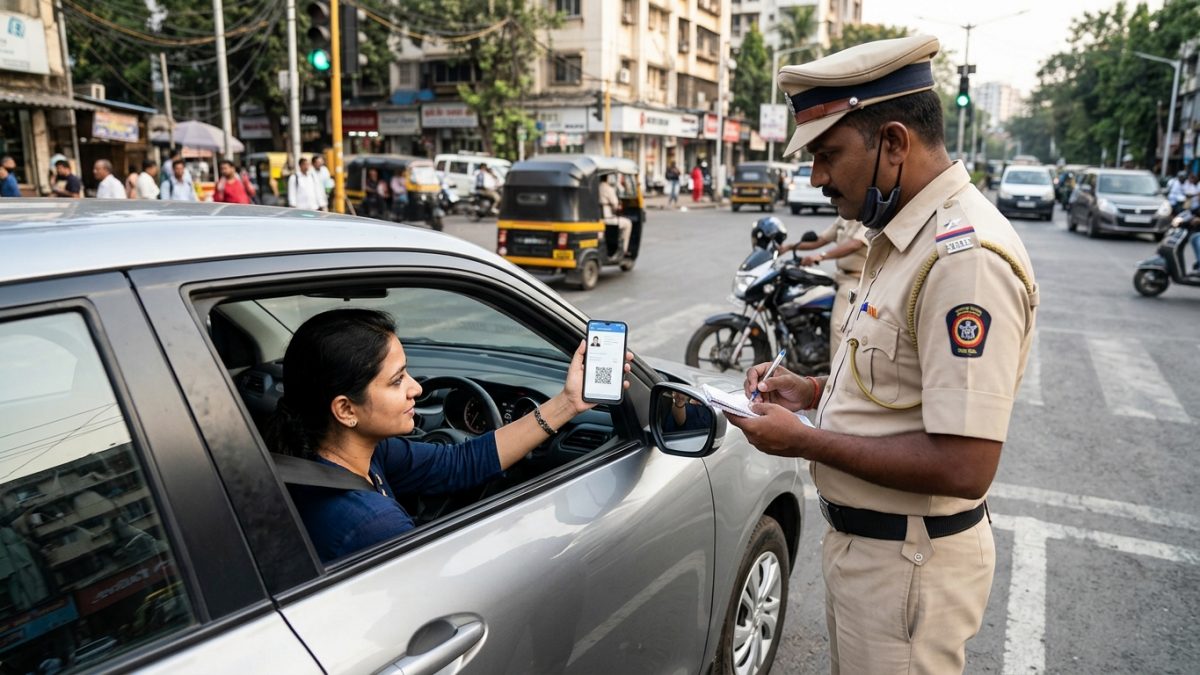
Rule 139 of the CMVR exempts motorists from carrying physical paperwork if their Registration Certificate and Driving Licence are available within the official DigiLocker or mParivahan mobile applications.
Motorists are advised to maintain active digital profiles through Parivahan services. Drivers can independently verify their licence records using driving licence status checks and validate their vehicle parameters via RC details before setting out on inter-state journeys.
Motor Vehicle Act Penalties & Traffic Fine List
The amended central legislation introduced rigorous financial penalties and mandatory judicial consequences to deter dangerous driving behaviours. While the central framework defines the baseline, state governments retain discretionary compounding powers under Section 200 of the Motor Vehicles Act to calibrate select non-fatal penalties.
| Traffic Violation | MV Act Section | Central Penalty Amount (INR) | Legal Consequence / Suspension |
|---|
| Driving without a valid Driving Licence | Sec 3 / 181 | ₹5,000 | Possible community service |
| Allowing unauthorized persons / Minors to drive | Sec 5 / 180 | ₹5,000 | Owner liability |
| Juvenile Driving Offenses | Sec 199A | ₹25,000 fine on guardian | Up to 3 yrs jail; RC cancelled for 1 yr; minor barred till 25 |
| Driving without Registration Certificate (RC) | Sec 39 / 192 | ₹2,000 to ₹5,000 (First) | Up to ₹10,000 and/or 1 year jail for repeat offense |
| Driving without Third-Party Insurance | Sec 146 / 196 | ₹2,000 (First offense) | Up to 3 months jail; ₹4,000 for subsequent offenses |
| Plying without valid PUC Certificate | Sec 190(2) | ₹10,000 | Up to 3 months jail; DL suspension for 3 months |
| Over-speeding (Light Motor Vehicles - LMV) | Sec 112 / 183(1) | ₹1,000 to ₹2,000 | Electronic speed-trap logging |
| Over-speeding (Commercial / Heavy Vehicles) | Sec 112 / 183(2) | ₹2,000 to ₹4,000 | Second offense may prompt DL impoundment |
| Dangerous / Rash Driving (incl. Red light jumping) | Sec 184 | ₹1,000 to ₹5,000 | 6 to 12 months jail; ₹10,000 for repeat offense |
| Drunken Driving (BAC > 30mg / 100ml blood) | Sec 185 | ₹10,000 | Up to 6 months jail; ₹15,000 / 2 yrs jail for repeat |
| Riding without Helmet (Rider or Pillion) | Sec 129 / 194D | ₹1,000 | Disqualification of Driving Licence for 3 months |
| Driving without Seatbelt (Front / Rear) | Sec 194B(1) | ₹1,000 | Applicable to all designated seating positions |
| Blocking Emergency Vehicles (Ambulance, Fire) | Sec 194E | ₹10,000 | Imprisonment up to 6 months |
| Disobedience of Lawful Orders / Resisting Check | Sec 179(1) | ₹2,000 | Summary police proceeding |
States such as Gujarat, Karnataka, and Jharkhand have previously notified lower compounding rates under Section 200 for specific civil infractions, such as initial helmet defaults. However, metropolitan police departments in Delhi, Mumbai, and Bengaluru strictly enforce the standard central schedule. Motorists facing unexpected vehicle holds should consult the guide on e-challan vehicle blacklist clearance to resolve registration blocks.
Driving under the influence with a Blood Alcohol Content exceeding 30 mg per 100 ml of blood mandates court prosecution under Section 185, where compounding by roadside officers is strictly prohibited.
Road Safety Rules in India: Lane Discipline & Expressways
Compliance with road safety rules in india requires strict adherence to standardized lane markings, right-of-way hierarchies, and safe passing protocols. Under the Rules of the Road Regulations, 2017, unauthorized lane deviations and improper overtaking incur statutory fines under Section 177A of the Motor Vehicles Act.
Standard Passing and Lane Rules
Every driver operating on an undivided two-way road must keep to the left side of the carriageway, allowing opposing traffic to pass unobstructed on the right. Overtaking must invariably be executed from the right side of the vehicle ahead. Passing on the left side is illegal unless the preceding vehicle is positioned centrally and visibly signaling an intention to make a right turn.
Expressway Speed Lanes and Lane Hogging
On multi-lane access-controlled expressways and national highways, traffic regulations mandate distinct functional separation between lanes. The extreme right lane is strictly an overtaking and emergency maneuver corridor. Heavy commercial vehicles and slow-moving traffic must occupy the extreme left lane at all times. Remaining persistently in the fast right lane without overtaking constitutes lane hogging, an offense prosecutable under Section 177A.
Roundabout Right-of-Way
Negotiating traffic circles requires complete clarity on directional priority. Traffic already circulating inside the roundabout holds statutory right-of-way over vehicles approaching to enter the circle. Entering drivers must yield, indicate their intended turn, and merge only when an adequate gap emerges in the circulating flow.
Traffic Signs and Rules in India
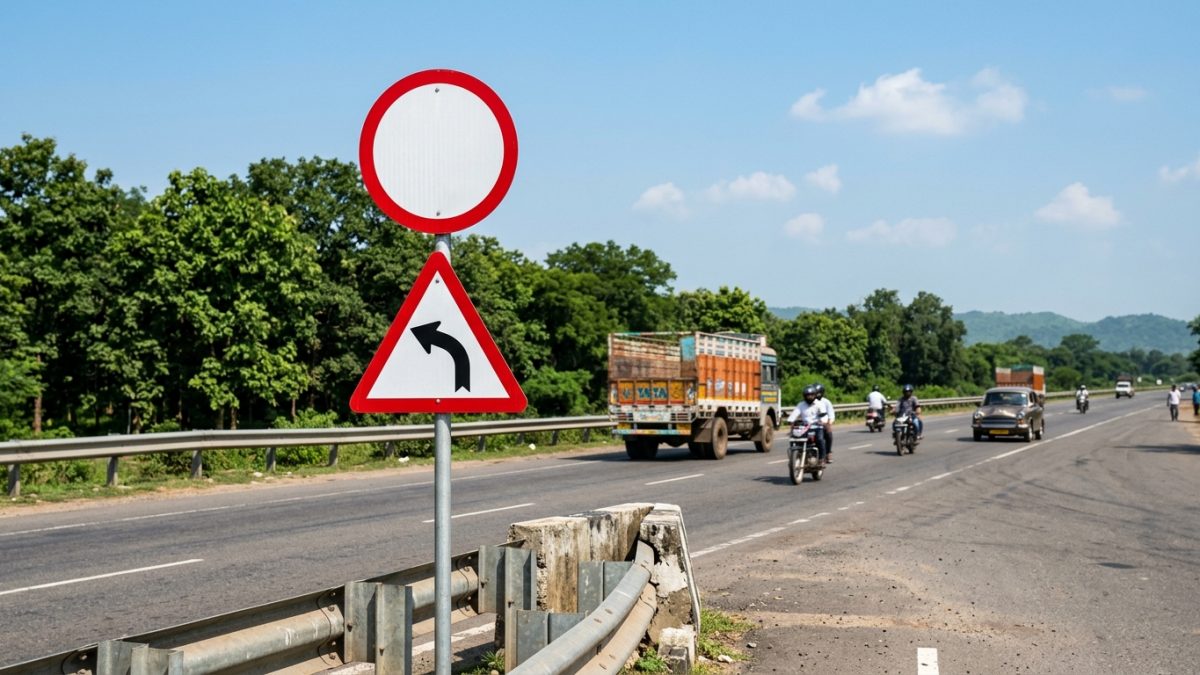
Standardized road infrastructure follows the specifications outlined by the Indian Roads Congress code IRC:67. Familiarity with traffic signs and rules in india prevents accidental infractions and navigates drivers safely through high-risk road corridors.
| Sign Category | Geometric Shape & Colour | Functional Purpose | Legal Status |
|---|
| Mandatory / Regulatory | Circular with red border (STOP is octagonal; GIVE WAY is inverted triangle) | Directives, prohibitions, and absolute restrictions | Legally binding; violations penalized under Sec 177A/184 |
| Compulsory Direction | Circular with blue background and white arrows | Mandatory paths (e.g., Compulsory Turn Left) | Legally binding direction mandate |
| Cautionary / Warning | Equilateral triangle with red border and white/yellow center | Alerts to imminent road hazards (curves, school zones) | Advisory; guides safe operational speed |
| Informatory | Rectangular / square with blue or green background | Navigation, distances, fuel stations, and amenities | Guidance and geographical information |
Mandatory Road Signs
Mandatory signs dictate actions you must or must not take. Disregarding a circular regulatory sign—such as 'No Entry', 'One Way', or 'No Right Turn'—attracts immediate electronic or physical enforcement. The 'STOP' sign is uniquely octagonal with a red background, requiring complete vehicular cessation before proceeding, while the 'GIVE WAY' sign takes the form of an inverted equilateral triangle.
Cautionary signs warn motorists of upcoming structural changes or environmental hazards. Common triangular alerts include narrow bridge warnings, steep descents, pedestrian zebra crossings, and speed humps. Informatory signs, framed in rectangular green or blue boards, deliver navigational assistance regarding junction splits, hospital locations, and public resting points.
Traffic Rules for Car Drivers in India vs Two Wheelers
Motor vehicle regulations establish explicit structural mandates based on vehicle class. Both passenger cars and motorized two-wheelers are subject to dedicated equipment guidelines and passenger behavior protocols.
Traffic Rules for Car Drivers in India
Car operators are subject to comprehensive cabin safety mandates under Section 194B of the Motor Vehicles Act:
- Seatbelt Mandate: All passengers seated in front-facing seats, including rear-seat occupants, must wear certified safety seatbelts while the vehicle is in motion.
- Child Restraint Systems: Under Section 194B(2), drivers transporting children must secure them using appropriate child restraints or safety harnesses to prevent sudden impact injuries.
- Mobile Phone Usage: Holding or operating a mobile telephone while driving—even when halted at a traffic light—is classified as rash driving under Section 184. Hands-free setups may only be utilized for navigation if the device does not obstruct vision.
Traffic Rules for Two Wheelers in India
Riders and pillion passengers face rigorous protective mandates under Section 129 and Section 194D:
- Protective Headgear: Both rider and pillion passenger aged above four years must wear crash helmets conforming to Bureau of Indian Standards (BIS ISI 4151) specifications. The chin strap must be securely fastened.
- Child Safety on Two-Wheelers: Enacted on 15 February 2022 via CMVR Rule 138N (effective February 2023), children aged between 9 months and 4 years must wear an approved crash helmet, be secured to the rider via an adjustable safety harness, and the motorcycle must not exceed a speed ceiling of 40 km/h.
- Triple Riding Prohibition: Carrying more than one pillion rider on a two-wheeled vehicle is prohibited under Section 128, leading to on-the-spot compounding and possible licence suspension.
Under Section 129 of the Motor Vehicles Act, the only statutory exemption from wearing a motorcycle crash helmet applies to a Sikh individual wearing a turban.
Traffic Police Rules for Vehicle Checking & Driver Rights
Navigating an on-road police stop requires a clear understanding of traffic police rules for vehicle checking. Knowing your rights ensures fair treatment while upholding mutual accountability between road users and law enforcement officers.
Rank Authorization for Issuing Challans
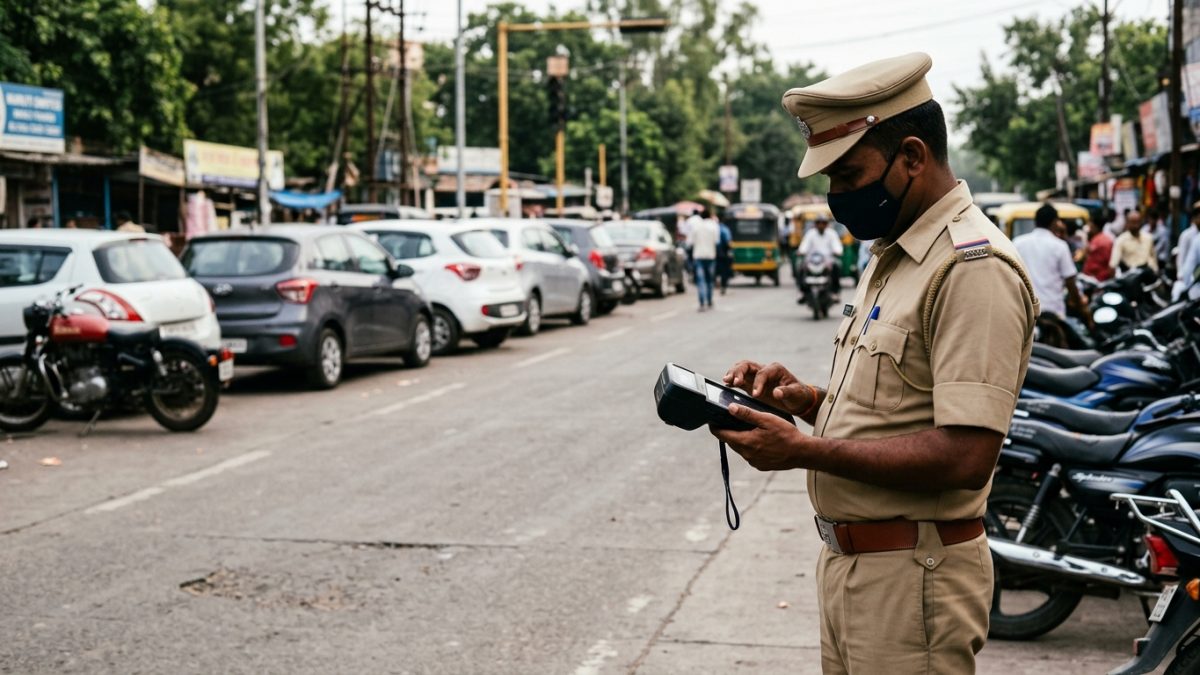
Under Section 200 of the Motor Vehicles Act, not every police personnel on duty has the statutory authority to penalize drivers. Only traffic officers holding the rank of Assistant Sub-Inspector (ASI - one star), Sub-Inspector (SI - two stars), or Inspector (three stars) are authorized to issue spot fines and compound traffic violations. Traffic constables and head constables are stationed to direct traffic and record incidents; they cannot levy spot fines exceeding ₹100 or seize records unless an explicit state gazette notification has formally delegated compounding duties.
Can Traffic Police Take Car Keys in India?
A frequent point of friction during traffic stops is the handling of ignition keys. Under the Motor Vehicles Act, a traffic police officer does not possess the legal power to snatch vehicle keys, switch off ignitions, or deflate tyres. Arbitrarily seizing keys or physically restraining a driver without lawful grounds constitutes wrongful restraint under Section 126 of the Bharatiya Nyaya Sanhita, 2023 (formerly Section 341 of the Indian Penal Code).
An officer can impound a vehicle only under Section 207 of the Motor Vehicles Act for specified infractions, such as operating without registration, driving without a permit, or severe drunken driving. In every impoundment scenario, the officer is legally mandated to hand over an official Seizure Memo or Panchnama detailing the grounds of seizure.
Driver Rights During Traffic Stop India
Motorists are protected by well-defined procedural safeguards during vehicle verification:
- Right to Identification: Motorists have the right to request the officer’s name, designation, and verifying buckle number. The checking officer must be in official uniform displaying these details.
- Protection Against Arbitrary Searches: Officers cannot conduct arbitrary physical searches of a vehicle's boot or private belongings without reasonable suspicion of a criminal offense or a judicial warrant.
- Safeguards for Female Drivers: Under Section 43 of the Bharatiya Nagarik Suraksha Sanhita, 2023, female motorists cannot be arrested after sunset and before sunrise except under extraordinary circumstances backed by a Judicial Magistrate's order. Physical searches of female drivers must be conducted exclusively by female officers.
- Right to Digital Presentation: Enforcement personnel must accept electronic documents presented via the official DigiLocker or mParivahan apps without insisting on physical hard copies.
- Receipt Requirement: Drivers are never obligated to hand over cash informally. Every spot penalty must yield an instantaneous electronic printout via an e-PoS device or a valid state government treasury receipt.
If an officer behaves unlawfully or forcefully confiscates your keys, note down their chest badge number, record the encounter if safe to do so, and submit a formal grievance to the local Traffic Police Commissionerate.
How to Check and Pay Traffic E-Challans Online
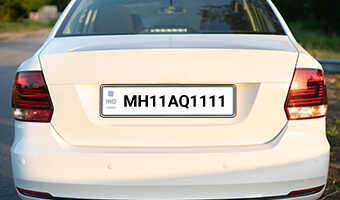
India's road transport machinery tracks moving violations automatically via High-Security Registration Plates (HSRP) and Automated Number Plate Recognition (ANPR) cameras. Traffic violations are routed to the central e-Challan Citizen Service Portal maintained by the National Informatics Centre (NIC).
- Access the Official Portal: Navigate to the central payment website at echallan.parivahan.gov.in or open your state-specific traffic police payment interface.
- Locate the Violation: Select "Check Challan Status" or "Pay Online" on the homepage dashboard.
- Enter Vehicle Identifiers: Provide either your unique Challan Number, Vehicle Registration Number (which requires entering the last 5 characters of your Chassis or Engine Number), or your Driving Licence Number.
- Submit Security Captcha: Enter the verification captcha text displayed on the screen and select "Get Detail".
- Review Violation Details: The screen will display all pending notices, containing the statutory offense section, date, precise GPS coordinates, fine figure, and photographic ANPR camera evidence.
- Initiate Settlement: Click on the "Pay Now" link corresponding to the specific challan you wish to settle.
- Authenticate via Mobile OTP: Complete the one-time password verification routed to the registered mobile number tied to your vehicle or driving licence record.
- Execute Online Payment: Choose your preferred transaction channel—including UPI, Net Banking, or Debit Cards—through the Bharatkosh or state treasury payment gateway.
- Download Payment Receipt: Once the transaction succeeds, download and save the digital clearance receipt to maintain proof of compliance.
If you encounter an incorrectly billed fine—such as an automated ticket generated due to a misread character on another vehicle's number plate—utilize the "Grievance" tab on the Parivahan portal to upload photo evidence. For contested compounding matters, unresolved challans transition to the Virtual Traffic Court at vcourts.gov.in, where individuals can contest the offense or resolve the fee before a presiding magistrate. Motorists with multiple disputed fines can also review guidelines on Lok Adalat challan token settlements for pre-litigation resolution.
Regularly monitoring your vehicle’s digital profile protects you against unforeseen impoundment notices during routine checks. Simply check challan status by vehicle number every quarter to ensure all road transport records remain accurate and fully cleared.
Conclusion
Mastering traffic rules india is a fundamental duty for every motorist, ensuring public road safety while guarding against hefty penalties and legal disputes. By following lane discipline, maintaining certified safety gear, and knowing your legal rights during roadside police stops, you can drive with confidence on any Indian roadway.
Stay proactive by verifying your documentation and monitoring pending traffic fines online to resolve violations promptly before they lead to registration blocks or court summons.