A lok adalat challan settlement allows vehicle owners to resolve pending, compoundable traffic fines through an amicable legal conciliation process held quarterly across India. Motorists can book digital appointment tokens, appear before judicial conciliators, receive discretionary fine waivers of 30% to 75%, and close pending court notices permanently without formal trials.
Before scheduling a court appearance, vehicle owners should check their pending traffic records. You can verify pending notices across state boundaries by running an online check challan status by vehicle number to confirm whether your violations have reached the court referral stage.
Key Takeaways
- National Lok Adalats occur quarterly under the Legal Services Authorities Act, 1987, charging zero court listing fees.
- Only compoundable motor vehicle offenses qualify; severe violations like drunk driving and hit-and-run incidents are strictly excluded.
- Fine reductions are discretionary, typically ranging from 30% to 75% depending on case facts and financial vulnerability.
- Delhi requires mandatory pre-booked digital tokens, whereas states like Haryana and Uttar Pradesh rely mostly on DLSA offline benches.
- Orders issued by the Lok Adalat bench are final civil decrees, barring any subsequent appeals in higher courts.
| Feature | National Lok Adalat Details |
|---|
| Governing Statute | Legal Services Authorities Act, 1987 |
| Organizing Frequency | Quarterly (4 times a year across India) |
| Court Filing Fee | Nil (Free dispute resolution) |
| Appeal Provisions | No appeal allowed under Section 21 |
| Average Fine Reduction | 30% to 75% (Discretionary by bench) |
| Parivahan Sync Window | 24 hours to 72 hours (up to 15 days) |
What Is National Lok Adalat Challan Settlement?
The national lok adalat challan resolution system operates under the statutory framework of the Legal Services Authorities Act, 1987. Organized quarterly nationwide by the National Legal Services Authority (NALSA) alongside State Legal Services Authorities (SLSAs), these benches serve as an alternative dispute resolution mechanism for pre-litigation and pending traffic court matters.
When a traffic violation notice sent to the virtual court remains contested or unpaid, the traffic police department forwards the matter to district judicial magistrates. Resolving a traffic challan in lok adalat prevents heavy case backlogs in regular metropolitan magistrate courts while offering citizens a fair opportunity to compound pending penalties.
Under Section 21 of the Legal Services Authorities Act, 1987, every award passed by a Lok Adalat bench is deemed a decree of a civil court. Because it is based on mutual consent, no appeal lies against this order in any court of law.
Litigants pay no court fees to list or resolve traffic offenses during these proceedings. If an amicable settlement amount cannot be agreed upon between the vehicle owner and the presiding bench, the case returns to regular court proceedings without any legal prejudice against the motorist.
Eligible vs Ineligible Traffic Violations for Lok Adalat
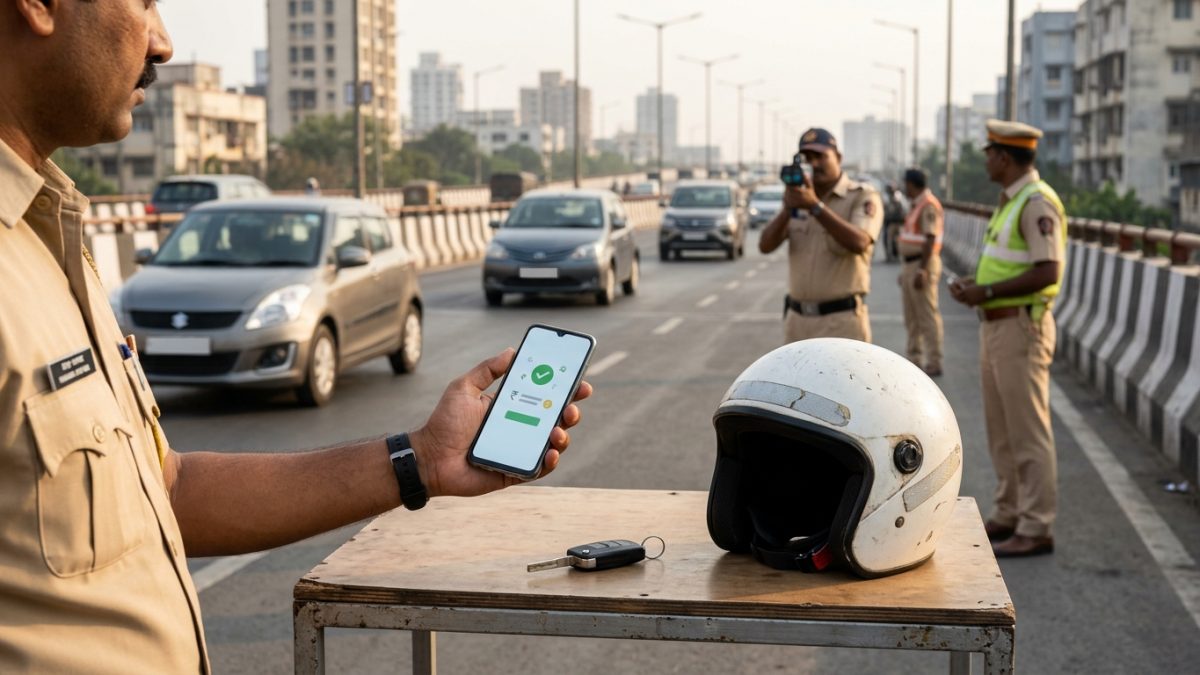
Under Section 200 of the Motor Vehicles Act, 1988, state governments reserve statutory powers to compound specific traffic infractions. A lok adalat traffic challan settlement applies strictly to compoundable infractions where administrative fines suffice in place of regular criminal trials.
Eligible (Compoundable) Offenses
Compoundable offenses involve standard road discipline breaches captured by automated electronic enforcement cameras or field traffic officers. The following violations qualify for consideration before the bench:
- Overspeeding violations detected via speed cameras or handheld laser interceptors.
- Jumping red lights and stop-line infringements at junctions.
- Driving or riding without an ISI-marked safety helmet or fastened seatbelt.
- Improper, obstructive, or unauthorized parking on public thoroughfares.
- Using a mobile phone while driving (first offense or minor infractions).
- Expired Pollution Under Control Certificate (PUCC) where updated compliance is shown.
- Challans forwarded to the Virtual Court Portal prior to the notified cutoff date.
Ineligible (Non-Compoundable) Offenses
Non-compoundable infractions carry mandatory court trials, vehicle impoundments, or imprisonment terms. Lok Adalats lack legal jurisdiction to compound the following offenses:
- Drunk driving or driving under the influence of narcotics under Section 185 of the Motor Vehicles Act.
- Hit-and-run incidents, reckless driving causing grievous hurt, or fatal road accidents.
- Underage driving offenses involving minors under Section 199A of the Motor Vehicles Act.
- Organized street racing or unauthorized speed trials under Section 189 of the Act.
- Vehicles seized or impounded in connection with active police First Information Reports (FIRs).
- Inter-state notices where the compounding authority belongs to an external state jurisdiction.
| Violation Type | MVA Section | Compoundable in Lok Adalat? | Standard Legal Consequence |
|---|
| Overspeeding | Section 112 / 183 | Yes | Fine reduction via mutual consent |
| Red Light Jumping | Section 119 / 177A | Yes | Compounding fee or symbolic fine |
| Drunk Driving | Section 185 | No | Mandatory criminal trial & jail term |
| Minor / Juvenile Driving | Section 199A | No | Court trial, heavy fine on guardian |
| Driving Without Helmet | Section 129 / 194D | Yes | Compounding fee reduced by bench |
How to Book Lok Adalat Challan Token Online

In jurisdictions with heavy case volumes such as Delhi, authorities mandate an online booking system to prevent courtroom stampedes. The delhi traffic police lok adalat token booking interface opens roughly 5 to 7 days before the scheduled Lok Adalat session.
- Access the official portal: Navigate to the designated Delhi Traffic Police Lok Adalat Portal once the booking date is officially notified.
- Submit vehicle identifiers: Enter your vehicle registration number, followed by the last five digits of the chassis number and engine number.
- Verify via mobile OTP: Enter the One-Time Password sent to the mobile number registered on the Parivahan database. If your contact details are outdated, consult our guide to update mobile number in Parivahan before token release day.
- Select eligible challans: Review the list of pending notices displayed on screen and select the eligible challans you wish to compound (usually capped between 2 to 5 notices per vehicle).
- Choose court venue and slot: Select your preferred district court complex (such as Tis Hazari, Saket, Patiala House, Rohini, Dwarka, or Karkardooma) and choose an open morning or afternoon slot.
- Download and print token: Generate the appointment token containing the unique QR code, bench number, vehicle details, and time window. Print a physical copy immediately.
Physical entry into the court complex on Lok Adalat day requires a printed paper token. Security teams at court entry gates do not accept digital smartphone screenshots in place of printed slips.
Lok Adalat Challan Discount and Fine Reduction Rules
Many motorists inquire about a standard lok adalat challan discount, assuming statutory percentage cuts exist across all files. However, National Lok Adalat benches operate on judicial conciliation rather than rigid commercial discounting schemes.
Presiding magistrates evaluate the nature of the violation, accumulated penalties, past driving history, and financial capacity before proposing a compounded amount. Typical settlement decisions yield waivers between 30% and 75% of the printed compounding fee.
In cases involving commercial passenger drivers (such as autorickshaws or taxis) carrying heavy accumulated camera notices, magistrates frequently reduce penalties by 80% to 90%, occasionally converting minor duplicate infractions into nominal token fines of ₹100 to ₹500.
| Offense Category | Original Compounding Fine | Typical Lok Adalat Settlement Range | Average Relief |
|---|
| Speed Limit Violation (Car) | ₹1,000 to ₹2,000 | ₹300 to ₹700 | 50% to 70% |
| Red Light Violation | ₹1,000 | ₹200 to ₹500 | 50% to 80% |
| No Helmet / Seatbelt | ₹1,000 | ₹200 to ₹400 | 60% to 80% |
| Accumulated Commercial Challans | ₹10,000 to ₹25,000 | ₹1,500 to ₹4,000 | 75% to 85% |
Distinct from discretionary Lok Adalat hearings, select state governments occasionally launch time-limited executive amnesty drives. For instance, Karnataka periodically notifies 50% rebate windows via state police portals. You can read more about executive rebate drives in our review of traffic challan discount payment options.
Hearing Proceedings, Payment & Digital Receipt Generation
Understanding how to pay challan in lok adalat online or in physical courtrooms prevents unnecessary procedural delays on the day of the hearing. Litigants should arrive 15 minutes before their allotted token time window.
Physical Courtroom Hearing
At the assigned court room, present your printed appointment slip and vehicle documents to the court bench reader. The bench, comprising a sitting or retired judge and an advocate conciliator, reviews the notices.
The presiding officer proposes an amicable fine amount. Once both you and the police representative agree, the magistrate signs a judicial compounding order disposing of the case permanently.
Payment Counters and Virtual Court Settlement
Following magistrate approval, settlement payments are processed via designated channels:
- On-site POS / Cash Counters: District court complexes deploy point-of-sale machines accepting UPI QR codes, debit cards, and cash.
- Virtual Court Online Payment: For e-Lok Adalat hearings, the matter is updated directly on the central Virtual Courts portal (vcourts.gov.in), where motorists enter their challan or case number to pay through net banking or UPI.
Settlement Receipt and Database Synchronization
Upon payment, motorists receive an official Disposal Order and Court Payment Receipt bearing the judicial seal, settlement date, and case disposal serial number. Preserve both hard and soft copies of this slip.
The court registrar forwards disposal batches electronically to the central MoRTH e-Challan database. While digital updates typically reflect within 24 to 72 hours, data synchronization can take up to 15 working days during heavy quarterly court sessions.
Keep physical and digital copies of your court disposal receipts inside your vehicle glove compartment. If a traffic officer stops you while online systems sync, the signed disposal receipt serves as definitive legal proof of closure.
State-Wise Differences in Lok Adalat Challan Processing
While the National Legal Services Authority establishes the nationwide calendar, ground administrative workflows differ significantly between states as of September 2026.
| State / UT | Token Booking Mechanism | Primary Payment Mode | Walk-in Eligibility |
|---|
| Delhi | Mandatory online portal | Court POS, Cash & Online | Strictly no walk-ins allowed |
| Haryana | Offline DLSA registry desks | Court cash & POS counters | Permitted at District Courts |
| Uttar Pradesh | District Court counters & Virtual Courts | Online via e-Courts & Cash | Permitted at CJM court desks |
| Maharashtra | Hybrid (MahaTraffic app / DLSA) | e-Challan portal & POS | Permitted in major sessions |
| Karnataka | Online transport portals / Court desks | Karnataka One & Bangalore Police | Permitted during special drives |
Delhi System
Administered jointly by the Delhi State Legal Services Authority (DSLSA) and Delhi Traffic Police, the union territory relies 100% on online token slots. Physical walk-ins without QR-coded tokens are turned away at court gates.
Haryana and Uttar Pradesh
In districts like Gurugram, Faridabad, Noida, and Ghaziabad, challan lists are managed through physical District Legal Services Authority (DLSA) counters. Motorists appear with vehicle papers before chief judicial magistrate benches or settle pre-litigation traffic dockets directly on the Virtual Court interface.
Required Documents for Lok Adalat Traffic Challan Settlement
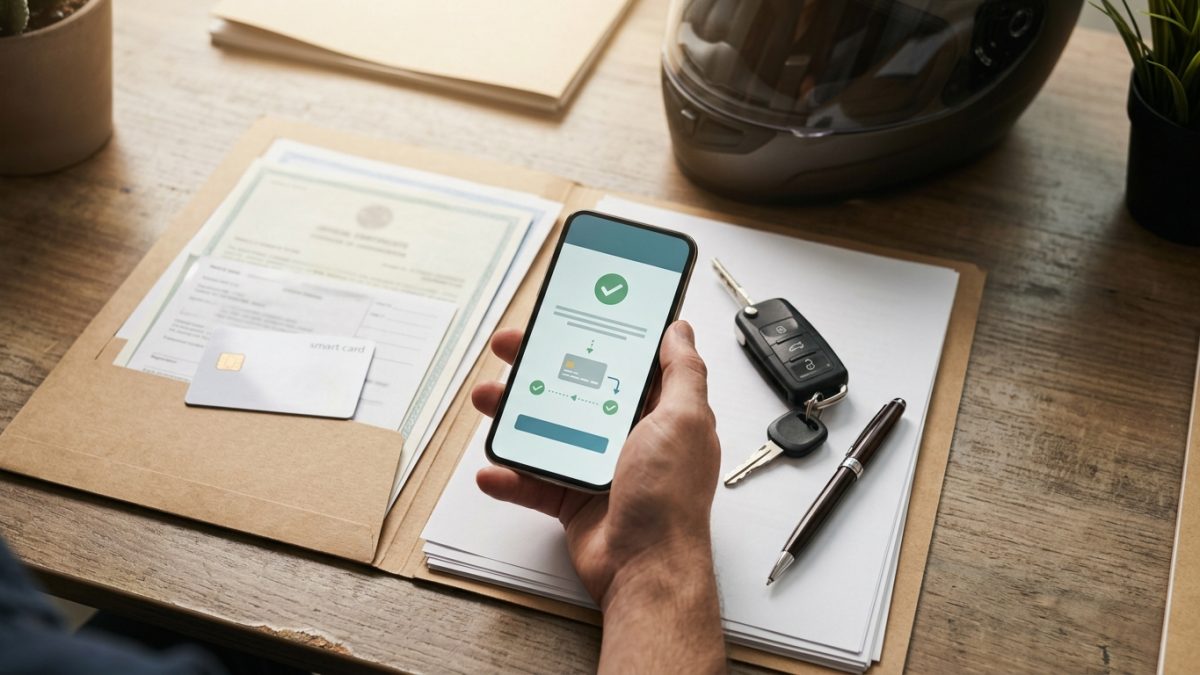
Approaching a Lok Adalat panel unprepared can lead to your case being adjourned back to standard court dockets. Litigants must carry original documents alongside one set of self-attested photocopies.
- Printed Lok Adalat Appointment Token (displaying assigned bench number and QR code).
- Printouts of the contested traffic notices or e-challan payment slips.
- Original Vehicle Registration Certificate (RC). You can verify vehicle particulars beforehand via our RC details search tool.
- Valid physical or DigiLocker Driving Licence of the registered owner or authorized driver.
- Active Motor Vehicle Insurance policy certificate.
- Valid Pollution Under Control Certificate (PUCC).
- Government photo identity card of the vehicle owner (Aadhaar, Voter ID, or Passport).
- Signed authorization letter and identity proof if an advocate or family representative appears for the owner.
Attempting to settle a challan with an expired PUCC or expired third-party insurance often backfires. Presiding magistrates can decline compounding relief or mandate regular fine compounding until compliance is demonstrated.
Common Bottlenecks and How to Avoid Them
Securing a lok adalat challan token booking slot and obtaining clean clearance requires careful timing. Watch out for these operational pitfalls:
- Token Quota Depletion: Online token booking links often exhaust assigned quotas within 15 to 30 minutes of opening. Monitor police social channels and log in the minute booking goes live.
- Parivahan Mobile Mismatch: If your registered vehicle profile lists an obsolete phone number, you will not receive the mandatory login OTP. Update your mobile number on Parivahan at least one week before booking begins.
- Delayed Portal Clearance: If the central MoRTH server fails to clear your notice status after payment, file an online grievance with your court payment receipt on the Parivahan e-challan portal.
- Pending Transfer Blocks: Unresolved challans listed under "Sent to Court" block vehicle ownership transfers and fitness certificates at the RTO. Settle these files immediately during Lok Adalat sessions.
Before planning your vehicle ownership transfer or RTO fitness inspection, run a routine e-challan status check to guarantee that all settled Lok Adalat files reflect clean zero-dues across the national database.
Conclusion
Settling an outstanding lok adalat challan offers vehicle owners a lawful, cost-effective way to clear traffic fines and lift administrative blocks on vehicle records. By securing an online token early, preparing original vehicle documents, and participating in the conciliation hearing, you can achieve an amicable settlement backed by a final civil court decree.
Check your pending notices periodically on official traffic portals, avoid non-compoundable road violations, and keep your contact details updated on the Vahan registry to benefit from upcoming Lok Adalat sessions.