Key Takeaways
- Never pay token money before running an official online background check on the vehicle.
- Verify active bank hypothecation on Parivahan to avoid buying a car facing repossession.
- Check national eChallan and Virtual Courts portals to clear pending fines and prevent RTO blacklisting.
- Inspect insurance No Claim Bonus (NCB) and service records to identify undisclosed accident repairs.
- Cross-check physical wear and OBD-II multi-module ECU data to catch fraudulent odometer rollbacks.
| Verification Parameter | Official Platform / Source | Mandatory Documents / Details | Processing Fee (CMVR) |
|---|
| RC & Hypothecation | Parivahan Sewa / VAHAN | Vehicle Registration Number | Free to check (₹100 HP removal) |
| Traffic e-Challans | eChallan Parivahan | Registration + Engine/Chassis No. | Cost of pending fine |
| Court Summons | Virtual Courts (vcourts.gov.in) | Vehicle No. or Challan No. | Fine determined by magistrate |
| Accident Claims | IIB Portal & Policy Certificate | Registration No. & Insurance Policy | Free / Included in insurer NOC |
| Odometer History | OEM Service Center / OBD-II Scan | VIN / Chassis No. + Owner Consent | ₹149–₹249 (Aggregator report) |
To run a complete second hand car check in India, inspect the vehicle registration number on official government portals like Parivahan and eChallan before handing over any token money. You can check the legal title, active loan hypothecation, road tax status, and pending court fines entirely online within minutes to avoid financial repossession or transfer rejection.
Before signing agreements or meeting the seller, you can verify vehicle history India instantly using a trusted platform like VahanX RC search to confirm the owner name, registration date, and hypothecation status. Skipping this step leaves buyers vulnerable to undisclosed bank encumbrances and blacklisted vehicles.
Why a Second Hand Car Check Is Crucial Before Paying Token Money
Buying a used car in India without due diligence carries severe financial, legal, and mechanical risks. When you put down non-refundable token money, you lose negotiation leverage if undisclosed issues surface later.
The primary hazard is financial encumbrance. When a vehicle is purchased through a bank loan, the financier holds legal hypothecation over the asset. If the previous owner stops paying EMIs or sells without a loan closure, the lender retains the legal right to repossess the car, leaving you with neither the vehicle nor your money.
Legal liabilities represent another major issue. Vehicles involved in unpaid traffic offenses or criminal investigations are flagged on central databases. Running a used car legal check by registration number ensures the registration certificate (RC) is not marked as "Blacklisted" on VAHAN. A blacklisted vehicle cannot undergo ownership transfer under Form 29 and Form 30 at the Regional Transport Office (RTO).
A vehicle with unpaid court challans or tax arrears will be marked as blacklisted on VAHAN, making RTO ownership transfer impossible until all liabilities are cleared.
Step-by-Step Second Hand Car Check Online Across Official Portals
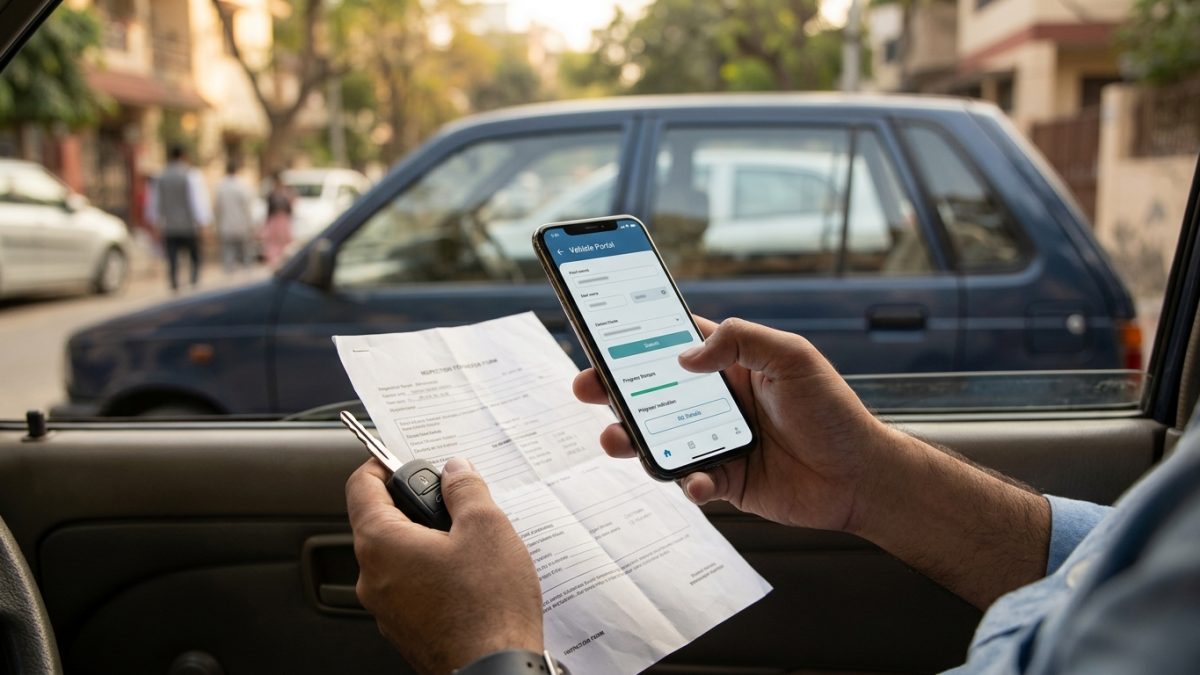
Conducting a second hand car check online involves querying three distinct central databases. Each portal provides a specific layer of verification regarding ownership, traffic fines, and judicial proceedings.
1. Verify RC Status and Hypothecation on Parivahan
The Ministry of Road Transport and Highways (MoRTH) maintains the central VAHAN registry. You can check the core registration credentials directly on the Parivahan Sewa portal.
- Access the citizen portal: Visit the official Parivahan website and navigate to Online Services > Vehicle Related Services.
- Enter registration details: Select the state where the vehicle is registered, and enter the complete vehicle registration number.
- Log in securely: Enter your mobile number to generate and submit an OTP for citizen access.
- Review dashboard metrics: Open Know Your Vehicle Details to review the masked owner name, registration date, vehicle fitness expiry, and emission norm (BS4 or BS6).
- Inspect hypothecation and status: Verify that the Hypothecation Status displays "No" or remains blank. If it lists a bank name, an active loan is still registered. Ensure the vehicle status is marked as "Active" and not "Suspended" or "Blacklisted".
2. Check Pending Traffic Fines on eChallan
Traffic enforcement cameras across India issue digital fines that follow the vehicle, not the driver. Before purchasing, verify that no unpaid penalties remain on the National eChallan portal or through VahanX e-challan search.
- Navigate to challan status: Open the official eChallan portal and click on Check Challan Status.
- Enter security identifiers: Enter the vehicle registration number along with the last 5 characters of the chassis number or engine number.
- Submit captcha verification: Solve the image captcha and click Get Detail to populate the violation list.
- Analyze outstanding fines: Review the date, violation type, fine amount, and status column. If the status indicates "Pending", demand that the current owner pay these fines before moving forward.
3. Search Contested Fines on Virtual Courts
When electronic challans remain unpaid beyond the statutory window (typically 45 to 90 days), traffic departments escalate them to judicial magistrates. These do not always reflect as simple payable fines on standard apps.
- Open the judicial portal: Go to the official Virtual Courts Portal managed by the Supreme Court e-Committee.
- Select jurisdiction: Choose the respective state and designated traffic court (such as Delhi Traffic Virtual Court or Maharashtra Virtual Court).
- Search by registration: Input the vehicle registration number or the specific challan number.
- Inspect summons and case status: Review whether cases are pending adjudication. If fines have been proposed by the magistrate, read our detailed Virtual Court challan payment guide to understand how the owner must plead guilty and pay online before the RTO will process an ownership transfer.
Never settle for verbal promises regarding unpaid challans. Any citation marked as "Sent to Court" will freeze the RTO application workflow until a magistrate disposes of the case.
How to Check Vehicle Hypothecation Status Parivahan and Clear Bank Loans
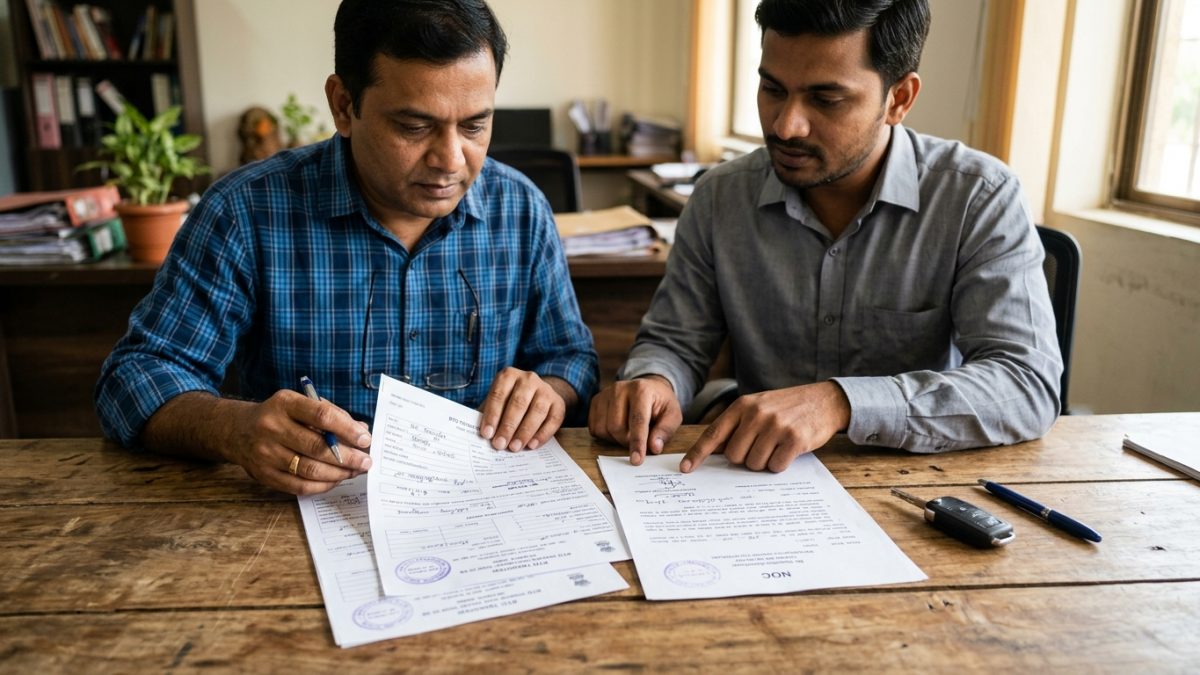
Under Section 51 of the Motor Vehicles Act, 1988, any vehicle bought via financing must have an endorsement on its registration certificate. You can easily check vehicle hypothecation status parivahan records to see if a lender still holds an interest.
If the Parivahan dashboard or physical smart card lists a financier, the seller must complete a formal loan termination process before selling the car. Even if the owner has paid their final loan installment, the hypothecation remains legally active at the RTO until Form 35 is processed.
| Document Required | Issuing Authority | Key Verification Point | Validity Period |
|---|
| Form 35 (Duplicate) | Lending Bank / NBFC | Signed by bank official with physical seal | Valid until processed |
| Bank NOC | Lending Bank / NBFC | Must mention engine and chassis number | Strictly 90 days from issue |
| Original RC | Registering RTO | Must show financier endorsement | Valid until fitness expiry |
| Valid PUC & Insurance | Authorized Center / Insurer | Policy must be current and active | PUC: 6–12 months |
To terminate hypothecation, the seller submits two signed copies of the official Form 35 and the original Bank NOC to the local RTO. The standard Central Motor Vehicles Rules (CMVR) fee is ₹100, though states may levy an additional ₹200 to ₹300 for generating a revised smart card. Online processing via Parivahan takes 7 to 15 working days.
How to Check Car Accident History Online India and Insurance Claims
Sellers rarely disclose structural accidents or flood damage. Learning how to check car accident history online india helps you separate cosmetic bumper scrapes from serious chassis damage.
The Insurance Information Bureau of India operates under the Insurance Regulatory and Development Authority of India (IRDAI). The IIB portal tracks policy records and claims linked to vehicle chassis numbers since April 2010. Note that central database records can take 1 to 2 months to reflect the most recent claims.
2. Analyze the No Claim Bonus (NCB) Percentage
The easiest forensic test for prior accident damage is the No Claim Bonus listed on the current insurance policy. NCB rewards policyholders with progressive discounts for every claim-free year.
| Claim-Free Policy Year | Expected NCB Percentage | Forensic Implication if 0% |
|---|
| After 1st Year Renewal | 20% | Claim filed in Year 1 |
| After 2nd Year Renewal | 25% | Claim filed in Year 2 |
| After 3rd Year Renewal | 35% | Claim filed in Year 3 |
| After 4th Year Renewal | 45% | Claim filed in Year 4 |
| After 5th Year Renewal | 50% | Claim filed in Year 5 |
If a 4-year-old car shows an NCB of 0%, the owner filed an accidental claim during the previous policy period. Ask the seller to provide their official Policy Clearance Certificate from their insurer, which outlines past payouts, damaged parts, and total claim values.
3. Guard Against Constructive Total Loss (CTL) Resales
When vehicle repair costs exceed 75% of its Insured Declared Value (IDV), insurers declare it a Total Loss. Unscrupulous salvage dealers buy these wrecks, patch them up at local independent garages, and sell them to unsuspecting buyers. Checking the past insurance claim trajectory is essential to avoid purchasing a rebuilt salvage car.
A multi-year-old vehicle showing a 0% No Claim Bonus on its comprehensive policy certificate is a direct indicator of an accident or own-damage insurance claim during the previous year.
How to Detect Odometer Tampering and Verify Service Records
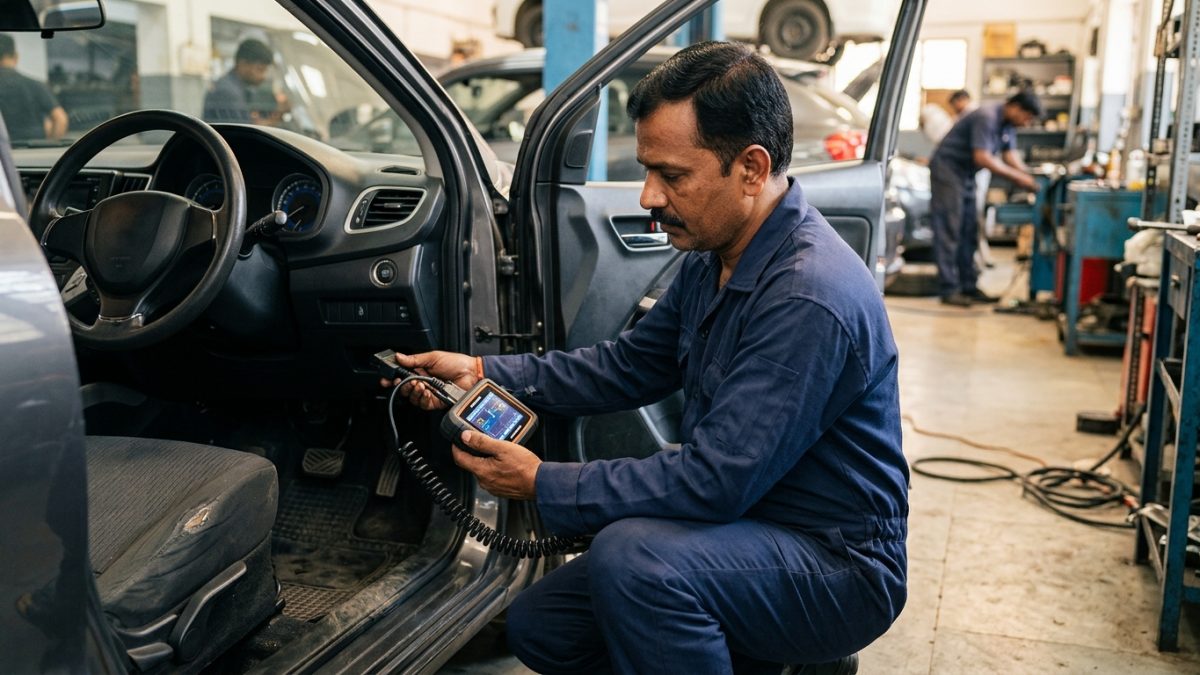
Odometer rollback is widespread in the unorganized used car market. Dishonest sellers routinely clock back digital odometers by 30,000 to 70,000 km to inflate the vehicle's asking price by ₹50,000 to ₹2,00,000.
To verify used car service history online, do not rely solely on the dashboard reading. Follow these structured verification methods:
- Check Authorized Brand Apps: Most major manufacturers (Maruti Suzuki, Hyundai, Tata Motors, Toyota) store digital service logs on their customer apps. Ask the seller to open their brand app and show the service history timestamps.
- Visit an Authorized Dealership: Accompany the seller to an authorized brand workshop with the vehicle identification number (VIN). The service advisor can pull the complete national digital service history, revealing recorded mileages and major part replacements.
- Order a Vehicle History Report: Online aggregator platforms offer digital vehicle history reports for ₹149 to ₹249. These reports source authorized network records to highlight date-stamped mileage logs.
- Run an OBD-II Multi-Module Scan: Cheap tampering tools only rewrite the mileage stored on the instrument cluster EEPROM chip. A professional diagnostic scanner queries the Engine Control Unit (ECU), Transmission Control Module (TCM), and ABS module, which log wheel revolutions and operating hours independently.
- Inspect Physical Wear Patterns: Check the accelerator, brake, and clutch pedal rubbers. Worn-down pedal rubber exposing bare metal indicates over 70,000 km of driving, regardless of a 25,000 km dashboard reading.
- Check Tyre DOT Codes: Inspect the 4-digit manufacturing date code stamped on the tyre sidewall (e.g., "2422" means the 24th week of 2022). A vehicle showing 20,000 km on the odometer should still have its factory-fitted tyres.
State-Wise Regulations and Transfer Compliance
Understanding how to check second hand car before buying also requires checking regional regulatory compliance. Local RTO mandates can make an otherwise legal vehicle undriveable in your city.
The 10-Year Diesel and 15-Year Petrol Rule (Delhi-NCR)
Per orders from the National Green Tribunal (NGT) and Supreme Court, diesel vehicles older than 10 years and petrol vehicles older than 15 years cannot operate within the National Capital Region. These vehicles cannot be re-registered or granted fitness extensions in Delhi-NCR. Always calculate the remaining legal lifespan using the initial registration date on Parivahan.
High Security Registration Plates (HSRP)
HSRP with laser-etched serial numbers and color-coded fuel stickers is mandatory across almost all Indian states. An RTO will summarily reject an ownership transfer application if the vehicle lacks valid HSRP plates. If the car does not have them, consult our guide on HSRP number plate booking online to factor this cost and process into your purchase plan.
Inter-State RTO Transfers
If you purchase a car registered in another state, the seller must provide an RTO No Objection Certificate (Form 28) from the original licensing authority. You will need to pay pro-rata road tax in your home state to obtain a new registration mark, while the previous owner must file a separate tax refund request at their home RTO.
Make sure you run a fast, comprehensive second hand car check through VahanX vehicle verification before making any non-refundable financial commitment to the seller.
Conclusion
Performing a thorough second hand car check before paying a single rupee protects you from repossessed assets, blacklisted titles, and dangerous accident-damaged vehicles. By validating the vehicle across Parivahan, eChallan, and insurance claim databases, you secure legal ownership without unpleasant financial surprises.
Always verify the physical chassis stamping against the registration certificate, pull the complete authorized service history, and make the final transaction contingent on a clear RTO title.