To complete your rc renewal online, submit Form 25 on the official Parivahan Citizen Services portal within 60 days before your 15-year registration expires. Pay the renewal fee, smart card charge, and state green tax, then book an RTO slot for a mandatory physical vehicle fitness inspection. Once cleared, a renewed RC is issued for five years.
Before you begin the application, verify your current registration expiry date and vehicle status using the VahanX RC search tool. Knowing your exact expiry timeline helps you avoid steep compounding monthly late penalties and statutory fines.
Key Takeaways
- RC renewal is mandatory for private vehicles upon completing 15 years from the initial registration date.
- Apply via Form 25 on Parivahan up to 60 days before the RC expiration date.
- Base renewal fees under Rule 81 are ₹1,000 for two-wheelers and ₹5,000 for private cars.
- Late renewals incur compounding delays of ₹300 per month for bikes and ₹500 per month for cars.
- Every vehicle must clear a physical roadworthiness and emissions test at an RTO or Automated Testing Station.
| Feature | Two-Wheelers (Bikes/Scooters) | Private Four-Wheelers (Cars/SUVs) |
|---|
| Applicable Form | Form 25 (CMVR 1989) | Form 25 (CMVR 1989) |
| Application Window | Within 60 days prior to expiry | Within 60 days prior to expiry |
| Renewal Validity | 5 Years | 5 Years |
| Base Renewal Fee | ₹1,000 | ₹5,000 |
| Fitness Test Fee | ₹400 (Manual) / ₹500 (ATS) | ₹600 (Manual) / ₹1,000 (ATS) |
| Late Fee Penalty | ₹300 per month | ₹500 per month |
Legal Rules and Timeline for RC Renewal After 15 Years
Under Rule 52(1) of the Central Motor Vehicles Rules (CMVR), 1989, every personal, non-transport vehicle owner must apply for registration renewal. The law specifies that this application must be submitted not more than 60 days before the initial 15-year registration term ends.
The initial registration certificate issued when buying a brand-new car or motorcycle remains valid for exactly 15 years. When an owner completes the rc renewal after 15 years, the RTO extends validity in subsequent 5-year blocks, provided the vehicle clears roadworthiness checks.
The Ministry of Road Transport and Highways (MoRTH) fundamentally changed legacy vehicle regulations through Notification G.S.R. 714(E), which took effect nationwide on 1 April 2022. This amendment increased renewal fees under Rule 81 to discourage the prolonged use of older, polluting BS-I, BS-II, and BS-III vehicles under the National Vehicle Scrappage Policy.
Rule 52(1) allows you to initiate renewal 60 days prior to expiry. Applying early ensures your vehicle does not lapse into expired status while you wait for an inspection slot.
Car and Bike RC Renewal Fees Breakdown

The total cost to renew your registration combines the base application fee, automated or manual fitness inspection charges, smart card personalization costs, and applicable state environmental taxes. Understanding the car rc renewal fees and two-wheeler schedules prevents unexpected surprises at the payment gateway.
According to Rule 81 of the CMVR, revised via MoRTH notifications, base application charges reflect a substantial increase over legacy fee schedules. Two-wheeler renewal jumped from ₹300 to ₹1,000, while non-transport light motor vehicles (LMVs) rose from ₹600 to ₹5,000.
| Vehicle Category | Renewal Fee (Form 25) | Fitness Test Fee | Smart Card Fee (Form 23A) |
|---|
| Motorcycles / Scooters | ₹1,000 | ₹400 (Manual) / ₹500 (ATS) | ₹200 |
| Three-Wheelers / Quadricycles | ₹2,500 | ₹400 (Manual) / ₹500 (ATS) | ₹200 |
| Private Cars / LMVs | ₹5,000 | ₹600 (Manual) / ₹1,000 (ATS) | ₹200 |
| Imported Two-Wheelers | ₹10,000 | ₹400 (Manual) / ₹500 (ATS) | ₹200 |
| Imported Cars / Four-Wheelers | ₹40,000 | ₹600 (Manual) / ₹1,000 (ATS) | ₹200 |
In addition to inspection and application costs, RTOs collect a grant of fitness certificate charge, typically ₹1,000 for two-wheelers and ₹1,000 to ₹1,500 for private cars depending on state rules. Detailed tariff announcements are documented on the official Press Information Bureau MoRTH release.
Scrappage Policy Fee Waivers
Vehicle owners can bypass these steep re-registration charges under Rule 47(1)(n). If you choose to surrender an end-of-life vehicle at an authorised Registered Vehicle Scrapping Facility (RVSF), you receive a Certificate of Deposit (CD). Presenting this certificate waives the registration fee when purchasing a new vehicle.
RC Renewal Penalty Per Month and Late Fee Rules
Failing to renew your registration prior to the expiry date triggers mandatory delay fees under Note 2 of Rule 81. Unlike earlier flat token fines, the current structure levies an escalating, compounding monthly charge.
For private cars and light motor vehicles, the rc renewal penalty per month is ₹500 for every month or part thereof following expiry. For two-wheelers, the late penalty stands at ₹300 per month. Commercial and transport vehicles face an even stricter regime of ₹50 per day for delayed fitness certification.
In April 2024, the Bombay High Court upheld these compounding monthly delay fees under Rule 81 as valid administrative charges intended to enforce vehicular compliance.
If a car registration has lapsed for six months, the late surcharge alone reaches ₹3,000, added directly on top of the standard ₹5,000 application fee, fitness test charges, and green tax levies.
State-Wise Green Tax Rules and Exemptions
Green Tax, also known as ecological cess, is an environmental surcharge collected during the re-registration of vehicles older than 15 years. State governments determine the exact percentage and collection method, meaning amounts vary across regional borders.
Standard green tax rates usually range between 10% and 25% of the applicable road tax for non-transport vehicles. In designated highly polluted industrial and urban zones, state transport departments are empowered to levy environmental cesses reaching up to 50% of original road tax slabs.
| State | Two-Wheeler Green Tax (5 Years) | Private Petrol Car Green Tax (5 Years) | Private Diesel Car Green Tax (5 Years) |
|---|
| Maharashtra | Approx. ₹2,000 | ₹3,000 – ₹3,500 | ₹4,000 – ₹4,500 |
| Karnataka | Flat ₹500 | Flat ₹1,000 | Flat ₹1,000 |
| Tamil Nadu | Percentage of Life Tax | Percentage of Life Tax | Percentage of Life Tax |
| Uttar Pradesh | Percentage of Base Tax | Percentage of Base Tax | Percentage of Base Tax |
Electric vehicles (EVs) enjoy complete exemption from green tax nationwide. Most state jurisdictions also offer full exemptions or subsidised slabs for vehicles converted to alternative fuels such as compressed natural gas (CNG), LPG, or ethanol blends.
Step-by-Step RC Renewal Process Online on Parivahan

The transport ministry has digitised the initial filing steps through the Vahan citizen infrastructure. Following this clear rc renewal process online saves substantial time before heading to the RTO for inspection.
- Open the official portal: Navigate to the Vahan Citizen Services portal, select your state from the dropdown menu, and choose your local registering authority. You can confirm your local jurisdiction using our RTO office directory.
- Select renewal service: From the top navigation bar, select Online Services, click on Vehicle Related Services, and choose Renewal of Registration.
- Authenticate your vehicle: Enter your full vehicle registration number and the last five characters of your chassis number. Click to generate an OTP, which arrives on the mobile number linked to the registration.
- Fill out Form 25 details: The portal pulls existing engine specifications, fuel classification, and owner details from the national registry. Verify the data, enter current odometer readings, and update your correspondence address if required.
- Calculate and pay fees: Review the automated fee breakdown, which aggregates Form 25 renewal fees, smart card charges, fitness test slot fees, green tax, and any accrued monthly penalties. Complete the transaction via UPI, debit card, or internet banking.
- Book an inspection appointment: Once the payment receipt generates, navigate to the appointment booking utility on the portal. Select an available date and time slot at your designated RTO testing track or licensed Automated Testing Station (ATS).
- Attend the physical inspection: Drive your vehicle to the designated RTO ground on your appointment date. Hand over physical copies of Form 25, tax payment receipts, and identity documents to the inspecting official.
- Receive your renewed RC: After the Motor Vehicle Inspector (MVI) approves the vehicle digitally in Vahan 4.0, your renewal is registered. Access your digital card immediately or wait for the physical smart card via speed post.
Always download and print the application receipt and Form 25 immediately after paying online; the inspecting RTO officer requires these hard copies during the fitness check.
Having every mandatory document in order ensures your form 25 parivahan filing progresses without objections from RTO scrutiny clerks. Missing paperwork or expired certificates will delay the physical inspection clearance.
- Form 25 Application: Signed physical printout of the auto-generated application containing vehicle identity metrics.
- Original Registration Certificate: The physical RC book or PVC smart card for verification and official endorsement.
- Valid PUC Certificate: Live emission compliance certificate registered on the central Parivahan network. Review renewal validity rules in our PUC certificate online guide.
- Active Motor Insurance: Valid comprehensive or mandatory third-party liability policy schedule.
- Pencil Chassis Impression: A clear pencil tracing of the VIN/chassis plate taken on the margin of physical Form 25.
- Proof of Identity and Address: Self-attested copies of Aadhaar card, Passport, Voter ID, or utility bills.
- PAN Card or Form 60: Mandatory financial identification document.
- Tax Receipts: Evidence of up-to-date road tax and environmental cess clearance.
- Loan Clearance NOC: Form 35 and bank NOC if the initial hire-purchase was never removed. Learn the clearance steps in our hypothecation removal guide.
- Fee Transaction Receipt: Printed proof of online payment showing the successful transaction reference number.
Vehicle Fitness Test for RC Renewal: What RTO Inspects
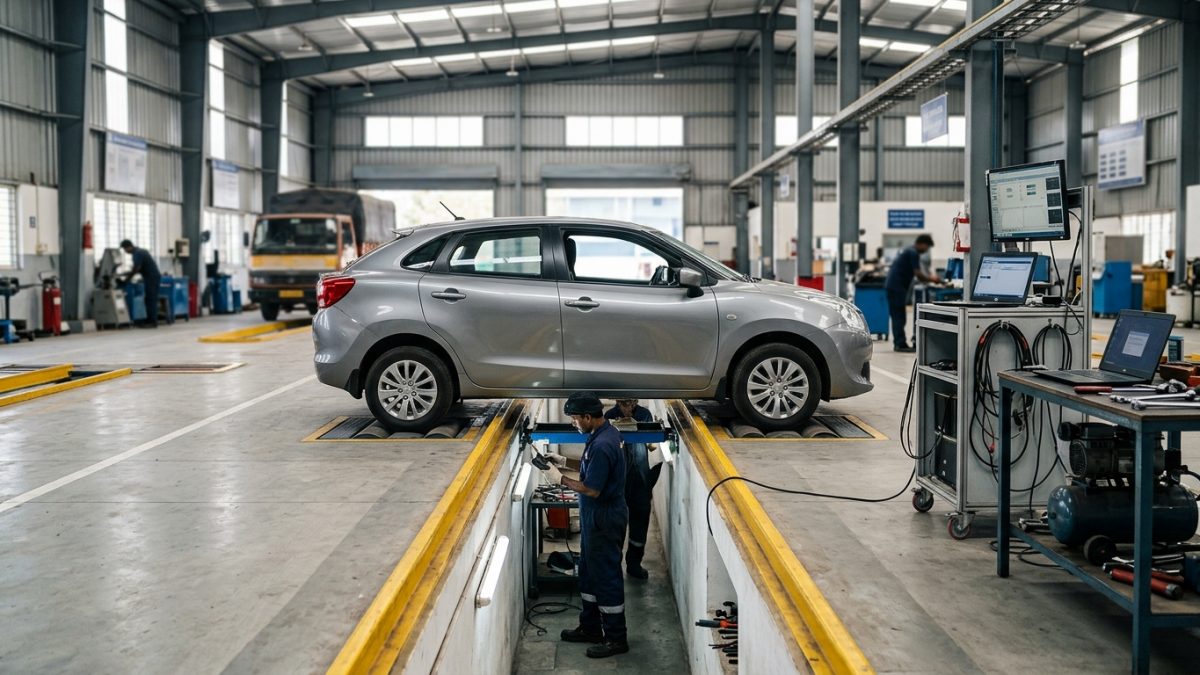
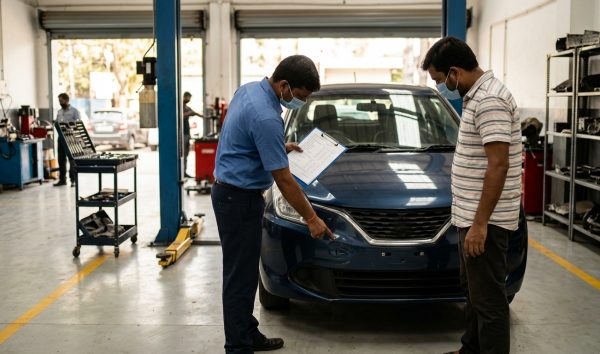
The physical vehicle fitness test for rc renewal evaluates whether an aging machine remains roadworthy and structurally safe. Motor Vehicle Inspectors perform both static identity checks and dynamic functional evaluations before granting approval.
Identity and Number Verification
The inspecting officer inspects the physical chassis frame and engine block. The stamped alphanumeric sequence must match the registration records and pencil tracing exactly, showing no signs of re-punching, tampering, or structural weld cuts.
Mechanical and Safety Inspection
Every critical driving mechanism must function according to original factory specifications. Key evaluation checkpoints include:
- Braking Efficiency: Operational response of primary service brakes and parking handbrake systems.
- Steering and Suspension: Absence of excessive steering column play, tie-rod damage, or leaking shock absorbers.
- Electricals and Lighting: Functional high/low beam headlamps, side indicators, hazard lights, reverse lamp, and license plate illuminators.
- Tire Roadworthiness: Tires must have adequate tread depth exceeding the legal minimum of 1.6 mm, free from structural bulges or exposed cords.
- Bodywork Integrity: No heavy chassis rust, bent structural pillars, or dangling bumper panels.
- Visibility Standards: Intact laminated front windscreen free from obstructive cracks, operating dual wipers, and functional mirrors.
Inspectors will reject vehicles displaying unauthorised modifications such as non-standard bull bars, unapproved window tint films, or loud aftermarket exhaust setups.
Delhi-NCR Vehicle Ban vs RC Renewal Regulations
Rules for rc renewal after 15 years operate under entirely different administrative parameters within the National Capital Region (NCR). Vehicle owners in Delhi, Gurugram, Noida, and surrounding districts must navigate stringent court-mandated environmental restrictions.
Under long-standing directives from the National Green Tribunal (NGT) and the Supreme Court in the 2018 M.C. Mehta vs Union of India matter, diesel vehicles older than 10 years and petrol vehicles older than 15 years are deemed End-of-Life Vehicles (ELVs). Consequently, Delhi RTOs do not entertain Form 25 renewal applications, and the Parivahan portal automatically blocks these submissions for DL-registered vehicles.
Supreme Court Ruling and Practical Impact
On 12 August 2025, a Supreme Court bench headed by Chief Justice B.R. Gavai granted interim relief prohibiting authorities from seizing or towing parked 10-year diesel and 15-year petrol vehicles solely on the grounds of age. The apex court agreed to re-evaluate blanket age prohibitions using scientific emission testing standards.
Despite this protection against arbitrary roadside impoundment, Delhi RTOs remain legally unable to issue renewed RCs. Fuel stations routinely check registration statuses, and local PUC centres decline to test deregistered vehicles. Owners in Delhi-NCR generally have two viable courses of action:
- Obtain an Inter-State NOC: Apply for an online No Objection Certificate via Parivahan prior to the vehicle reaching the 15-year limit, transferring registration to another Indian state that permits re-registration.
- Voluntary Scrappage: Surrender the legacy vehicle to an authorised Registered Vehicle Scrapping Facility to claim tax concessions and fee waivers on a replacement purchase.
Penalties for Driving with an Expired RC
Operating any automobile after its registration certificate expires constitutes a major violation of Indian transport law. Enforcement teams, high-definition ANPR highway cameras, and traffic police routinely monitor vehicle validity.
Under Section 39 of The Motor Vehicles Act, 1988, driving an unregistered or invalidly registered vehicle on public roads is strictly prohibited. The statutory penalties prescribed under Section 192 are severe:
| Offence Level | Statutory Fine | Judicial Penalty / Consequence |
|---|
| First Offence | ₹2,000 to ₹5,000 | Traffic challan issued on the spot or online |
| Second or Subsequent Offence | ₹5,000 to ₹10,000 | Possible imprisonment up to 1 year, or fine, or both |
| Compounding Action (Section 207) | Vehicle Seizure | Impounding of the vehicle by police or RTO officers |
Beyond statutory traffic fines, driving on an expired registration exposes owners to severe insurance risks. If a vehicle without valid registration is involved in an accident, insurance companies can legally repudiate all third-party and own-damage claims on grounds of fundamental policy breach. You can check if your vehicle has any outstanding violations using our challan search service.
Always verify your current legal status, tax standing, and fitness validity with a quick check on VahanX vehicle owner details before taking an older car or motorcycle out on highway routes.
Conclusion
Completing your rc renewal online ensures that your car or two-wheeler remains completely road-legal, insured, and safe for public roads past its 15th year. Initiating the Form 25 application within the 60-day window on Parivahan saves you from compounding monthly late fees and sudden roadside impoundment.
Before you schedule your vehicle fitness test at the RTO, use VahanX RC search to double-check registration dates, pending challans, and technical specifications so your renewal is processed without unexpected hurdles.