Key Takeaways
- You can apply for a permanent DL 30 days after your Learner's Licence issue date.
- The permanent driving test must be cleared within 180 days before your Learner's Licence expires.
- Base statutory government fees start at ₹700 for a single class and ₹1,000 for two classes.
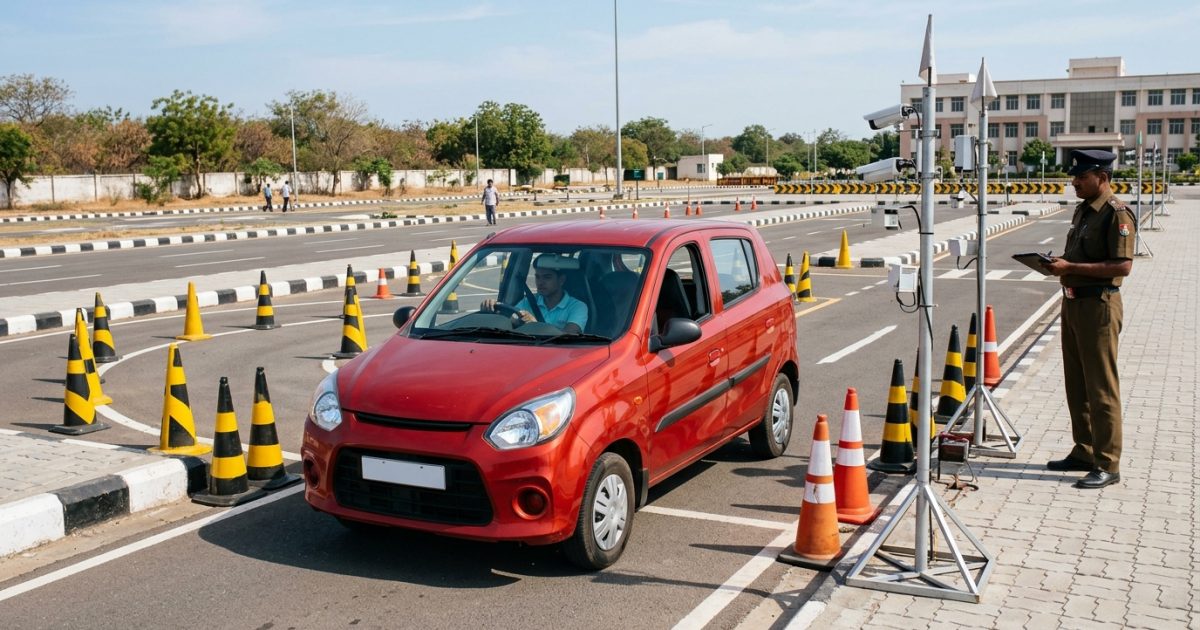
- Automated tracks use sensors, cameras, and RFID tags to evaluate rollback, parking, and lane discipline.
- Form 5B from Accredited Driver Training Centres (ADTC) legally exempts applicants from the practical RTO driving test.
To complete your permanent driving licence apply online process, visit the official Sarathi Parivahan portal, log in with your valid Learner's Licence details, pay the statutory fees, and book an RTO test appointment slot. You must hold your learner licence for at least 30 days before appearing for the mandatory driving skill test at the RTO track.
You can monitor your application progress or perform a driving licence status check at any point using your application credentials. Navigating this procedure independently saves you from paying excessive agent commissions while ensuring you are fully compliant with Central Motor Vehicles Rules.
| Aspect | Details (as of September 2026) |
|---|
| Application Portal | sarathi.parivahan.gov.in |
| Mandatory Waiting Period | Minimum 30 days after Learner's Licence issuance |
| Licence Validity Window | Must clear driving test within 180 days of LL issue |
| Base Statutory Fees | ₹700 (single class) / ₹1,000 (MCWG + LMV combined) |
| Test Mode | Automated Driving Test Track (ADTT) / Sensor-based evaluation |
Eligibility Rules for DL Apply Online After Learning Licence
Before initiating the dl apply online after learning licence procedure, verify that you meet all legal eligibility criteria established under Rule 15 of the Central Motor Vehicles Rules (CMVR), 1989. Attempting to book a slot before completing the statutory waiting timeline will lead to an immediate portal error.
- Holding Period: You must have held a valid Learner's Licence (LL) for a minimum of 30 days. You cannot book a driving test slot for day 29 or earlier.
- Validity Deadline: Your driving skill test must be cleared within 180 days (6 months) from the date your Learner's Licence was generated. If the LL lapses, you must restart the entire process from the learner stage.
- Age Minimums: Applicants must be at least 18 years old for Light Motor Vehicles (LMV cars) and Motorcycles with Gear (MCWG). A minimum age of 16 applies to gearless two-wheelers up to 50cc (with parental consent), and 20 years for transport commercial vehicles.
- Medical Requirements: Applicants under 40 years of age applying for private categories submit a Form 1 self-declaration. Applicants aged 40 and above must provide a Form 1A medical fitness certificate verified by a registered medical practitioner.
Rule 15(1) of the CMVR mandates a strict 30-day waiting period from the date of LL issuance before an applicant can appear for a permanent driving test.
Documents Required for Permanent Driving Licence
Submitting the right paperwork prevents administrative rejections. When applying online, specific details are fetched directly from your existing learner records, while original physical documents must be presented at the test facility.
Digital Documents Uploaded During Application
- Learner's Licence number (automatically pulls records on the Sarathi database).
- Medical Fitness Certificate in Form 1A (compulsory for applicants aged 40 and older).
- Driver Training Certificate: Form 5B issued by an Accredited Driver Training Centre (ADTC) if seeking driving test exemption, or Form 5 from standard driving schools.
- Identity or address proofs only if biographical details have changed since your LL issuance.
Physical Documents to Carry on Test Day
- Original physical copy of your active Learner's Licence.
- Printed Application Form 2 generated from the Sarathi portal.
- DL slot appointment confirmation slip with QR code.
- Original government fee payment receipt.
- Original proof of identity (Aadhaar card, Passport, or Voter ID).
- Valid original documents for the test vehicle: Registration Certificate (RC), motor insurance policy, and active Pollution Under Control (PUC) certificate.
Before driving to the test track, verify that your test car or bike has an active insurance and emission certificate. You can check RC details using the online RC search tool to verify that vehicle records are completely valid.
Permanent Driving Licence Fees Under Rule 32
Statutory permanent driving licence fees are regulated nationally under Rule 32 of the Central Motor Vehicles Rules, 1989. While the central base fee is uniform across India, minor surcharges apply depending on state-level postal delivery charges and local digital administrative fees.
| Fee Component | Single Class (e.g., LMV or MCWG) | Two Classes (LMV + MCWG Together) | Re-Test (After Failure) |
|---|
| Driving Test Fee | ₹300 | ₹600 (₹300 per class) | ₹300 per class |
| DL Issuance Fee (Form 7) | ₹200 | ₹200 | Nil (Already Paid) |
| Smart Card Formulation | ₹200 | ₹200 | Nil (Already Paid) |
| Total Statutory Base | ₹700 | ₹1,000 | ₹300 (+ State charges) |
As of September 2026, several state transport departments charge nominal speed post delivery and convenience fees. Maharashtra charges ₹716 for a single class and ₹1,016 for two classes (including a ₹16 postal service fee). In states like Delhi, Karnataka, Tamil Nadu, and Uttar Pradesh, an extra ₹50 to ₹100 is typically added to cover speed post dispatch directly to your residential address. Always check your state transport portal at the time of payment to verify local add-ons.
How to Apply for Permanent DL Online via Sarathi Parivahan

Completing your sarathi parivahan permanent dl apply workflow does not require middlemen. The central portal offers a direct, secure interface for learner licence holders.
- Visit the official portal: Open your browser and navigate to the official Sarathi Parivahan portal. Select your resident State or Union Territory from the dropdown menu.
- Initiate the DL workflow: Under the main navigation banner, click on the "Driving Licence" menu and select "Apply for Driving Licence". Review the displayed process steps and click "Continue".
- Authenticate credentials: Enter your existing Learner's Licence Number and Date of Birth exactly as recorded on your LL slip. Click "OK" to fetch your stored data.
- Select vehicle categories: The system displays the vehicle classes endorsed on your learner licence. Check the boxes for the classes (such as MCWG, LMV, or both) for which you are prepared to take the practical test.
- Submit application details: Confirm your residential address and contact details. Upload Form 1A if you are 40 or older, or Form 5B if you trained at an Accredited Driver Training Centre. Submit the form to generate your DL Application Number.
- Pay the statutory fees: Navigate to the fee payment gateway. Select your payment mode (UPI, Net Banking, or Debit Card) and complete the transaction. Download the Form 2 acknowledgement and payment receipt.
If you encounter navigation errors on state sub-domains, review our detailed Sarathi Parivahan driving licence portal guide to resolve common technical glitches.
Driving Test Slot Booking Online and Rescheduling
Once payment is verified, you must secure your driving test slot booking online to lock in your evaluation date and time at your designated RTO or automated testing centre.
- Access appointments module: Go to `sarathi.parivahan.gov.in`, open the "Appointments" tab, and click on "Slot Booking" followed by "LL/DL Services Slot Booking".
- Provide application data: Enter your DL Application Number, Date of Birth, and the displayed security CAPTCHA. Click "Submit".
- Choose testing track: Confirm your vehicle class endorsements and select your assigned RTO test facility or designated automated driving track.
- Select an available date: Examine the interactive calendar. Green calendar blocks indicate open dates with available test quotas, red blocks signify fully booked days, and blue blocks indicate public holidays or track maintenance days.
- Confirm slot timing: Select your preferred testing time window (such as 09:30 AM to 11:30 AM or 12:00 PM to 02:00 PM). Submit the request and authenticate the prompt using the security OTP delivered to your registered mobile phone.
- Print appointment slip: Save and print your final sarathi parivahan driving test appointment receipt, which features your application bar code and designated reporting time.
You can cancel or reschedule an RTO appointment up to 24 to 48 hours prior to your slot without forfeiting the test fee. If you fail to appear without prior cancellation, you will be marked absent and must pay for appointment renewal.
Automated Driving Test Track (ADTT) Rules and Passing Criteria
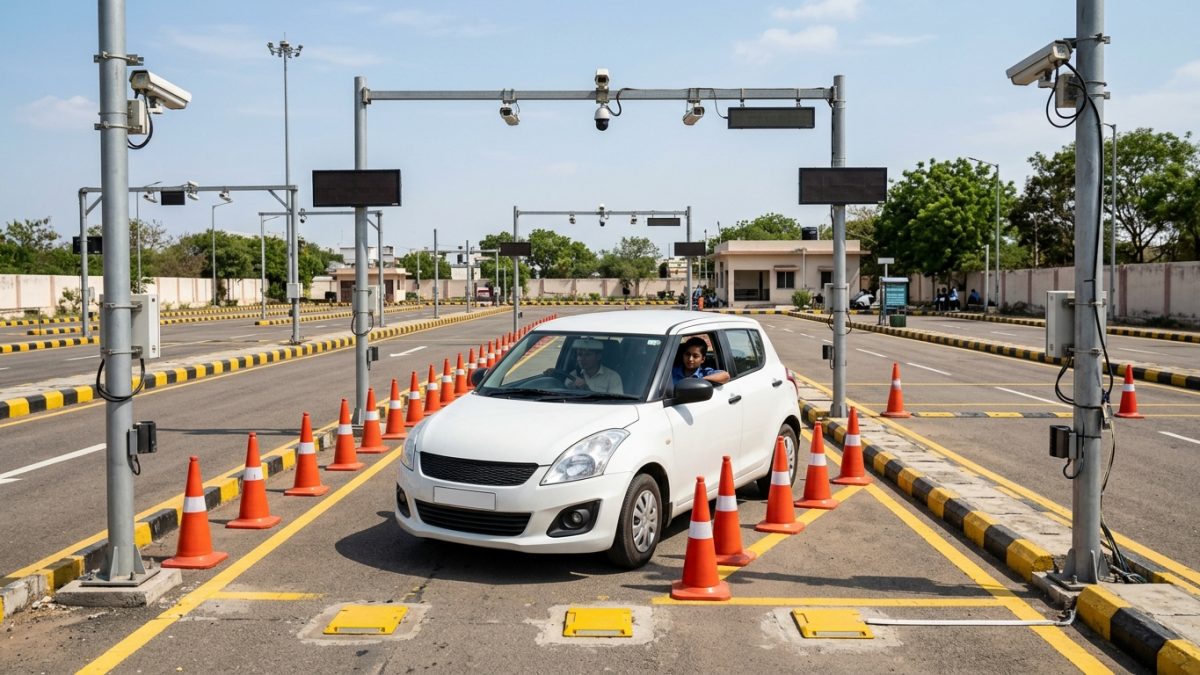
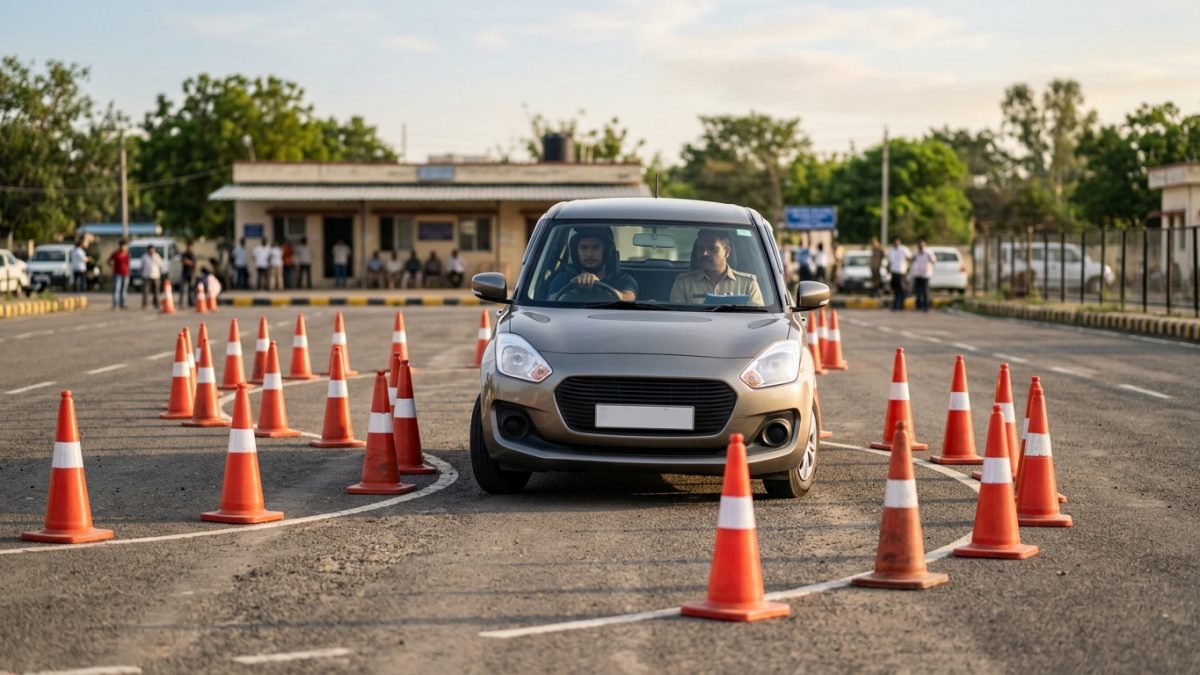
Transport departments across major states—including Delhi, Maharashtra, Karnataka, Tamil Nadu, Uttar Pradesh, and Gujarat—have fully transitioned to sensor-driven Automated Driving Test Tracks (ADTT). These computerised facilities remove human discretion through high-definition overhead cameras, underground magnetic loops, and RFID tracking poles.
| Test Maneuver | Vehicle Class | Time Allowed | Automatic Failure Trigger |
|---|
| Reverse 'S' Curve | Car (LMV) | 120–180 seconds | Touching boundary kerbs, exceeding forward gear shifts |
| Parallel Parking | Car (LMV) | 90–120 seconds | Wheels touching boundary lines, running over curb sensors |
| Gradient / Up-Ramp | Car (LMV) | 60–90 seconds | Vehicle rolling back more than 30 cm (12 inches) |
| Figure of '8' | Bike (MCWG) | 60–90 seconds | Putting foot down on track, touching perimeter line |
| Narrow Plank Balance | Bike (MCWG) | 30–45 seconds | Wheels slipping off plank, putting feet down |
To comply with permanent licence test rules parivahan, your test vehicle must meet specific standards. Under Rule 3 of the CMVR, a prominent red 'L' sticker on a white background must be fixed to both the front and rear of your vehicle. You must also be accompanied to the venue by an individual holding a valid permanent driving licence.
Using a compact car with a short turning radius (such as a Maruti Alto or WagonR) significantly improves your clearance margins on the narrow parallel parking and reverse-S tracks.
Common Mistakes That Cause Driving Test Failures
The vast majority of candidates fail automated RTO tests due to minor handling oversights rather than severe driving deficiencies. Being aware of track triggers will help you pass on your first attempt.
- Excessive Ramp Rollback: The gradient hill-start is the single most common failure point for four-wheeler applicants. The automated ground sensors register any rollback exceeding 30 cm (approx. 12 inches) as an immediate disqualification. Practice your handbrake-to-accelerator coordination thoroughly before testing.
- Foot-Down Penalties for Two-Wheelers: On the two-wheeler Figure of '8' and narrow balancing plank, touching even one foot to the asphalt triggers an automatic fault deduction or outright sensor fail. Maintain smooth, steady throttle-clutch balance.
- Choosing an Unwieldy Vehicle: Attempting to navigate compact automated parking bays in long sedans or wide SUVs increases the chance of bumping kerb sensors. Compact hatchbacks provide optimal spatial awareness.
- Incomplete Test Vehicle Papers: Testing officials disqualify applicants immediately if the vehicle used for the test carries an expired insurance policy or lapsed PUC certificate. Ensure all vehicle documentation is fully updated.
- Letting Your Learner Licence Expire: Some applicants wait too long after their 30-day window, allowing the 180-day overall validity to lapse. Once expired, an LL cannot be extended; you must retake the learner test from the beginning.
Exemption from RTO Driving Tests: The ADTC Route
Under Rules 31B through 31J of the Central Motor Vehicles Rules, 1989 (introduced vide GSR 394(E)), applicants who successfully complete structured training at a government-recognised Accredited Driver Training Centre (ADTC) are legally exempt from taking the practical driving test at the RTO under the proviso to Rule 15(2).
Upon passing your evaluation at an accredited centre, the facility uploads your completion records directly to the national database and issues Form 5B. When completing your online permanent DL application, submitting this certificate waives the physical track test. Note that ordinary local driving schools operate under Rule 24 and issue Form 5, which does not confer any exemption from the RTO driving skill test. The statutory licensing authority remains the sole government body authorised to issue and deliver the actual driving licence.
To understand broader regulatory changes across state licensing authorities, consult our overview of new RTO rules for driving licence and fitness.
Tracking Your Application and Licence Delivery
After clearing your automated track test, the inspecting officer approves your file on the portal. Your biometrics—including high-resolution photograph and digital signature—are consolidated into your central record.
The RTO smart card cell processes and prints your physical licence card within 7 to 15 working days. The card is then dispatched through India Post Speed Post to the address registered on your Aadhaar record. You can track parcel transit through the tracking consignment number uploaded to your Sarathi profile or use the VahanX DL search portal to confirm active approval status and print a temporary digital copy via DigiLocker or mParivahan.
If you need to verify where your jurisdictional licensing authority is located, you can review your regional center using the RTO office details directory before planning your visit.
Conclusion
Completing your permanent driving licence apply online process via Sarathi Parivahan is a straightforward, transparent procedure that eliminates any reliance on unauthorised agents. By ensuring your paperwork is in order, practising key maneuvers like the 30 cm ramp hill-start and parallel parking, and booking your appointment well before your Learner's Licence expires, you can comfortably secure your licence on the first attempt.
Once you clear your test, monitor your document dispatch status and conduct a quick driving licence status check to access your valid digital driving credentials right away.