Key Takeaways
- India lacks a single unified database; checking a vehicle requires cross-verifying Parivahan, NCRB, and IIB records.
- NCRB offers a 100% free online vehicle NOC check via CCTNS to verify police theft and criminal cases.
- Insurance claim records and No Claim Bonus (NCB) indicate past accidental structural damage.
- OBD-II diagnostic tools and physical wear reveal digital odometer tampering executed across secondary control modules.
- VAHAN 4.0 alerts buyers immediately if a vehicle is blacklisted due to loan defaults, unpaid court challans, or FIRs.
To check vehicle history India, buyers must cross-reference official portals: verify ownership, hypothecation, and blacklist alerts on Parivahan, check theft FIRs on the NCRB CCTNS portal, inspect claims history on IIB, and examine OEM dealership service logs for hidden structural accident repairs.
Before transferring any token advance, your immediate first step should be to run a comprehensive RC details search to confirm the registered owner name, registration status, existing insurer, and hypothecation status. Unmasking a pre-owned vehicle's background ensures you avoid stolen property, illegal odometer rollbacks, and unpaid virtual court fines.
| Verification Area | Official Portal / Source | Statutory Cost | Key Data Revealed |
|---|
| RC & Blacklist Status | Parivahan / VAHAN 4.0 | Free (Record Extract ₹50–₹100) | Owner serial, hypothecation, blacklisted flags |
| Theft & Criminal FIRs | NCRB / Digital Police CCTNS | ₹0 (Completely Free) | Stolen status, seized vehicle release, FIR details |
| Insurance Claims | IIB V-Seva (IRDAI) | Free | Past policy history, claims tied to vehicle |
| Accident & Service Logs | OEM Authorized Dealerships | Free with owner / ₹149–₹249 private | Part replacements, frame work, genuine mileage |
Why You Must Check Vehicle History in India Before Buying
Unlike international markets that offer consolidated reports like Carfax, India has a fragmented automotive reporting structure. Government transport offices, criminal enforcement wings, and insurance boards operate distinct databases that do not automatically aggregate into one commercial portal.
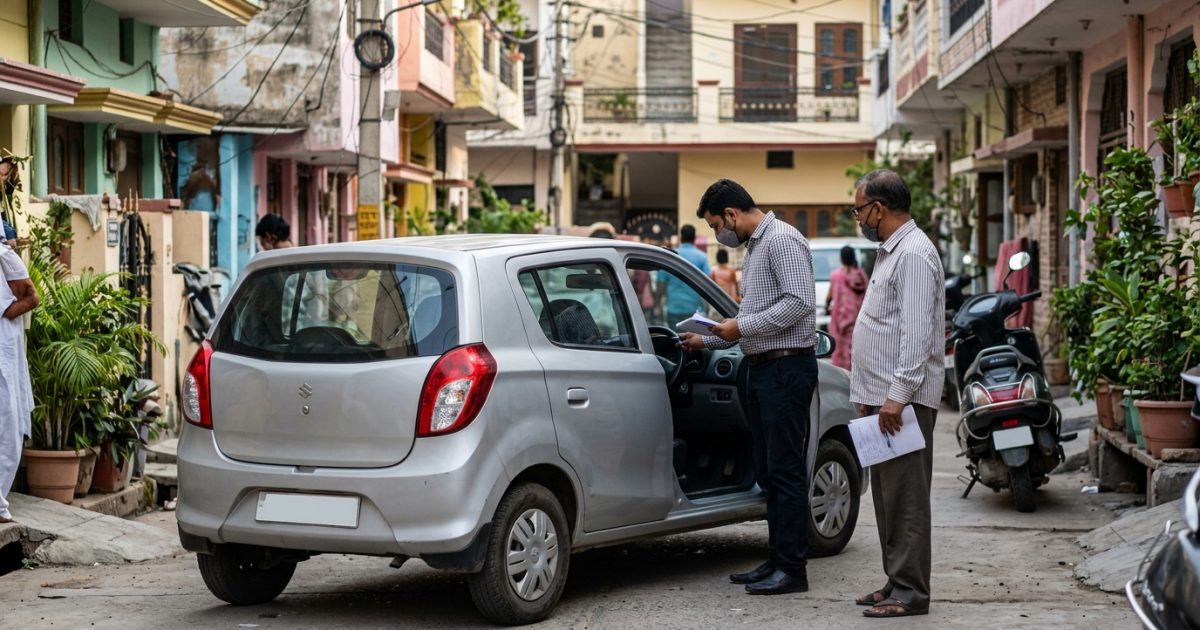
Sellers often conceal major frame repairs, salvage rebuilds, or multiple past owners. Conducting a targeted second hand car check ensures you do not inherit liabilities such as pending virtual court challans or bank hypothecation disputes that block ownership transfer under Central Motor Vehicles Rule 55.
Warning: Never pay a token advance before verifying the Registration Certificate (RC) status on official portals. A vehicle marked as blacklisted or cancelled cannot be legally transferred to your name.
How to Check Car Accident History in India
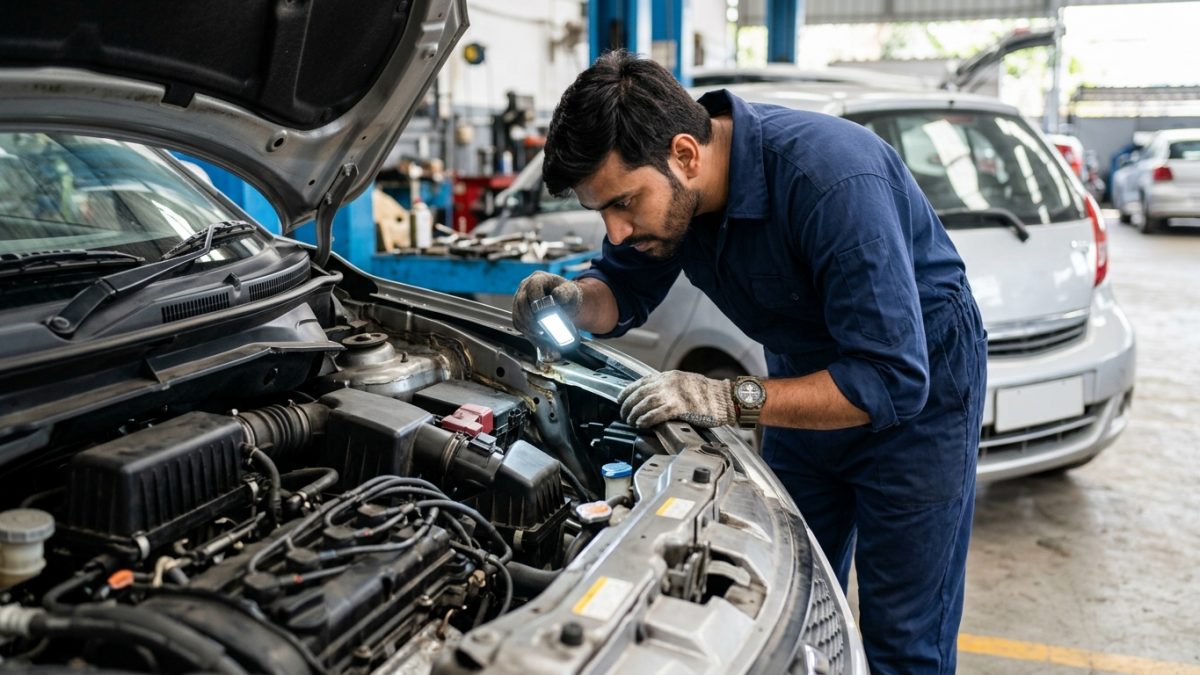
Uncovering past crash repairs requires examining both paper trails and physical vehicle architecture. When a car suffers serious accidental damage, owners typically rely on comprehensive insurance coverage or authorized OEM body shops.
1. Inspect the No Claim Bonus (NCB) Percentage
Examine the seller’s current comprehensive insurance policy schedule. An active NCB ranging between 20% and 50% confirms that no accidental damage claims were processed through the insurer during those policy terms. If a 3-year-old vehicle carries a 0% NCB, the previous owner likely filed an insurance claim in the preceding policy cycle.
2. Review Authorized OEM Dealership Records
Major manufacturers like Maruti Suzuki, Hyundai, Tata Motors, Toyota, and Mahindra maintain centralized Dealer Management Systems (DMS). If accidental repairs—such as apron pulls, radiator core support replacements, or airbag deployments—were completed at an authorized service centre, every part number and labour operation is permanently archived against the Vehicle Identification Number (VIN).
Tip: Authorized service advisors officially share maintenance records only with the registered owner. Ask the seller to accompany you to the service centre or display their OEM smartphone application.
3. Conduct a Structural and Paint Depth Inspection
Factory sheet metal paint thickness in India generally measures between 80 and 140 microns. Use a digital paint depth gauge across the bonnet, pillars, roof, and quarter panels; repainted sections or heavy body filler will trigger readings between 200 and 600+ microns. Check the engine apron, A/B/C pillars, boot floor, and door sills for non-factory robotic spot welds, rippled metal, or freshly sprayed sealant.
| Vehicle Component | Factory Condition Indicator | Accident / Repair Warning Sign |
|---|
| Engine Apron / Strut Towers | Uniform spot welds, smooth factory seam sealant | Reworked sealant beads, heating torch marks, kinks |
| Pillars (A, B, and C) | Consistent factory paint depth (80–140 µm) | Readings over 250 µm, missing spot welds under weatherstrips |
| Radiator Core Support | Factory fasteners, unbent brackets, intact tags | Mismatched bolts, fresh spray paint, misaligned headlamps |
| Boot Floor / Spare Tyre Well | Symmetrical stamping, clean drainage plugs | Hammer marks, crinkled sheet metal, aftermarket seam paste |
Check Car Insurance Claim History India via IIB V-Seva
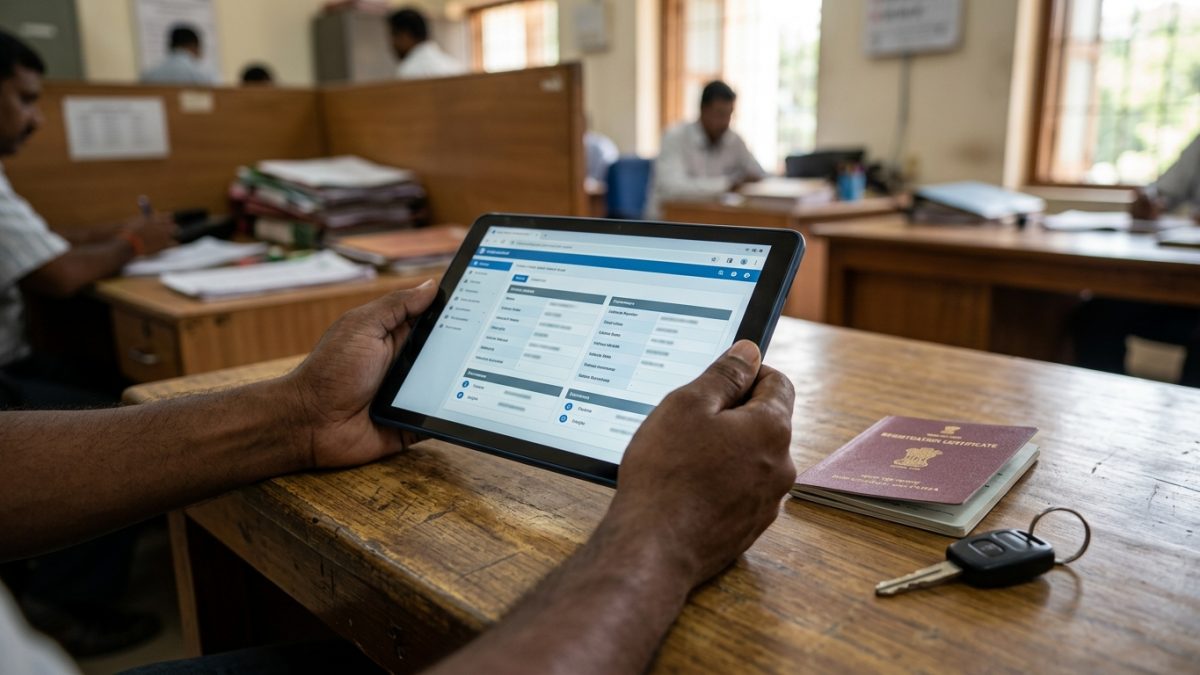
The Insurance Information Bureau of India (IIB), established by the Insurance Regulatory and Development Authority of India (IRDAI), tracks commercial insurance transactions and claims dating back to April 1, 2010. Buyers can query past insurance claims to uncover concealed accident events.
- Navigate to the portal: Open your web browser and visit iib.gov.in, then click on the V-Seva tab.
- Provide vehicle details: Enter the registration number without spaces, hyphens, or special characters.
- Input user credentials: Enter your full name, valid email address, mobile number, and residential address as prompted.
- Submit the search: View the recorded general insurer names, policy durations, and claim settlement references logged against the chassis.
Data Latency Note: General insurance providers upload underwriting and claim settlement data to IIB in periodic batches. Claim records typically exhibit an update latency of up to 60 days, meaning recent repairs may not appear immediately.
Stolen Vehicle Check Online India: NCRB & Police Portals
Buying a stolen two-wheeler or four-wheeler leads to immediate vehicle impoundment and potential criminal inquiries under Indian law. The Ministry of Home Affairs provides official clearing tools via the National Crime Records Bureau (NCRB) and the Crime and Criminal Tracking Network & Systems (CCTNS).
- Visit the official citizen portal: Navigate to digitalpolicecitizenservices.gov.in.
- Authenticate access: Select Generate Vehicle NOC, enter your name and mobile number, and submit the OTP received.
- Input technical identifiers: Select the vehicle class (e.g., 2-Wheeler or 4-Wheeler/Car) and input the registration number, full chassis number, and engine number.
- Generate the report: Click Search / Generate NOC. The system will query all linked police stations nationwide.
If the vehicle is clear, the system generates a downloadable digital PDF certificate verifying no active theft FIR or criminal seizure exists. If flagged, the portal displays the corresponding FIR number and the jurisdiction of the registering police station. As of September 2024, NCRB updated the system to include vehicle release details from police Malkhana records, ensuring lawfully recovered vehicles released by court orders are not blocked during RTO transfers.
Regional Theft Databases: Northern States and ZIPNET
If you are purchasing a vehicle in northern India, cross-verify records on the Zonal Integrated Police Network (ZIPNET). This network consolidates stolen vehicle FIRs across eight states and union territories: Delhi, Haryana, Punjab, Chandigarh, Uttar Pradesh, Rajasthan, Himachal Pradesh, and Uttarakhand.
How to Check if Car is Blacklisted in VAHAN 4.0
Under CMV Rule 55, an RTO cannot process an ownership transfer if a vehicle is blacklisted. A blacklist flag is placed on the MoRTH VAHAN 4.0 database due to pending court challans, transport enforcement compounding notices, crime branch FIRs, or bank recovery notices.
- Open Parivahan: Visit parivahan.gov.in and head to Informational Services > Know Your Vehicle Details.
- Log in to Citizen Services: Enter your mobile number to sign in via OTP.
- Run vehicle search: Enter the registration number and the security captcha.
- Evaluate the RC parameters: Verify that the RC Status is marked as ACTIVE. Watch out for status tags such as "Suspended", "Cancelled", or "Alert: Vehicle is Blacklisted".
- Check loan hypothecation: Ensure any existing bank hypothecation has an active NOC and Form 35. You can check the complete guide on hypothecation removal online process to understand how financiers close encumbrance records.
- Audit traffic fines: Head to echallan.parivahan.gov.in or run a quick query via our e-challan search tool to review pending penalties or matters referred to virtual courts.
Cost Notice: Basic RC and blacklist status checks on Parivahan are free. If you request a formal digital Form 24 vehicle extract, state transport departments charge a statutory fee between ₹50 and ₹100.
Odometer Fraud Detection: Digital Rollbacks and Mechanical Clues
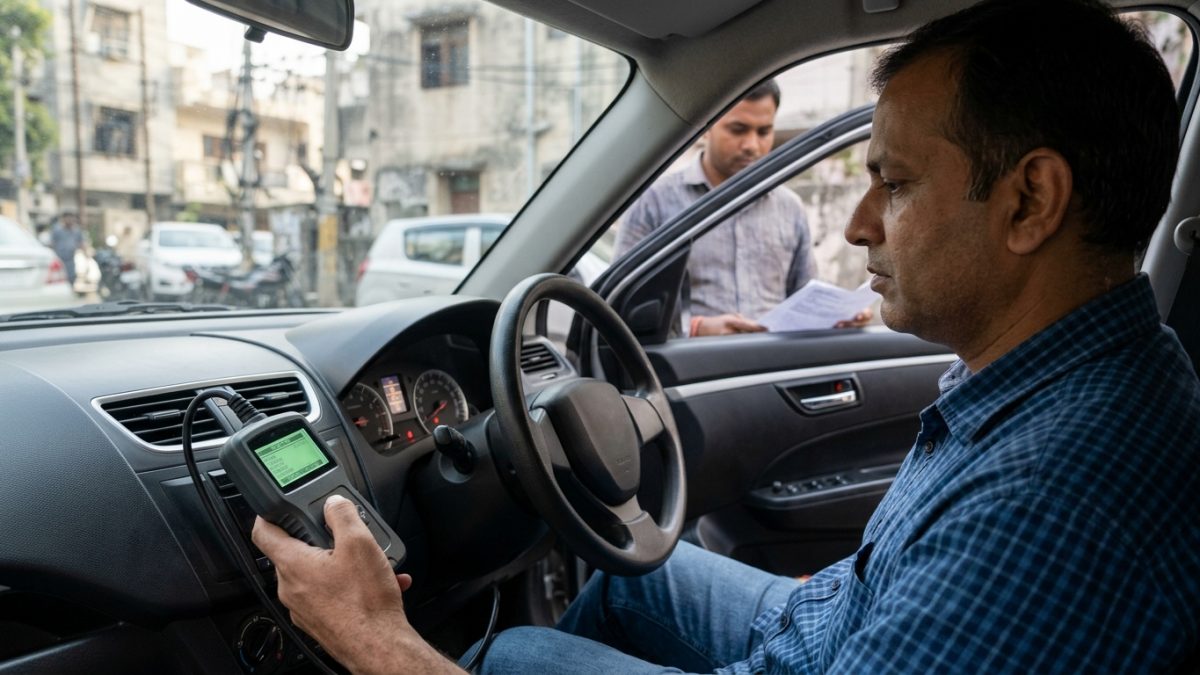
Digital odometer tampering on modern BS6 cars is an illicit practice accomplished in minutes using basic OBD-II diagnostic tools. Fraudulent sellers alter the instrument cluster EEPROM chip without realising that secondary vehicle control units continue logging actual distance data.
1. Run an ECU vs Cluster Diagnostic Scan
Modern vehicle architectures (Bosch, Continental, Denso) store mileage data across multiple control modules, including the Engine Control Unit (ECU), Transmission Control Module (TCM), and ABS/ESP module. Connect an advanced OBD-II diagnostic scanner to the car's OBD port. If the instrument cluster displays 38,000 km but the ECU or ABS module logs 74,000 km, odometer fraud is proven.
2. Cross-Verify Maintenance Timelines
Compare the dashboard mileage against recorded workshop visits. If authorized dealer service records show a routine service at 65,000 km in 2024, but the odometer reads 42,000 km in 2026, the mileage has been rolled back. For further advice on verifying documents, check our guide on second-hand car history checks.
3. Inspect Physical Touchpoints and Wear Patterns
- Tyre Manufacturing Codes (DOT): Factory-fitted tyres generally last between 35,000 and 50,000 km. If a car with an alleged 18,000 km on the clock has brand-new replacement tyres, or tyres with date codes older than the car's manufacture date, treat it as a red flag.
- Driver Control Surfaces: Inspect rubber pedal pads on the clutch, brake, and accelerator. Smooth, worn pedal surfaces, polished steering wheel leather, and collapsed seat bolsters typically indicate over 80,000 km of driving.
- Instrument Cluster Screws: Inspect the binnacle housing. Missing screw caps, rounded screw heads, or pry marks around the plastic trim indicate the cluster was removed for physical manipulation.
Check Used Bike History Online: 2-Wheeler Verification Steps
Buying a used motorcycle or scooter follows the same rigorous process. Two-wheelers in India are disproportionately involved in theft and hit-and-run incidents, making background checks essential.
- Match Engine and Chassis Stampings: Physically inspect the chassis number punched on the steering headstock and the engine number stamped on the crankcase. Ensure they match the registration certificate character for character.
- Generate NCRB 2-Wheeler NOC: Use digitalpolicecitizenservices.gov.in to ensure the motorcycle is not wanted in theft cases.
- Inspect Frame Alignment: Look for cracked paint, uneven gaps between the front fork stanchions, or frame repainting near the headstock, which indicate heavy collision impact.
- Check Chain Sprocket and Disc Wear: Deep grooves on the brake discs or sharply hooked sprocket teeth contradict low odometer readings on analogue and digital consoles.
Conclusion
Taking the time to check vehicle history India protects your hard-earned money and shields you from legal complications, structural safety hazards, and financial liabilities. Never rely solely on verbal commitments or glossy cosmetic detailing when buying a used car or two-wheeler.
Always verify the complete registration profile, insurance policy validity, and blacklisted status using our online RC check before executing sale agreements or transferring ownership funds.