Choosing the right electric scooter requires looking beyond marketing brochures and laboratory test figures. In real Indian conditions, true riding range is usually 20% to 35% lower than certified ARAI numbers, while home charging demands proper 15A electrical earthing. Before purchasing a new model or inspecting an existing vehicle on the road, buyers can verify vehicle specifications and registration status using the VahanX RC search tool.
Key Takeaways
- Real-world range delivers roughly 65% to 80% of certified ARAI/IDC lab ratings.
- Monthly charging expenses average between ₹250 and ₹350 for 1,000 km of commuting.
- Lithium batteries last 5 to 10 years depending on NMC or LFP chemistry.
- Home charging requires a 15-Amp socket with neutral-to-earth voltage below 5 Volts.
- High-speed models require RTO registration, green plates, and a driving licence.
| Feature | Low-Speed Electric Scooter | High-Speed Electric Scooter |
|---|
| Top Speed Limit | Maximum 25 km/h | Above 25 km/h (typically 65 to 105 km/h) |
| Motor Power Limit | Up to 250W (0.25 kW) continuous | Exceeding 250W |
| Driving Licence | Not required (minimum age 16) | Mandatory (MCWOG / MCWG, age 18+) |
| RTO Registration | Exempt under CMVR Rule 2(u) | Mandatory green HSRP plate |
| Typical Real Range | 45 to 60 km | 80 to 140 km |
Electric Scooter Real World Range vs ARAI Claims
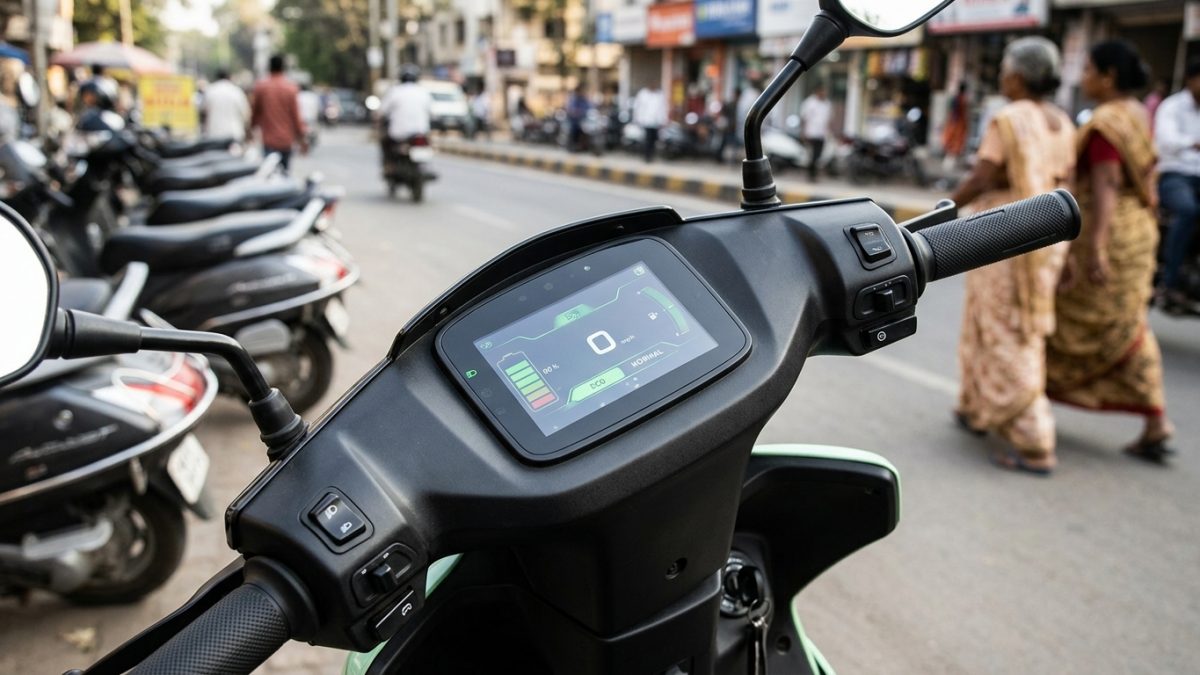
Certified range figures are evaluated in temperature-controlled laboratories under standard AIS-040 testing procedures. The testing agency conducts the Indian Driving Cycle (IDC) at around 25°C on a smooth chassis dynamometer with zero wind resistance, gentle throttle application, and a single light test load. These ideal parameters do not represent typical daily riding in Indian cities.
On regular roads, several conditions quickly reduce available battery charge:
- Ambient Heat: Peak summer temperatures between 35°C and 45°C force battery management systems to limit power to protect cells.
- Pillion Passenger: Adding 60 to 80 kg of rider weight substantially increases motor workload.
- Riding Modes: Aggressive throttle responses in Sport or Hyper modes draw high current, decreasing overall range by 25% to 40% compared to Eco mode.
- Road Elevation: Flyovers, inclines, and frequent stop-and-go traffic prevent consistent regenerative braking recovery.
As a practical rule, calculate expected real-world range at 65% to 80% of the manufacturer ARAI rating. The table below outlines how popular battery capacities translate from lab claims to street riding.
| Scooter & Battery Size | Claimed ARAI / IDC Range | Realistic City Range (Normal Mode) | Expected Variance |
|---|
| Ola S1 Pro (4.0 kWh) | ~180 – 195 km | 125 – 135 km | ~30% lower |
| Ather 450X (3.7 kWh) | ~150 km | 105 – 110 km | ~28% lower |
| TVS iQube (3.4 kWh) | ~145 km | 95 – 100 km | ~32% lower |
| Bajaj Chetak (3.2 kWh) | ~126 – 137 km | 90 – 95 km | ~29% lower |
Range Buying Tip: Select a model where 70% of its official range covers at least two full days of your daily commute so you do not experience battery anxiety.
Electric Scooter Battery Life in India: LFP vs NMC Chemistry
The traction battery pack is the heart of an electric two-wheeler. In India, manufacturers primarily rely on two distinct lithium-ion battery chemistries: NMC (Nickel Manganese Cobalt) and LFP (Lithium Iron Phosphate). Each chemistry provides specific benefits regarding energy density, weight, and thermal stability in extreme heat.
Understanding cell characteristics helps you determine long-term reliability:
- NMC (Nickel Manganese Cobalt): Favoured by models like the Ather 450 and Ola S1. These packs deliver high energy density, allowing lighter designs and longer range from compact spaces. They offer 1,000 to 1,200 full charge cycles, which equals roughly 5 to 7 years (60,000 to 80,000 km) before maximum capacity dips below 75%.
- LFP (Lithium Iron Phosphate): Used in select variants such as the Bajaj Chetak and heavy commercial fleet vehicles. LFP cells have superior thermal runaway resistance in hot weather and endure 2,000+ charge cycles, yielding an operational life of 8 to 10 years (over 1,00,000 km).
Standard factory warranties across major brands cover 3 years or 30,000 to 50,000 km. Most top manufacturers offer optional 5-year to 8-year extended warranties that guarantee a State of Health (SoH) above 70%. If you are researching top models in the market, check our guide on the best electric scooter models in India.
Electric Scooter Battery Replacement Cost and Warranties
The battery pack accounts for roughly 35% to 50% of an electric two-wheeler invoice price. Cell and pack replacement costs across India generally stand between ₹18,000 and ₹25,000 per kWh, factoring in battery enclosures, management wiring, and taxation.
Out-of-warranty battery replacement costs vary significantly by capacity:
- 2.2 kWh Battery Pack (Entry Models): ₹45,000 to ₹55,000
- 3.4 to 4.0 kWh Battery Pack (Mainstream Models): ₹65,000 to ₹88,000
- 5.0+ kWh Battery Pack (Long-Range Flagships): ₹1,00,000 to ₹1,20,000
Warranty Advice: Always purchase manufacturer extended battery warranty packages at delivery to secure coverage up to 8 years or 80,000 km against early degradation.
Electric Scooter Home Charging Setup and Safety Rules
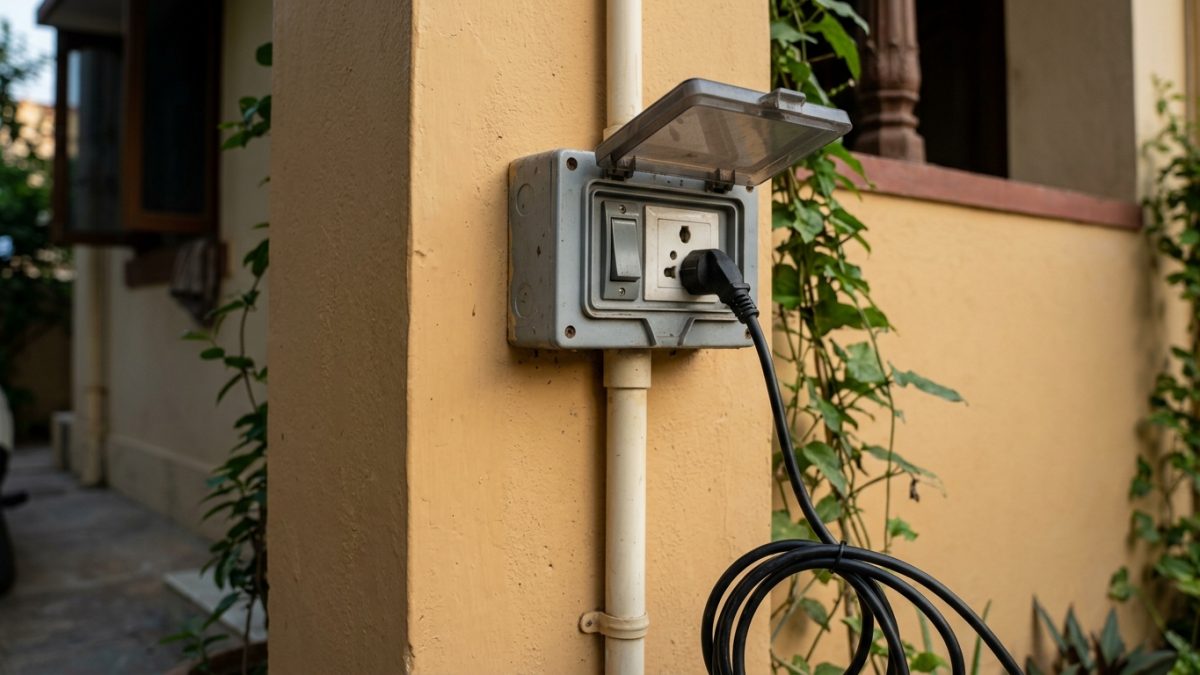
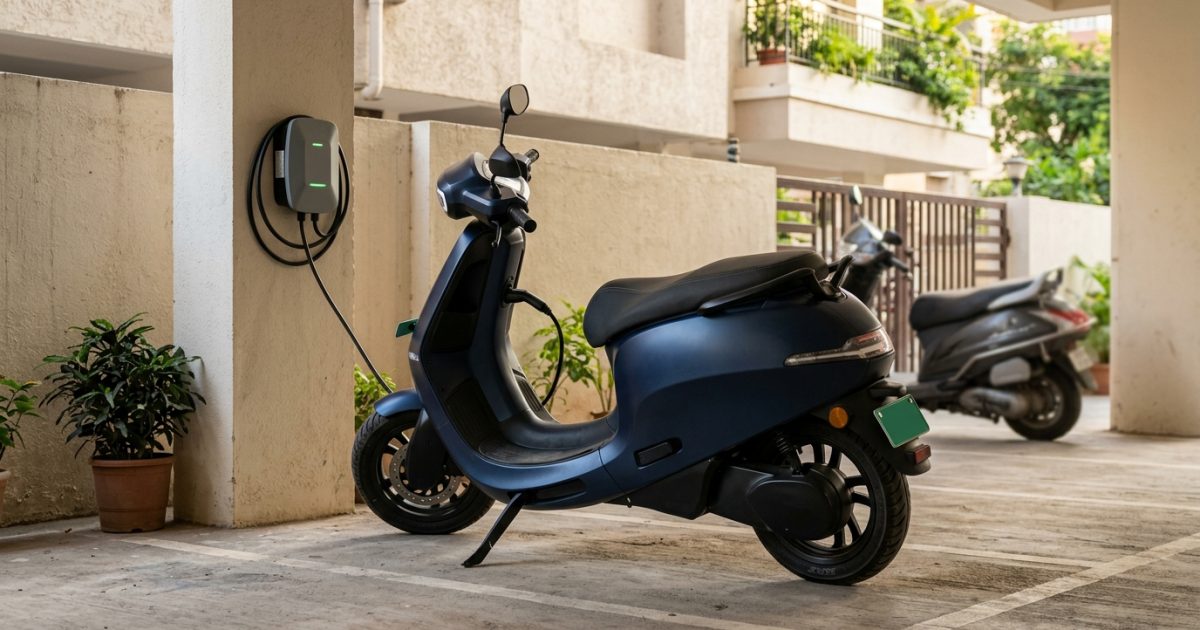
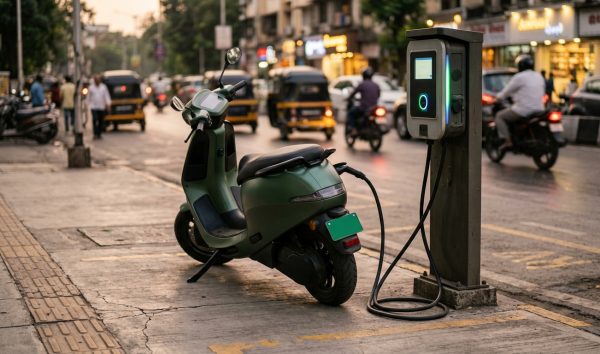
Most two-wheelers charge through portable AC units pulling 650W to 1,500W. Never connect your vehicle charger to an ordinary 5A domestic outlet. Standard 5-amp pins cannot handle continuous heavy electrical loads for 4 to 6 hours, creating severe fire and wire melting risks.
Follow this standard installation process to establish a secure home charging point:
- Mount a Dedicated 15A/16A Power Socket: Install a heavy-duty industrial 3-pin switch socket rated for 16 Amperes near your parking space, matching the plugs used for water geysers.
- Wire Directly to an Independent MCB: Run 2.5 mm² or 4 mm² fire-retardant copper wiring directly from the distribution board to an independent 16A or 20A Miniature Circuit Breaker.
- Test Ground Earthing Resistance: Engage a certified electrician to test earthing with a multimeter. Ensure neutral-to-earth voltage remains under 3 to 5 Volts AC, complying with BIS IS 3043 guidelines on earthing published on the Bureau of Indian Standards portal.
- Verify Apartment Approvals: If living in a multi-story society, submit a formal request to your Resident Welfare Association (RWA) for drawing a metered line to your basement slot.
If earthing voltage spikes above 5 Volts, modern onboard chargers will automatically trip and blink red error codes to protect sensitive electronics. For complete residential wiring advice, read our detailed guide on setting up an EV charging station at home.
Safety Warning: A floating neutral or ungrounded socket will trigger charger safety locks, preventing your vehicle from initiating a charge cycle.
Electric Scooter vs Petrol Scooter Running Cost
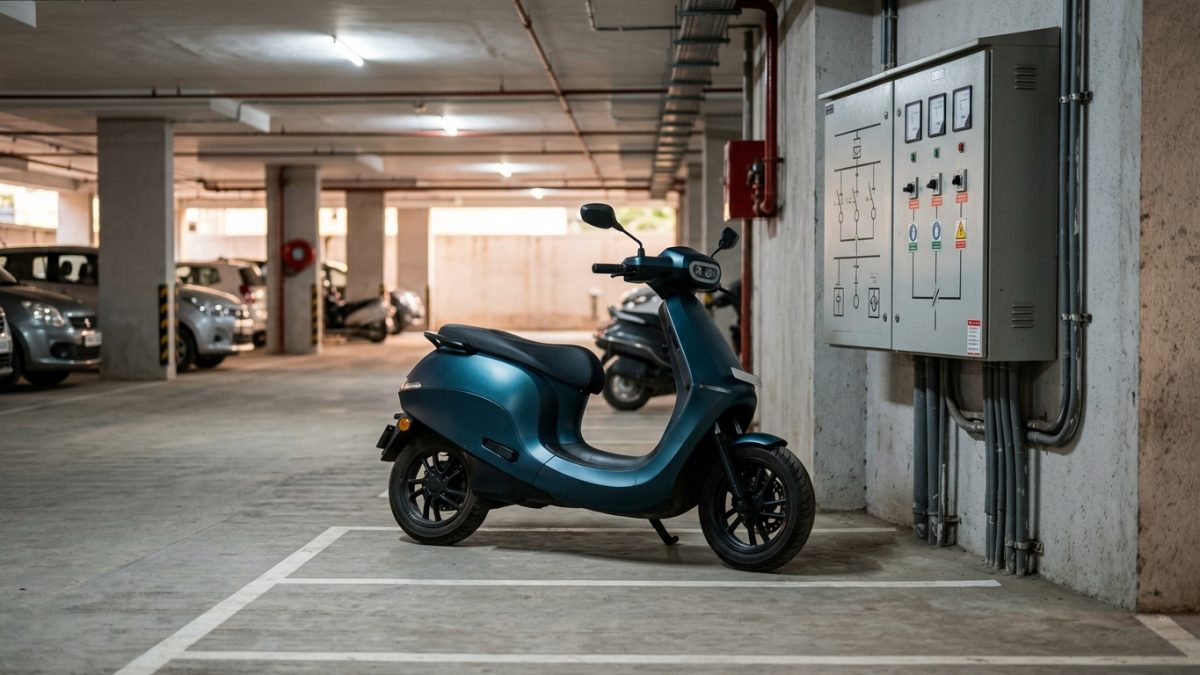
The primary financial incentive to switch to electric mobility is operational savings. While conventional scooters running on petrol incur rising fuel costs and regular fluid maintenance, electric drivetrains operate with minimal mechanical wear.
The calculation below compares an ICE scooter averaging 45 km/L (petrol at ₹100–₹105 per litre) against an electric model consuming 3.5 to 4.0 kWh per 100 km (electricity tariff at ₹7.00–₹8.50 per unit):
| Operating Expense (1,000 km Monthly) | Petrol Scooter (e.g., 110cc ICE) | Electric Scooter (3.4 kWh Pack) |
|---|
| Cost per Kilometre | ₹2.22 – ₹2.33 / km | ₹0.26 – ₹0.34 / km |
| Monthly Fuel / Energy Bill | ₹2,250 – ₹2,350 | ₹280 – ₹340 |
| Annual Fuel / Energy Cost (12,000 km) | ₹27,000 – ₹28,200 | ₹3,360 – ₹4,080 |
| Annual Scheduled Maintenance | ₹3,000 – ₹4,500 | ₹800 – ₹1,500 |
| Total Annual Operating Cost | ₹30,000 – ₹32,700 | ₹4,160 – ₹5,580 |
| Estimated 5-Year Operating Total | ₹1,50,000 – ₹1,63,500 | ₹20,800 – ₹27,900 |
Riders logging 12,000 km annually save over ₹25,000 each year in fuel and service costs. Over a 5-year ownership period, cumulative savings of ₹1,25,000 to ₹1,37,000 offset the initial purchase price and easily cover battery maintenance.
RTO Registration, Driving Licence, and PM E-DRIVE Subsidy
Before purchasing, riders must understand vehicle legal classifications under the Central Motor Vehicles Rules (CMVR), 1989. The regulatory framework separates two-wheelers into distinct compliance tiers based on motor output and maximum speed.
Legal parameters governed by the Ministry of Road Transport and Highways include:
- Low-Speed Vehicles (CMVR Rule 2u): Models limited to 250 Watts continuous power and a 25 km/h top speed do not require RTO registration, road tax, or driving licences. The minimum legal riding age is 16 years.
- High-Speed Registered Vehicles: Models capable of exceeding 25 km/h require mandatory RTO registration, high-security green registration plates (HSRP), and a minimum 5-year third-party insurance policy under Section 146 of the Motor Vehicles Act, 1988. Riders must possess a valid two-wheeler driving licence. You can quickly verify permit credentials using the VahanX driving licence search.
On the subsidy front, the Ministry of Heavy Industries introduced the PM Electric Drive Revolution in Innovative Vehicle Enhancement (PM E-DRIVE) scheme, effective October 1, 2024, running through March 31, 2028. It replaced older FAME and EMPS programs with an allocated ₹11,900 crore outlay, as confirmed by official guidelines on the PM E-DRIVE portal.
Under PM E-DRIVE rules, incentives for electric two-wheelers are set at ₹2,500 per kWh of battery capacity, capped strictly at ₹5,000 per vehicle (or 15% of ex-factory cost, whichever is lower). The vehicle ex-factory price must stay below ₹1,50,000 to qualify. Dealerships process this deduction directly on the sales invoice via Aadhaar e-KYC validation. To understand eligible models and documentation rules, read our breakdown of the electric scooter subsidy rules under PM E-DRIVE.
Subsidies Note: PM E-DRIVE allows only one subsidized vehicle purchase per individual Aadhaar number across all participating manufacturers.
Things to Check Before Buying an Electric Scooter
Taking delivery without evaluating your daily parking infrastructure or regional tax waivers can lead to unexpected expenses. Follow this clear checklist before booking your two-wheeler:
- Calculate True Daily Running Needs: Map your daily round-trip distance. Ensure the vehicle real-world city range (not claimed ARAI) covers your regular two-day commute on a single charge.
- Inspect Home Socket Earthing: Have an electrician test your designated parking socket to ensure ground earthing resistance satisfies IS 3043 codes and voltage stays below 5V.
- Decide on Battery Portability: If you live on upper floors without a dedicated basement socket, prioritize scooters with detachable, portable battery packs.
- Confirm Regional Road Tax Waivers: Check whether your state offers zero road tax exemptions or levies green taxes between 2% and 8% by checking your regional RTO office at VahanX RTO office details or visiting the official Parivahan Sewa portal.
- Review Pending Traffic Fines on Old Vehicles: If trading in an existing vehicle during exchange programs, verify clear legal standing and settle pending tickets through the VahanX challan search.
- Add Factory Extended Warranty: Confirm the extended battery protection package is documented on the final invoice to secure 5 to 8 years of cell health coverage.
Conclusion
Investing in an electric scooter delivers unmatched operating economy, reducing your per-kilometre travel costs from over ₹2.20 down to less than ₹0.35. By factoring in real-world range discounts, securing a certified 15A earthed charging socket, and opting for extended battery coverage, you can make a seamless and financially sound transition to electric mobility.
Before you finalize your booking, explore current registration requirements and check any two-wheeler background with the VahanX RC search tool to ensure your new ride is fully compliant from day one.