Key Takeaways
- Setting up an EV charging station at home is fully de-licensed across India under Ministry of Power regulations.
- An OEM-supplied 7.2 kW charger costs ₹8,000 to ₹20,000 for standard installation and protective switchgear.
- Running a 7.2 kW charger requires upgrading your domestic sanctioned load to 8 kW–11 kW with your local DISCOM.
- RWAs cannot arbitrarily deny permissions for charger installation in designated apartment parking bays.
- A separate EV electricity meter is optional but provides lower concessional unit tariffs in states like Delhi and Karnataka.
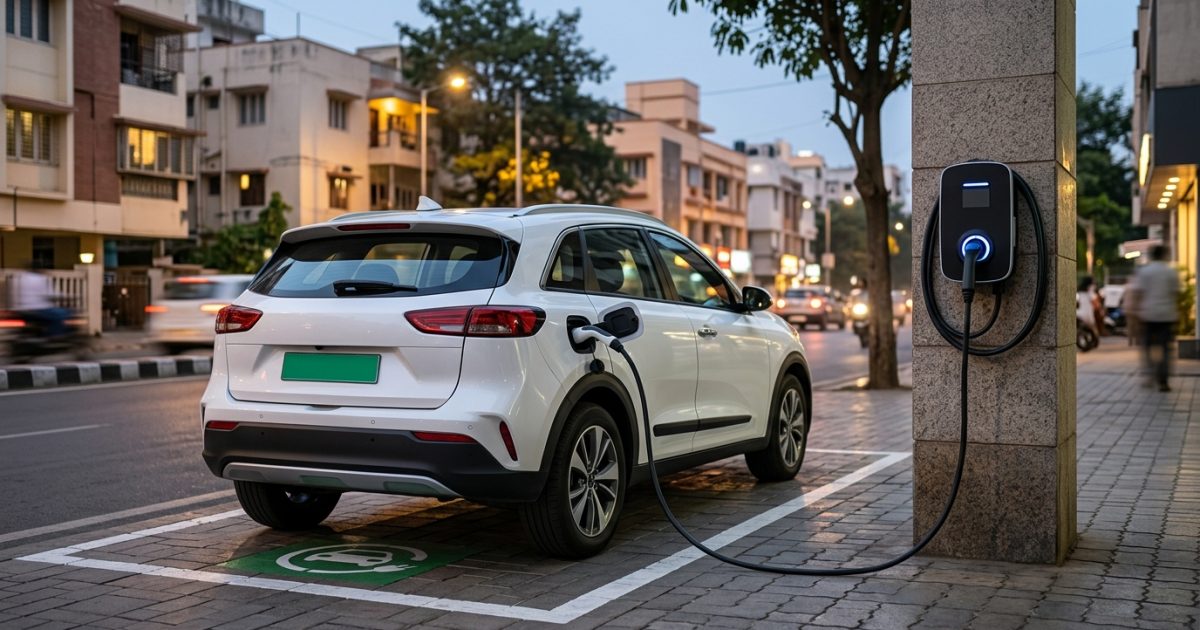
Setting up an ev charging station at home in India typically costs between ₹8,000 and ₹20,000 for basic installation if your electric car comes with an OEM charger. If you buy a separate 7.2 kW fast AC wallbox and require a sanctioned load enhancement, total expenses range from ₹45,000 to ₹85,000. Before mounting electrical hardware, vehicle owners can verify their registration status through an RC search online to ensure their vehicle particulars match their utility connection details.
| Setup Factor | 3.3 kW Slow Charger (15A/16A) | 7.2 kW – 7.4 kW AC Wallbox | 11 kW – 22 kW 3-Phase AC Charger |
|---|
| Typical Hardware Cost | ₹8,000 – ₹12,000 (often bundled free) | ₹35,000 – ₹45,000 (standard) | ₹55,000 – ₹85,000 |
| Sanctioned Load Needed | 3 kW – 5 kW (existing domestic) | 8 kW – 11 kW (single or 3-phase) | 11 kW – 25 kW (3-phase mandatory) |
| Charging Time (40 kWh Battery) | 12 – 15 hours | 6 – 8 hours | 3.5 – 5 hours |
| DISCOM Approval | Not required if load suffices | Load upgrade required | Load upgrade & phase change required |
MoP Regulatory Framework: Your Right to Charge at Home
Under the Electricity Act 2003 and the consolidated guidelines issued on 17 September 2024 by the Ministry of Power, setting up EV charging infrastructure is a completely de-licensed activity in India. Any citizen can establish an EV charging point at their residence or office without obtaining an electricity trading or generation licence.
The MoP framework explicitly protects EV owners, ensuring they can charge vehicles via their existing domestic electrical supply. If you are exploring an electric transition alongside clean mobility incentives, reviewing rules like the electric scooter subsidy guidelines can also clarify central transport policies.
For apartment dwellers, the Ministry of Housing and Urban Affairs amended the Model Building Bye-Laws to mandate that at least 20% of parking spaces in new residential developments must be EV-ready. Resident Welfare Associations (RWAs) and Apartment Owners Associations (AOAs) cannot arbitrarily deny permissions or enforce discriminatory utility fees on EV owners.
Regulatory Fact: The Ministry of Power guidelines confirm that EV charging at home does not require commercial clearances or specialized trade permits from municipal bodies.
15A Socket vs 7.4kW EV Charger: Which One Do You Need?
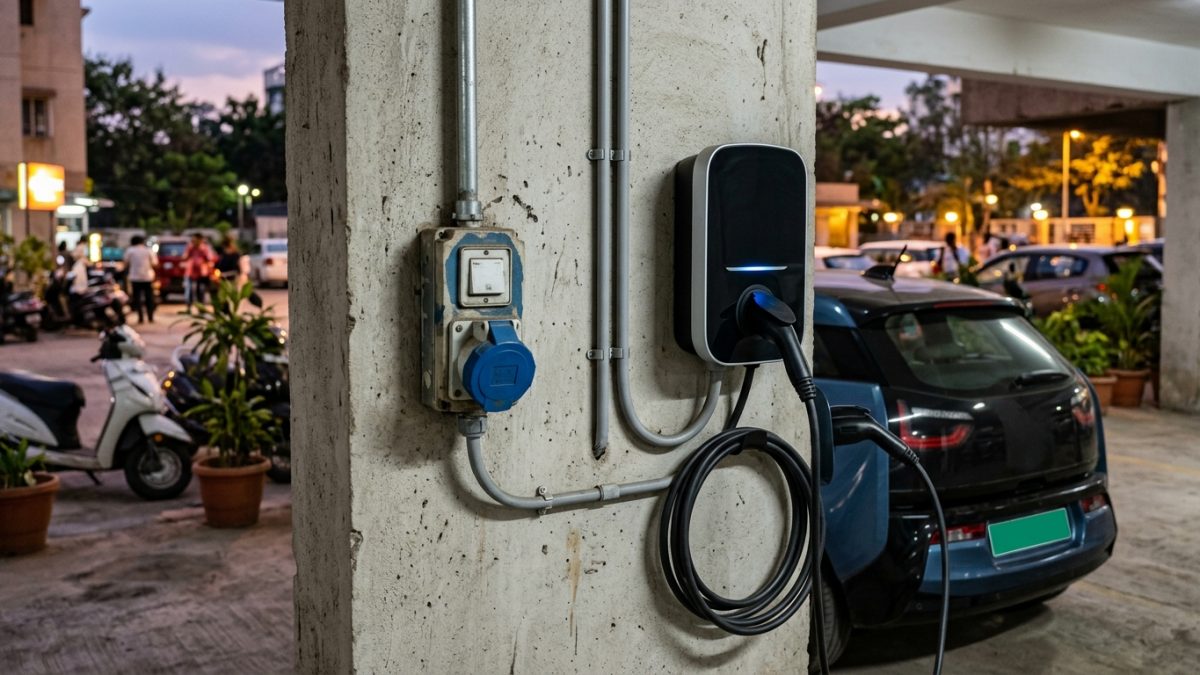
Choosing the right charging speed depends on your daily commute, battery capacity, and the existing electrical wiring in your building. Most car owners alternate between slow trickle charging and dedicated wallboxes.
Level 1: 3.3 kW AC Slow Portable Charger
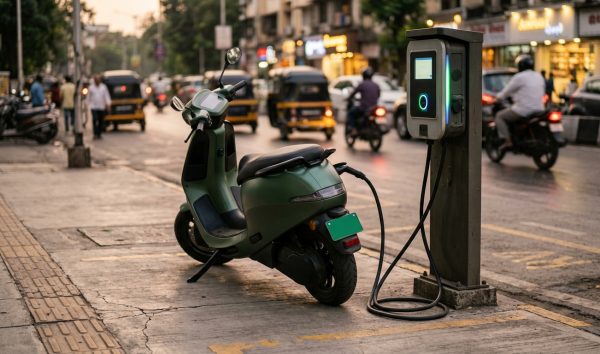
A Level 1 setup relies on a 230V single-phase supply pulling 15A to 16A of continuous current. It delivers around 2.5 kW to 3.3 kW, adding roughly 15 to 20 km of driving range per hour of charging. This is ideal for two-wheelers, small city runabouts, or overnight top-ups when your daily driving is under 50 km.
Level 2: 7.2 kW to 7.4 kW AC Fast-Home Wallbox
Operating on a 230V single-phase line at 32A, a 7.2 kW charger delivers 35 to 45 km of range per hour. It can charge a mid-size electric vehicle battery (30 kWh to 50 kWh) from zero to full in 6 to 8 hours. These units use a Type-2 connector compliant with Bureau of Indian Standards IS 17017-1 specifications.
Level 2: 11 kW to 22 kW Three-Phase Wallbox
Reserved primarily for premium EVs equipped with 11 kW onboard AC chargers, this setup runs on a 400V three-phase domestic connection drawing 16A to 32A per phase. Installing this hardware requires a heavy domestic load sanction and specialized three-phase distribution panels.
EV Charging Station Cost in India: Complete Breakdown
The total expense of a home ev charging station setup combines charging hardware, structural civil work, electrical distribution switchgear, and safety earthing. As of September 2026, prices for standard installation materials remain consistent across most Indian metros.
| Hardware & Installation Component | Price Band (₹) | Technical Purpose & Specifications |
|---|
| 3.3 kW Portable 15A Charger | ₹8,000 – ₹12,000 | Slow backup cable, generally bundled with car delivery. |
| 7.2 kW AC Wallbox (Standard) | ₹35,000 – ₹45,000 | Standard wall-mount unit without mobile connectivity. |
| 7.2 kW Smart Wallbox | ₹45,000 – ₹65,000 | OCPP compliant with RFID access, Wi-Fi, and load scheduling. |
| Armoured Copper Cable (per metre) | ₹180 – ₹300 / m | 4 sq mm to 6 sq mm 3-core copper; up to 10 sq mm for basement runs. |
| Circuit Breakers (MCB / RCCB / SPD) | ₹2,500 – ₹5,000 | 32A 2-pole MCB, 30 mA Type A RCCB, and Type 2 Surge Protector. |
| Dedicated Earthing Pit | ₹3,500 – ₹8,000 | Chemical copper electrode pit for resistance below 5 Ohms. |
| Conduit, Clamps & Civil Work | ₹1,000 – ₹3,500 | Heavy-duty rigid PVC or GI conduit pipes and mounting box. |
| Certified Electrician Labour | ₹2,000 – ₹5,000 | Cable routing, terminal tightening, load and earth testing. |
When the OEM carmaker covers the wallbox hardware, your out-of-pocket expenditure is usually limited to ₹8,000 to ₹20,000 for safety switchgear, wiring, and certified labour. However, if your parking spot is located more than 40 metres away from the main meter room, extra cable length can push overall costs by ₹15,000 to ₹30,000.
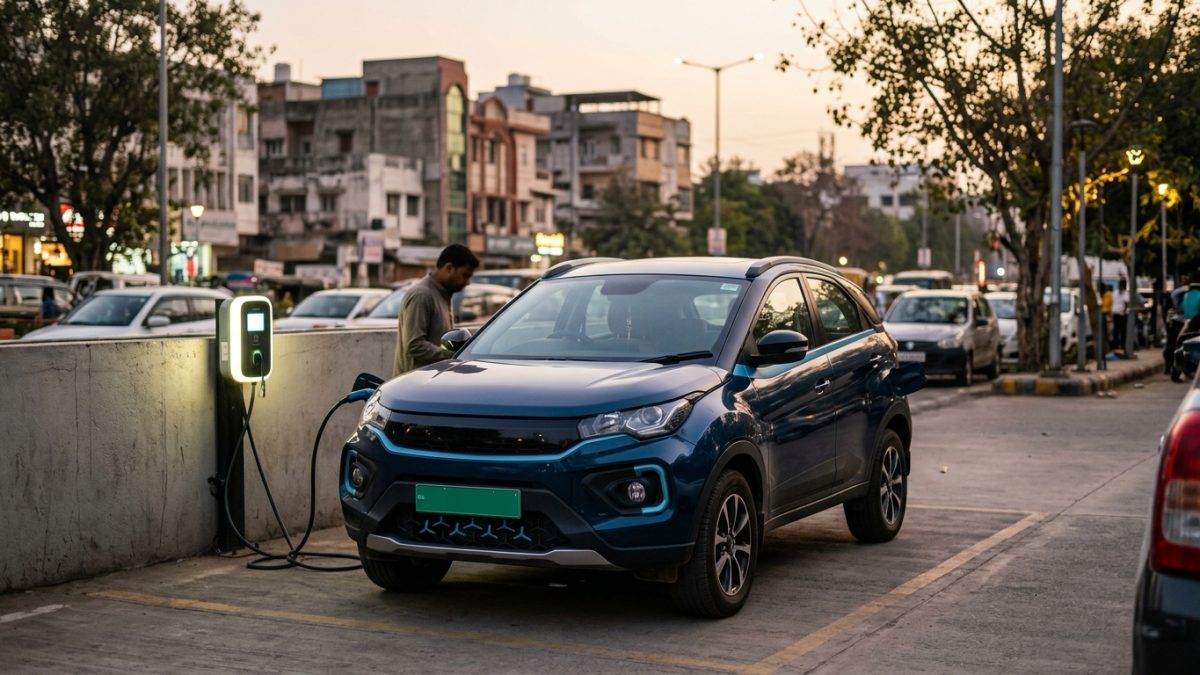
Most residential electricity connections in Indian cities come with a sanctioned load of 3 kW to 5 kW. A 7.2 kW AC wallbox pulls approximately 31A to 32A of continuous current. If you run a high-output charger alongside your air conditioners and water heaters without expanding your load, the main circuit breaker will trip, and your distribution utility will levy non-compliance demand penalties.
To support a 7.2 kW wallbox safely, you must request a discom load increase for ev charger usage, bumping your domestic capacity to 8 kW, 10 kW, or 11 kW. In most states, crossing 5 kW or 7 kW also necessitates transitioning your home from a single-phase supply to a three-phase connection.
- Log into your utility portal: Open your state electricity board consumer portal or mobile app (such as BSES or Tata Power DDL in Delhi, MSEDCL in Maharashtra, BESCOM in Karnataka, or UPPCL in Uttar Pradesh).
- Select service enhancement: Navigate to the "Change of Service" section and select "Load Enhancement / Addition", entering your Consumer Account (CA) number.
- Specify your new capacity: Enter your required sanctioned load (for instance, upgrading from 4 kW to 9 kW) under the Domestic Low Tension (LT) tariff category.
- Upload documents: Submit your ownership deed or recent electricity bill, identity proof (Aadhaar or PAN), and an installation test certificate prepared by a Licensed Electrical Contractor (LEC).
- Pay statutory fees: Settle the load enhancement charges and security deposit online via net banking or UPI.
- Schedule meter upgrade: A DISCOM technician will visit your premises within 7 to 15 business days to verify the incoming service wire and replace the single-phase meter with a three-phase LT smart meter.
Cost Rule: State DISCOM load enhancement charges generally average ₹1,000 to ₹2,500 per additional kW. Upgrading by 5 kW typically requires ₹6,000 to ₹15,000 in fixed line charges and refundable deposits.
Separate Electricity Meter for EV Charging vs Existing Domestic Meter
You do not need a separate electricity meter for ev charging by law. You are permitted to run a dedicated circuit straight from your existing domestic energy meter. However, opting for a second meter under the dedicated LT-EV tariff can significantly reduce your electric car home charging electricity bill.
In many Indian states, residential electricity billing uses tiered slabs. If your household consumption already reaches the upper slab of 400 to 500 units—where rates hover between ₹8 and ₹11 per kWh—every unit used by your car is billed at that highest rate. A second EV-specific meter routes charging under fixed, flat concessional rates.
| State / DISCOM Authority | Dedicated EV Charging Tariff | Standard Domestic Top Slab | Fixed Monthly Demand Charges |
|---|
| Delhi (BSES / Tata Power DDL) | ₹4.50 / kWh | ₹6.50 – ₹8.00 / kWh | ₹0 / kW for dedicated EV line |
| Karnataka (BESCOM) | ₹5.00 / kWh | ₹7.00 – ₹8.50 / kWh | Nominal fixed charges apply |
| Gujarat (UGVCL / DGVCL / PGVCL) | ₹4.10 – ₹5.00 / kWh | ₹5.50 – ₹6.80 / kWh | Standard domestic fixed fee |
| Maharashtra (MSEDCL) | ₹7.50 – ₹8.95 / kWh | ₹11.00 – ₹14.00 / kWh | Time-of-Day (ToD) off-peak discounts |
To acquire a dedicated EV meter, apply through your DISCOM portal under the "LT - EV Charging" category. You will need your premises ownership papers, electricity bill, identity proof, and your vehicle registration certificate or dealer booking slip. Initial meter installation fees range from ₹2,500 to ₹6,000.
How to Install EV Charger at Home India: Independent Houses vs Apartments
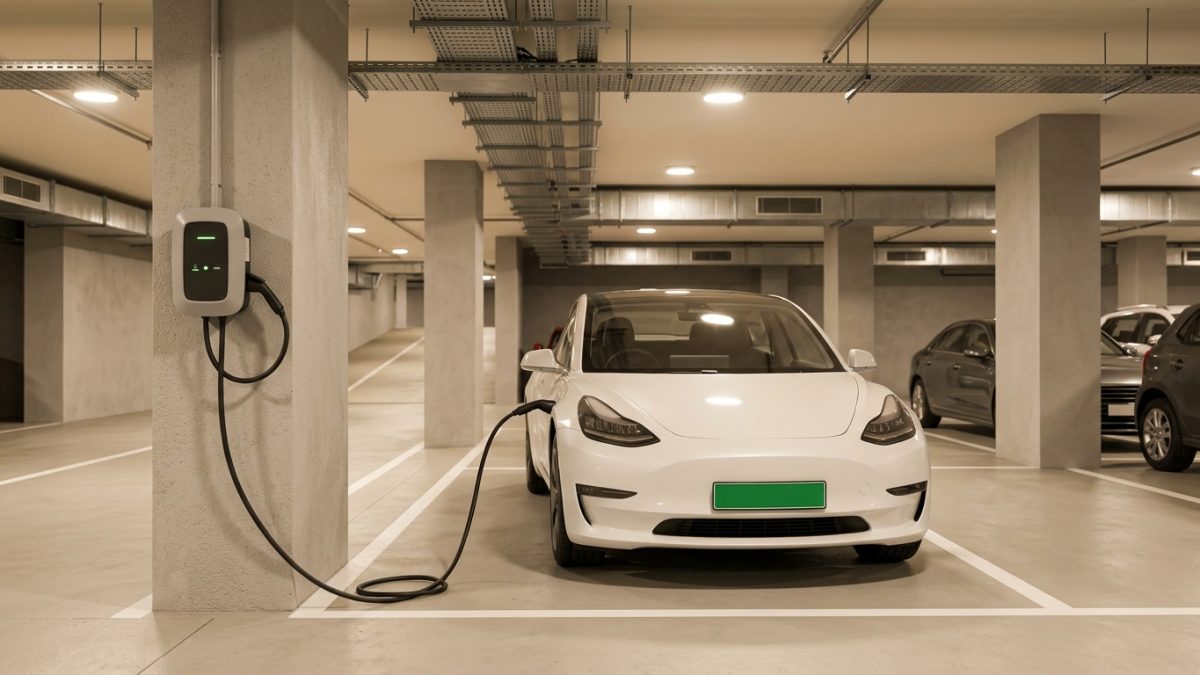
The exact installation blueprint depends on whether you reside in an independent property or a gated high-rise complex. Understanding how to install ev charger at home india saves substantial time during electrical site surveys.
1. Independent Houses and Villas
Detached bungalows and independent villas offer the simplest setup path since you do not need society approvals or long cable pathways:
- Perform a site assessment: Inspect your main distribution board, incoming service cable thickness, and current sanctioned load.
- Mount an auxiliary sub-board: Install a dedicated enclosure next to your main board containing a 32A MCB, a 30 mA RCCB, and a Type 2 Surge Protection Device.
- Run armoured cabling: Lay 3-core 6 sq mm copper cable inside weatherproof GI or rigid PVC conduit from the distribution board to your parking porch.
- Secure the wallbox: Mount the AC charger at a height of 1.2 to 1.5 metres from the finished floor level to guard against water ingress and splashing.
- Commission and test: Connect the dedicated earthing cable, power up the wallbox, and verify that the residual current device trips correctly during a fault simulation.
2. EV Charger Installation in Apartment Parking
Navigating ev charger installation in apartment parking lots involves coordinating with your RWA and routing wiring through shared utility shafts:
- Survey the meter room distance: Measure the physical distance from your assigned basement or stilt parking slot to the residential meter room.
- Submit a formal intimation to the RWA: Present a technical plan containing the charger’s ARAI/BIS certification, an electrical single-line diagram (SLD), and the licensed installer’s credentials.
- Select your power supply route: Choose between pulling an armoured cable directly from your flat’s existing basement energy meter or applying for a second dedicated DISCOM EV meter in the utility panel.
- Lay cabling along designated trays: Fasten armoured copper cables along society ceiling cable trays using proper fire-retardant clamps, leaving no loose wiring exposed.
- Install an isolated lockable enclosure: Position the wallbox inside a locked, weatherproof box or activate RFID access to prevent unauthorized power tapping.
State RWA Norms: In Maharashtra, the Department of Co-operation mandates that housing societies must issue an EV charging NOC within 7 days of application, or it is deemed approved. In Delhi, state EV policy explicitly bars RWAs from rejecting legitimate home charging applications.
Electrical Safety Standards and Common Pitfalls
The Central Electricity Authority enforces stringent safety regulations governing electric vehicle supply equipment. Skipping core safety measures can endanger your home wiring and void vehicle warranties.
Critical Grounding and Earthing Requirements
Electric vehicle chargers continuously monitor ground loop integrity. According to CEA guidelines, earth loop resistance must measure strictly below 5 Ohms. If your property's existing earthing is worn or shared with outdated domestic lines, you must install an independent chemical copper earthing pit.
Shock and DC Fault Protection
Standard household circuit breakers only trip during thermal overloads or short circuits. To prevent electrocution from alternating current and direct current leakages, you must install a 30 mA Type A RCCB featuring 6 mA smooth DC fault detection, or a dedicated Type B RCCB. A Type 2 Surge Protection Device (SPD) is also necessary to protect the car’s internal Battery Management System (BMS) against sudden grid voltage spikes.
Why You Should Avoid Generic 15A Sockets
Standard household 15A wall sockets are designed for intermittent appliances like electric irons or microwave ovens that run for 15 to 30 minutes. An electric car draws 13A to 15A continuously for 10 to 14 hours. Under this persistent thermal load, standard socket pins soften, scorch, and create fire hazards. If you must use slow charging, install an industrial-grade IEC 60309 standard 16A socket wired with 4 sq mm copper cables directly to your main panel.
Before finishing your garage installation, make sure your vehicle documents are up to date and resolve any pending citations through a quick e-challan status check. If you need assistance verifying your registration data during a utility inspection, you can double-check your vehicle particulars with an online RC verification to ensure all ownership details match your DISCOM service records.
Conclusion
Installing an ev charging station at home provides the ultimate convenience for electric car ownership, ensuring your vehicle charges securely and economically overnight. By upgrading your DISCOM sanctioned load, using heavy-duty 6 sq mm armoured copper cables, and adding certified RCCB safety breakers, you protect your property while optimizing battery life.
Evaluate your daily commute to pick between a standard 15A industrial socket and a 7.2 kW smart AC wallbox. Check your state electricity tariff slabs today to determine if a separate concessional EV meter makes financial sense for your household.