Verifying all essential used car documents is the only foolproof way to avoid inheriting unpaid bank loans, pending traffic fines, or a blacklisted vehicle. Before paying a seller, you must inspect the original Registration Certificate (RC), RTO transfer forms (Form 29 and 30), a loan clearance certificate (Form 35), active insurance, and a valid PUC.
Never rely on a stamp-paper agreement or delivery note. Under Indian law, legal ownership transfers strictly when the regional transport office updates the vehicle record. You can start by running an instant check on VahanX RC search to verify the registered owner name and hypothecation status before meeting the seller.
Key Takeaways
- Stamp paper agreements do not grant legal vehicle ownership in India.
- Always demand the physical, original smart card RC before paying.
- A vehicle with an active loan requires Form 35 and bank NOC.
- Pending challans sent to court must be cleared by the seller.
- Intra-state RC transfers must be reported within 14 days of sale.
| Document | Purpose | Mandatory Before Payment | Authority / Rule |
|---|
| Original RC | Proves legal ownership and vehicle specs | Yes | Section 50, MV Act |
| Form 29 & 30 | Notifies and applies for RC transfer | Yes | Central Motor Vehicles Rules |
| Form 35 & Bank NOC | Removes bank hypothecation/loan lien | Yes (if financed) | Rule 61, CMVR |
| Insurance Policy | Protects against damage and liabilities | Yes | Section 146, MV Act |
| PUC Certificate | Confirms vehicle emission compliance | Yes | Rule 115, CMVR |
Complete Used Car Documents Checklist: Physical Papers to Verify
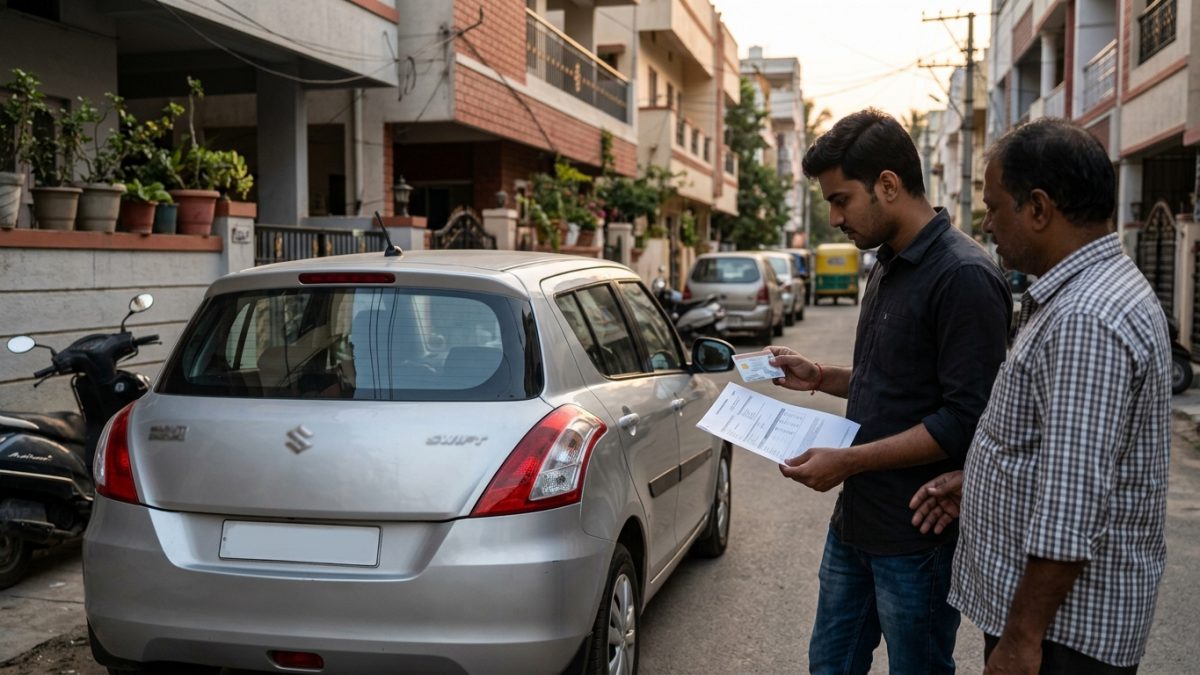
When purchasing a pre-owned vehicle, inspecting original hard copies is non-negotiable. Scans, laminated photocopies, or mobile screenshots are not valid proofs of ownership at an RTO.
Use this comprehensive used car documents checklist to scrutinize every paper the seller provides before negotiating or executing a sale agreement.
Original Registration Certificate (RC)
The original RC smart card contains critical parameters that must match the vehicle precisely. Inspect the owner name, vehicle class, chassis number, engine number, fuel type, and manufacturing year.
Check the emission norm rating (BS4 or BS6) and registration validity. Crucially, review the hypothecation field at the bottom of the card to see if an active bank lien exists.
Warning: Never accept a seller claim that an RC is misplaced or will be delivered later. Without an original RC, the RTO will reject your transfer application outright.
If the vehicle was bought on an auto loan, verify that the debt is fully cleared. You must collect two signed copies of hypothecation clearance form 35 alongside the bank's original No Objection Certificate (NOC).
Most financial institutions issue an NOC that remains valid for only 90 days from the date of issue. Ensure the NOC has not expired; otherwise, the RTO will refuse to cancel the bank endorsement.
Used Car Insurance Transfer Rules and Policy Inspection
Review the existing insurance policy to determine whether it provides comprehensive or standalone third-party cover. Under established used car insurance transfer rules, you have 14 days from the date of RC transfer to transfer the policy to your name.
Scrutinize the No Claim Bonus (NCB) percentage on the policy schedule. If the NCB is 0%, it indicates that the seller likely lodged insurance claims, which warrants asking questions about past collision repairs.
Valid PUC Certificate and Road Tax Receipts
Every vehicle on Indian roads must hold an active Pollution Under Control (PUC) certificate. The PUC certificate confirms that exhaust emissions meet Central Motor Vehicles Rules standards.
Verify that the testing center details, vehicle registration number, and validity dates are legitimate. You should also verify the road tax payment receipt, especially for commercial-to-private converted vehicles or interstate vehicles.
Identity Proof and Service History Logs
Collect self-attested identification documents from the registered owner, such as an Aadhaar card, Voter ID, or Passport. The signature on the identity proof must match the signatures on the RTO transfer forms.
Request authorized dealership service logs and repair invoices. Matching the scheduled service dates and kilometer records against the physical odometer will help you spot odometer rollback fraud.

Executing the correct statutory notices ensures that legal title passes from the seller to the buyer. Without these forms, the transport authority cannot recognize your purchase.
You can download blank forms directly from the Parivahan downloadable forms portal for submission.
The form 29 and 30 used car transfer process starts with Form 29, which serves as the official notice of transfer of ownership. The registered owner submits this form in duplicate to the local RTO.
Form 29 formally informs the registering authority that the vehicle has been handed over to the buyer. Both copies must carry the genuine signatures of the registered seller.
Form 30 is the formal application and intimation of transfer submitted by the purchaser. This form confirms that you have bought the car and request the RTO to issue a new RC smart card in your name.
Form 30 is submitted in duplicate along with valid insurance, PUC, identity proofs, and address documentation. For a deeper breakdown of online workflows, consult our guide on RC transfer online.
If the buyer resides under a different RTO jurisdiction or across state borders, Form 28 is mandatory. It serves as an application for the grant of a No Objection Certificate from the originating RTO.
Form 28 must be submitted in triplicate (or quadruplicate if the car had a loan). The parent RTO verifies that the vehicle is free from theft reports and tax dues before granting clearance.
Timeline: An NOC issued under Form 28 is valid for up to 6 months. File your re-registration application in the new state before this validity expires.
Step-by-Step Used Car RC Verification Online

Physical inspection alone is not enough, as paper documents can be forged. Conducting a used car rc verification online cross-references the official records held in the central Vahan database.
Follow this exact process to inspect the vehicle profile through official transport channels:
- Access the Parivahan portal: Visit the official portal at parivahan.gov.in and select Informational Services.
- Navigate to vehicle lookup: Click on the Know Your Vehicle Details tab and log in using your registered mobile number.
- Enter registration details: Type the full vehicle registration number and complete the security captcha verification.
- Inspect hypothecation status: Check the Financier / Hypothecation field. If an active bank appears, the loan has not been closed on government records.
- Match engine and chassis digits: Compare the masked chassis and engine numbers shown on the portal against the physical RC and engine stamping.
Tip: You can also link the car on the mParivahan mobile app using the vehicle number and the last 5 digits of the chassis number for a full digital RC view.
Check Vehicle History India: Pending Challans and Blacklist Status
Buying a pre-owned car without checking past enforcement actions can leave you liable for expensive traffic fines. It is vital to check vehicle history india before agreeing on the final sale price.
Enforcement agencies across India log unresolved traffic violations, road tax defaults, and police complaints directly onto the Vahan registry.
Checking Unpaid Traffic E-Challans
Ensure there are no pending notices that could prevent the transfer of ownership. You can run a quick check on VahanX challan search or visit the Ministry portal.
- Open the challan portal: Go to the official portal at echallan.parivahan.gov.in and click on Check Challan Status.
- Query by vehicle number: Enter the registration number alongside either the engine number or chassis number.
- Review the violation ledger: Inspect all unpaid offenses, total dues, violation dates, and the specific issuing traffic jurisdictions.
Pay close attention to challans flagged as Sent to Virtual Court or Regular Court. These violations cannot be settled at ordinary RTO counters and require prior resolution before the RTO approves ownership transfer.
Detecting Blacklist and Police FIR Status
An RTO will instantly freeze any vehicle transaction if the chassis number is blacklisted. A vehicle may be blacklisted due to unresolved road tax arrears, commercial permit violations, or a stolen vehicle FIR.
Log in to the Vahan Citizen Services portal at vahan.parivahan.gov.in to review pending blacklisting entries. If the vehicle is subject to a court stay order or custody dispute (Superdari), walk away from the deal immediately.
Clearing Linked FASTag Liabilities
Under current transport rules, pending toll arrears tied to an electronic toll collection tag can complicate transfer clearance. Ensure the seller removes or deactivates their existing FASTag from the vehicle's chassis prior to hand-off.
Can a Used Car Be Transferred Without the Seller Original RC?
A frequent question among buyers is whether a car can be transferred if the seller has lost the original registration certificate. Under the Motor Vehicles Act, an RTO will never process an ownership transfer using photocopies or digital screenshots alone.
If the original RC is missing, the seller must resolve the documentation deficiency through the prescribed legal channel before transferring the car:
- File a police missing report: The registered seller must lodge a formal online or offline police report for the lost document.
- Submit Form 26 to the RTO: The seller must apply for a duplicate RC using Form 26, backed by the police report, valid insurance, and an affidavit.
- Await duplicate smart card delivery: The RTO prints and delivers a Duplicate RC to the seller, typically taking 15 to 30 days.
- Initiate transfer paperwork: Once the duplicate smart card is in hand, the seller and buyer can proceed with Form 29 and 30.
Warning: Beware of brokers claiming they can transfer ownership without the physical RC card. This tactic is often used to offload stolen or encumbered vehicles.
Statutory Timelines, RTO Fees, and Late Penalties
The Motor Vehicles Act, 1988, enforces strict deadlines for reporting the sale of motor vehicles. Missing these cut-offs leads to recurring monthly financial penalties for both parties.
The table below breaks down statutory timeframes, baseline fees under Central Motor Vehicles Rules, and delay penalties as of September 2026:
| Transaction Component | Statutory Deadline | Standard Fee (LMV/Car) | Penalty for Delay |
|---|
| Intra-State RC Transfer | Within 14 days of sale | ₹150 to ₹300 (Base Fee) | ₹500 per month delay |
| Inter-State Transfer | Within 45 days of sale | ₹150 to ₹300 + State Taxes | ₹500 per month delay |
| Smart Card Printing | At time of transfer | ₹200 | Not applicable |
| Hypothecation Removal (HP) | With loan closure | ₹100 to ₹200 | Prevents clean title transfer |
| Speed Post / Postal Fee | At application dispatch | ₹30 to ₹50 | Not applicable |
Driving an unregistered vehicle or operating with an outdated RC violates Section 39 and Section 192 of the MV Act. Traffic police can impose fines up to ₹5,000 for the first violation and up to ₹10,000 for subsequent offenses.
Critical Red Flags Before Finalizing the Purchase
Even if the seller presents all required second hand car documents required for transfer, certain red flags demand immediate caution. Protect your financial investment by verifying these scenarios:
- Unmatched chassis stampings: If the metal chassis numbers stamped on the engine firewall or B-pillar show signs of tampering or grinding, do not buy the vehicle.
- Unresolved Superdari status: Vehicles released from police custody on interim bonds (Superdari) cannot be legally sold until the underlying court proceedings conclude.
- Pre-signed blank transfer forms: Avoid deals with third-party brokers holding open Form 29/30 sheets signed by an unverified owner who is not present.
- Delhi-NCR age limits: Diesel cars older than 10 years and petrol cars older than 15 years cannot be transferred or driven in Delhi-NCR under environmental mandates.
- Inter-state road tax obligations: Transferring a car to another state requires paying pro-rata road tax (4% to 18% of depreciated value) in the receiving state.
Online Faceless Verification vs Physical Submission
RTO processes are progressively shifting toward faceless digital workflows across multiple Indian states. Understanding your state's operating procedure helps prevent processing delays.
| Workflow Type | Applicable States (e.g.) | Submission Mode | Physical Visit Needed |
|---|
| Aadhaar e-KYC (Faceless) | Delhi, UP, Maharashtra, Karnataka | Digital upload + OTP validation | No (subject to clear documents) |
| Semi-Online Workflow | Rajasthan, Haryana, Kerala | Online fee + Physical paper delivery | Yes, counter drop or speed post |
| Manual Submission | Select regional RTOs | Physical counter verification | Yes, both parties or representatives |
In faceless states, both seller and buyer authenticate their identities via Aadhaar-linked OTPs. However, in states requiring physical verification, you must submit original documents and chassis pencil imprints at the RTO counter.
Before signing the final papers, always run a comprehensive history review on VahanX RC search to verify that the vehicle details, fitness validity, and ownership count match the seller's claims.
Conclusion
Securing genuine used car documents is the most critical step in purchasing a pre-owned vehicle in India. Take the time to inspect physical cards, verify chassis stampings, clear all outstanding court fines, and execute Forms 29, 30, and 35 properly.
Before you hand over your hard-earned money, make sure you perform an independent digital check on VahanX to verify ownership, confirm loan clearance, and ensure a completely smooth RTO transfer experience.