Key Takeaways
- Verify ownership status, active hypothecation loans, and blacklisting via the Parivahan portal before making any payment.
- Match physical 17-digit chassis and engine numbers against the original Registration Certificate (RC) to prevent cloned vehicle fraud.
- Check e-challan portals to ensure all pending traffic fines and virtual court notices are settled by the seller.
- Inspect the motorcycle on a cold start for blue smoke, worn chain sprockets, and old tyre manufacturing dates.
- Submit Form 29 and Form 30 to the RTO within 14 days of purchase to complete statutory ownership transfer.
A reliable used bike buying checklist requires verifying vehicle registration records online, matching physical frame numbers, running a comprehensive mechanical inspection, and filing the mandatory RTO transfer forms within 14 days. Before you exchange cash, verify the bike's history, active hypothecation, and insurance details online using VahanX RC search to confirm the seller is the genuine registered owner.
| Verification Phase | Key Checks | Required Documents / Portal | Statutory Deadline |
|---|
| Digital Background | Owner serial, loan hypothecation, blacklisting, challans | Parivahan Sewa, NextGen eChallan | Before paying booking token |
| Physical Inspection | Chassis punch, cold start, smoke, chain, tyre DOT code | Original RC card, pencil trace sheet | During physical inspection |
| Paperwork Exchange | Identity match, Form 29/30 signing, bank NOC | Sale agreement, Form 29, Form 30, Form 35 | At vehicle delivery |
| RTO Ownership Transfer | Fee payment, biometric e-KYC or postal file submission | Parivahan portal or jurisdictional RTO | 14 days (intra-state) / 45 days (inter-state) |
Phase 1: Second Hand Bike Verification Online
Never rely solely on verbal claims or paper photocopies from a private seller or broker. Online verification confirms whether the bike is legally cleared for resale or tied up in financial and judicial liabilities.
1. Parivahan RC Status Check
Log on to the official MoRTH Parivahan Portal under informational services or use the mParivahan application. Enter the vehicle registration number to inspect the live national VAHAN register.
- Owner Serial Number: Check whether the seller is the 1st, 2nd, or 3rd owner. A vehicle changing hands multiple times within short intervals depreciates value and may conceal recurring mechanical defects.
- Vehicle Status: The status must show "Active". If the system flags the registration as "Suspended", "Stolen", "Scrapped", or "Blacklisted", walk away immediately.
- Tax Validity: Ensure that Lifetime Road Tax (LTT) shows as fully paid. Unpaid commercial or quarterly taxes become the new buyer's legal liability.
Warning: If the seller's name on their government ID does not match the registered owner name on the VAHAN database, avoid the deal. Never buy bikes via open-letter or blank transfer forms.
2. Hypothecation (Bank Loan) Check
Examine the financier field on the VAHAN record. If a commercial bank or NBFC is recorded under hypothecation, the two-wheeler remains the legal property of the lender.
The current owner must fully clear the loan balance. They must supply two signed copies of Form 35 alongside a formal bank No Objection Certificate (NOC) to remove the hypothecation at the RTO.
3. Traffic Challans and Court Cases
Unsettled traffic violations follow the vehicle, not the driver. Before closing the price, run an online e-challan status check using the registration number and the last five digits of the chassis number.
Verify that there are no pending compound fines or summons referred to Virtual Courts or National Lok Adalats. State RTO systems automatically freeze ownership transfer applications if unpaid e-challans remain logged against the vehicle.
| Portal / Tool | Verification Focus | Critical Field to Inspect | Red Flag Warning |
|---|
| Parivahan VAHAN | Registration Validity | Vehicle Status & Owner Count | Status marked Blacklisted or Suspended |
| Parivahan Hypothecation | Lender Claims | Financier Name | Active loan without Form 35 and Bank NOC |
| NextGen eChallan | Traffic Penalties | Pending Challan Count & Amount | Unpaid fines or active Virtual Court cases |
| City Traffic Portals | Local Spot Violations | Local Municipal Camera Notices | Unsynced local camera fines (e.g., Delhi, Bengaluru) |
Phase 2: Documents Required to Buy Second Hand Bike
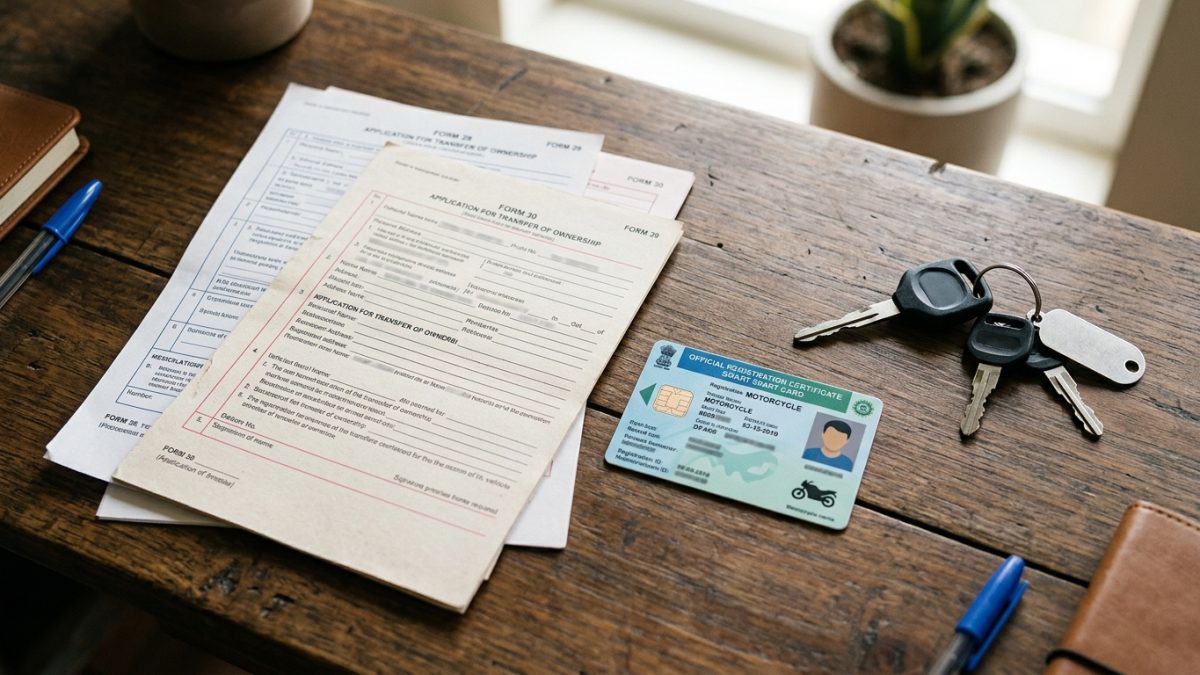
Missing or defective paperwork can prevent you from registering the motorcycle under your name. When organizing your used bike buying checklist, ensure the seller hands over these authentic documents.
Mandatory RTO Transfer Documents
- Original Registration Certificate (RC): Laminated card or smart card containing legible details of frame, engine, and ownership.
- Form 29: Notice of transfer of ownership, signed in duplicate by the registered seller.
- Form 30: Application for intimation and transfer of ownership, signed in duplicate by both seller and buyer.
- Valid Insurance Policy: Active third-party or comprehensive policy document showing policy dates and vehicle details.
- Pollution Under Control (PUC) Certificate: An active PUC test recorded on the national online database.
- Chassis Pencil Imprint: Clear physical tracing of the chassis serial taken directly from the motorcycle frame using a soft graphite pencil.
If the motorcycle had a loan or is being moved across state lines, you must collect specialized clearance certificates.
- Form 35 and Bank NOC: Mandatory if the vehicle RC carries an active hypothecation mark.
- Form 28 (Triplicate): Mandatory RTO No Objection Certificate issued by the parent RTO for inter-state transfers.
- Crime Bureau Clearance: Certain states require an NCRB police report certifying the motorcycle has not been linked to criminal cases.
- Sale Agreement / Delivery Challan: Executed on stamp paper recording the exact hour, date, meter reading, and sale price to establish clear transfer of physical custody.
Pro Tip: Under Section 157 of the Motor Vehicles Act, third-party insurance transfers automatically for 14 days, but Own Damage cover does not. You must submit an endorsement request to the insurer within 14 days to keep accidental damage protection active.
Phase 3: Chassis Number Check and Physical Verification
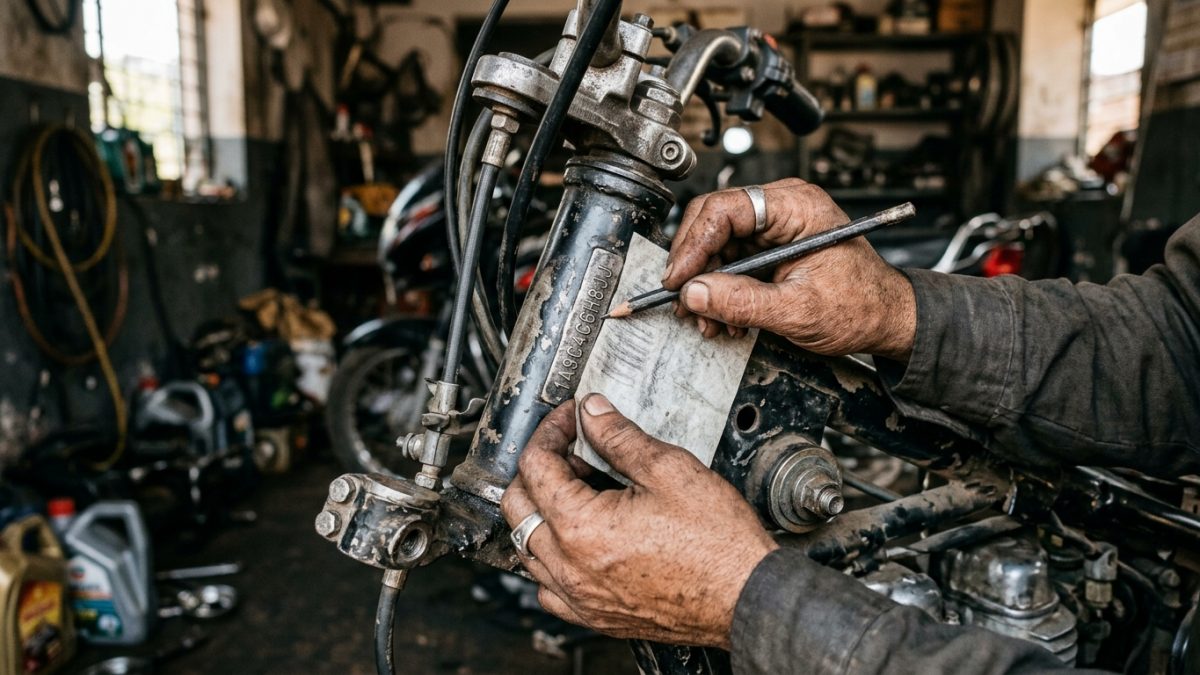
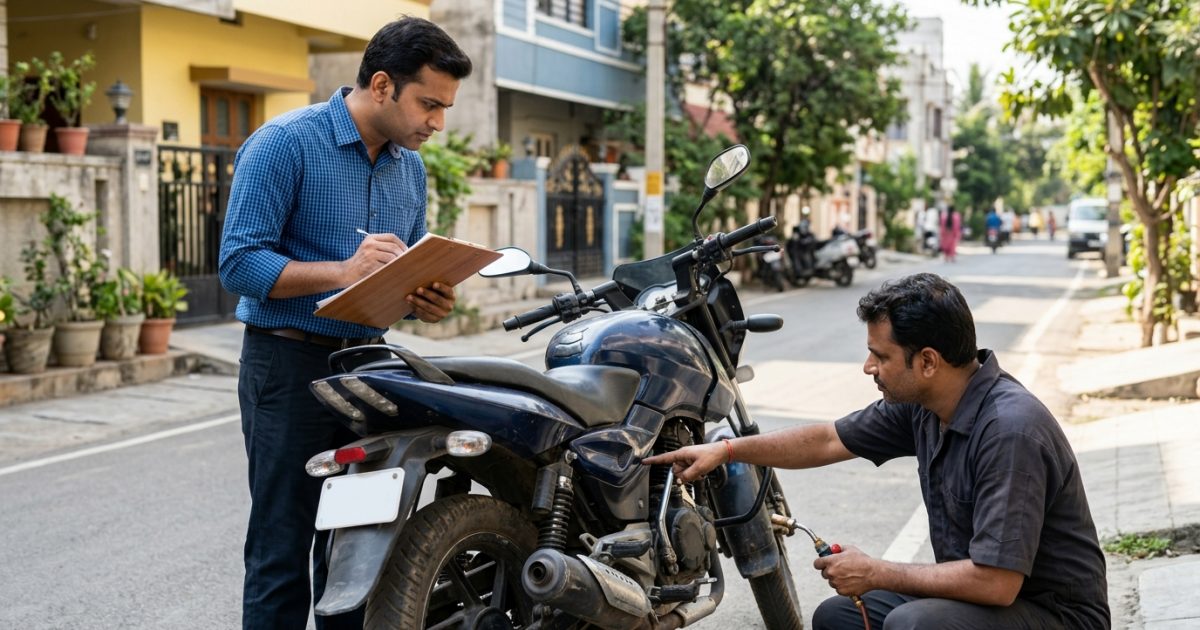
Stolen and accident-damaged motorcycles are frequently masked using forged plates. A precise chassis number check on a used bike ensures the mechanical hardware matches legal paperwork.
Locating and Verifying the Chassis Number
On motorcycles, locate the 17-digit Vehicle Identification Number (VIN) stamped directly onto the steering headstock tube behind the headlight mask. On gearless scooters, check the frame beneath the floorboard inspection flap or directly on the chassis beneath the under-seat storage bucket.
Inspect the stamped metal carefully. Look for uneven fonts, misaligned digits, rough grinding marks, or excessive paint layers applied to mask welding seams. The 17 characters must mirror the alphanumeric sequence on the RC card character-by-character.
Inspecting the Engine Number
Look at the engine crankcase casting near the bottom-left gear shift pedal or next to the clutch housing. Read the engraved alphanumeric serial.
Under Section 52 of the Motor Vehicles Act, altering an engine without official RTO endorsement is illegal. If the engine number does not match the RC, the RTO will decline the transfer.
Phase 4: Second Hand Bike Inspection Checklist (Mechanical Test Ride)
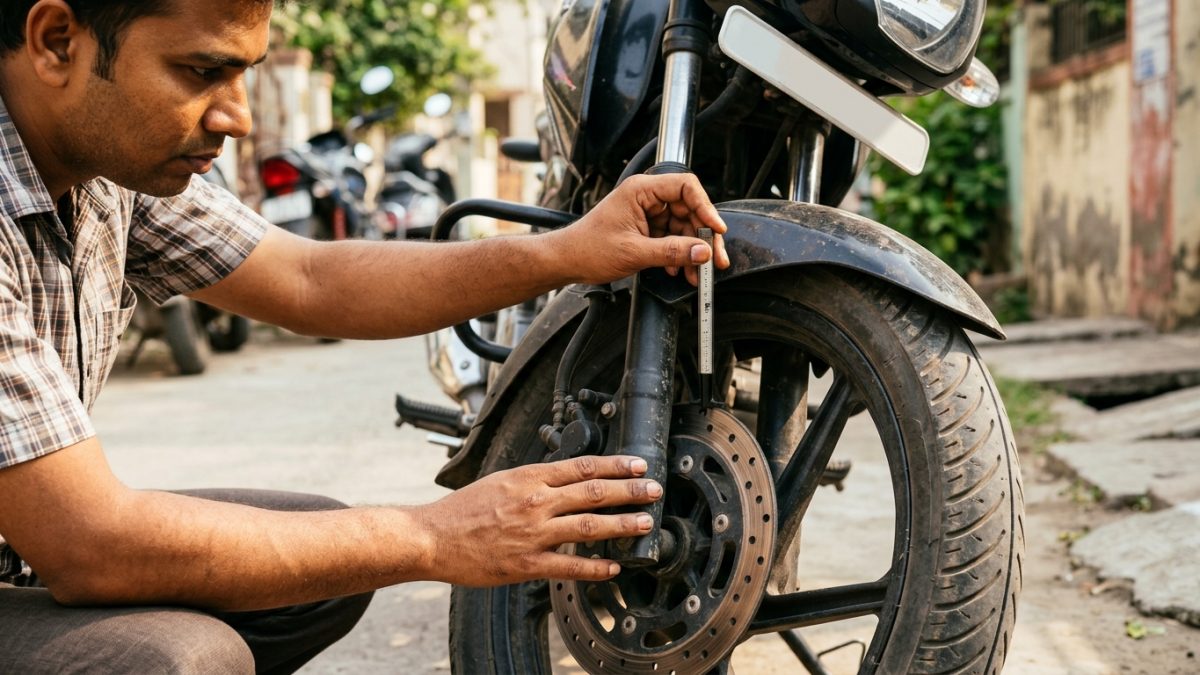
Do not finalize a deal based solely on a short spin around the block. Use this mechanical checklist to systematically evaluate the two-wheeler's condition.
1. Cold-Start and Exhaust Inspection
Ensure the motorcycle has not been pre-warmed before your arrival. Touch the metal engine crankcase with your hand to confirm it is completely cold.
- Start the engine from cold: The starter should crank effortlessly, and the engine must settle into a stable idle without stalling.
- Inspect exhaust gas: Blue or grey exhaust smoke indicates burnt engine oil caused by damaged piston rings, scored cylinder walls, or worn valve guides.
- Check combustion mixture: Thick black smoke indicates unburnt fuel from a clogged air filter or poorly tuned carburettor and fuel injectors. White smoke on liquid-cooled engines points to a blown head gasket leaking coolant into the cylinder.
2. Frame, Fork, and Suspension Alignment
Accident impacts distort structural motorcycle geometry. Inspect the front fork stanchions (chrome inner tubes) for deep scratches, rust pitting, or weeping hydraulic oil around the rubber dust seals.
While riding at 30 to 40 km/h on an empty, flat stretch of road, gently loosen your grip on the handlebars. The motorcycle must continue in a true, straight line; any sudden veering to the left or right indicates bent fork legs or a twisted swingarm.
Inspection Rule: Hold the front brake firmly while stationary and push the handlebars forward and backward. Any noticeable clunking or play confirms worn steering headstock cone bearings.
3. Transmission, Clutch, and Drivetrain
Depress the clutch lever to test operation. If the clutch lever feels unusually heavy, the internal cable is frayed. Accelerate hard in third gear; if the engine revs spike rapidly without an equivalent surge in road speed, the clutch friction plates are slipping and require replacement.
Shift through every gear to verify clean engagement without false neutrals. Examine the rear drive chain and sprocket. Teeth shaped like curved shark fins mean the drivetrain is worn out and requires an immediate replacement set.
4. Braking Hardware, Tyres, and Odometer
Check the thickness of the brake pads and inspect disc rotors for deep scoring grooves or surface warping. If the motorcycle features Anti-lock Braking Systems (ABS), confirm that the ABS instrument light turns off once the bike exceeds 5 to 10 km/h.
Inspect tyre tread depth and find the four-digit DOT manufacturing date code on the sidewall (for example, "3821" indicates the 38th week of 2021). Tyres older than 5 years experience compound hardening and severe loss of traction, necessitating an immediate replacement.
| Component | Check Method | Acceptable Condition | Costly Defect / Warning Sign |
|---|
| Engine Internals | Cold crank & tailpipe view | Clean exhaust, steady idle | Blue smoke (worn piston/cylinder) |
| Steering & Frame | Hands-free coast at 35 km/h | Tracks straight ahead | Veers sharply (bent chassis or forks) |
| Clutch System | Hard throttle in 3rd gear | Direct acceleration pickup | Revs climb without speed (clutch slip) |
| Drive Sprocket | Visual inspection of teeth | Symmetrical, blunt tooth tips | Curved, sharp "shark-fin" profile |
| Tyre Lifespan | DOT 4-digit code on sidewall | Age under 5 years, good tread | Code older than 5 years or dry rot cracks |
Phase 5: Step-by-Step Bike Ownership Transfer Checklist India
Ownership transfer must be filed within statutory timelines to avoid mounting penalties. For intra-state sales, the application must reach the RTO within 14 days under Rule 55 of the Central Motor Vehicles Rules (CMVR), 1989.
Statutory Fees and Late Penalties
As of October 2026, the central base RTO fee structure governed under Rule 81 of the CMVR includes:
- Base Ownership Transfer Fee: ₹150 for two-wheelers (representing half of the base registration fee).
- Smart Card / Laminated RC Fee: ₹200.
- Postal & Smart Card Processing Charges: ₹50 to ₹100 depending on the state portal.
- Statutory Late Fine: ₹300 per month of delay (or part thereof) if the buyer fails to apply within the mandatory 14-day window.
Note: Always confirm exact regional user fees on your state transport portal, as postal dispatch tariffs and local administration charges vary slightly across states.
Online RC Transfer Process via Parivahan Sewa
In states operating faceless transport modules, the ownership transfer can be executed online using Aadhaar authentication. You can learn more about digital submissions in our guide to faceless RTO services.
- Log in to the VAHAN portal: Visit the official VAHAN Citizen Services portal, pick your state, and select your local jurisdictional RTO.
- Input vehicle details: Enter the registration number alongside the last five digits of the chassis number to fetch the record.
- Choose services: Select "Transfer of Ownership" (and "Hypothecation Termination" if you are simultaneously clearing an existing loan).
- Authenticate using e-KYC: Complete mobile OTP verification linked to the buyer's and seller's Aadhaar profiles.
- Enter buyer details: Input the buyer's full legal name, permanent residential address, and mobile number.
- Upload scanned documents: Upload signed copies of Form 29, Form 30, valid insurance, PUC, and the pencil chassis imprint via the Document Management System (DMS).
- Pay the statutory fees: Pay the transfer fee and smart card charges through net banking, debit card, or UPI, then download the payment acknowledgement and Form 29/30 receipt.
- Finalize submission: If applying in a contactless jurisdiction, the Motor Vehicle Inspector (MVI) approves the file digitally and mails the RC via Speed Post. In manual RTO regimes, deliver the physical file and original RC card directly to your jurisdictional RTO office counter.
Physical possession of a motorcycle does not confer legal immunity. Until the RTO updates its register, legal ownership remains with the individual named on the official VAHAN portal.
Under Section 2(30) of the Motor Vehicles Act, the registered owner remains strictly liable for motor accident claims. Landmark Supreme Court rulings (*Naveen Kumar v. Vijay Kumar* and *Brij Bihari Gupta v. Manmet*) confirmed that registered owners are liable for third-party compensation payouts if the vehicle causes an accident before formal RTO registration transfer.
To safeguard both parties during this transitional phase, execute an official Delivery Challan on ₹100 stamp paper. The agreement must state the exact minute, hour, and calendar date of physical handover, the vehicle odometer reading, total consideration paid, and an explicit declaration that the buyer assumes all civil, criminal, and traffic responsibilities from that timestamp onward.
Before taking delivery, complete a final digital check using VahanX RC search to confirm the chassis number matches the vehicle records and ensure you have all original papers in hand.
Conclusion
Using a detailed used bike buying checklist protects you from unexpected mechanical repairs, unpaid e-challans, and vehicle ownership fraud. Take the time to inspect the motorcycle mechanically, match the frame numbers carefully, and submit your ownership transfer forms to the RTO within 14 days of purchase.
Before paying an advance or taking delivery of any pre-owned motorcycle, verify the legal owner name, hypothecation status, and registration validity on VahanX to ensure a clean transaction.