Key Takeaways
- Faceless RTO services eliminate physical visits by verifying identity through Aadhaar OTP and e-KYC.
- MoRTH Notification S.O. 3680(E) expands contactless citizen transport services to 100 online transactions.
- Permanent driving licence track tests and 15-year vehicle fitness checks still require in-person visits.
- Demographic discrepancies between Aadhaar and existing vehicle records are the primary cause of rejection.
- Outstanding traffic fines must be settled before applying for any vehicle ownership transfer or duplicate RC.
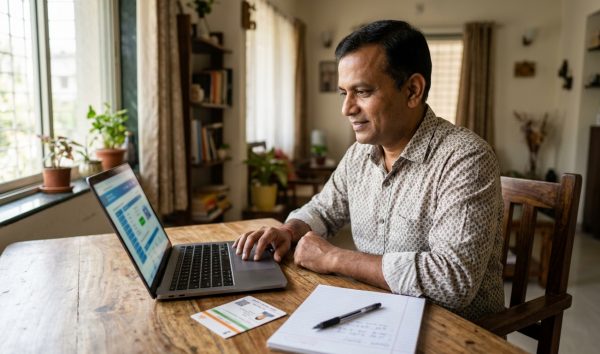
Faceless RTO services allow Indian citizens to complete essential driving licence and vehicle registration tasks 100% online without stepping into a regional transport office. By authenticating via UIDAI Aadhaar OTP on the Parivahan portal, you can renew licences, transfer vehicle ownership, or update addresses from home in minutes.
Before initiating any paperwork, vehicle owners should check their registered particulars using the RC details and vehicle owner search. Ensuring your registered mobile number, name spelling, and active vehicle documents match official records will save you from procedural holds and unexpected delays.
| Feature | Faceless Process | Non-Faceless (Counter) Process |
|---|
| Primary Portal | sarathi.parivahan.gov.in / vahan.parivahan.gov.in | Physical State RTO Counter |
| Identity Verification | Aadhaar OTP / Biometric e-KYC | Physical ID Proofs (Voter ID, Passport, etc.) |
| Average Approval Time | 3 to 7 working days | 15 to 45 working days |
| Physical Presence | Nil (100% remote from home) | Mandatory counter token and queue |
| Document Delivery | Digital download / Speed Post dispatch | Manual counter collection or Speed Post |
The push toward contactless transport governance began formally on March 3, 2021, when the Ministry of Road Transport and Highways (MoRTH) issued notification S.O. 1005(E). This statutory order permitted voluntary Aadhaar authentication for 18 citizen-centric transport services. It enabled citizens to complete routine administrative filings remotely.
On March 31, 2021, an amendment to the Central Motor Vehicles Rules (CMVR), 1989 officially granted legal recognition to electronic signatures and Aadhaar OTP authentication. Forms such as Form 20, Form 29, Form 30, and medical Form 1-A no longer required wet ink signatures. Delhi became the first union territory to operationalise this on a mass scale in August 2021, shutting routine public physical counters for over 33 transport services.
Recognising the efficiency gains, MoRTH issued Notification S.O. 4353(E) on September 16, 2022, expanding the list from 18 to 58 contactless citizen-centric services. More recently, on July 6, 2026, the Central Government published Notification S.O. 3680(E), effective July 8, 2026, under the Aadhaar Authentication for Good Governance Rules, 2020. This landmark order superseded previous notifications, broadening Aadhaar-based transport provisions to 100 online services spanning driving credentials, automated fitness appointments, dispute resolutions, and scrapping certifications.
Regulatory Note: While Aadhaar authentication is legally voluntary under Supreme Court privacy rulings, choosing not to use Aadhaar means you cannot use the faceless route and must submit documents physically at the RTO counter.
Comprehensive Faceless RTO Services List

The scope of online rto services without visiting is divided across the two flagship digital backbones: the Sarathi portal for driving credentials and the Vahan portal for vehicle registration management. As of October 2026, citizens residing in participating states can execute the following services without visiting an RTO office.
Faceless Services in Sarathi Parivahan (Driving Licences)
The Sarathi platform facilitates all personal credential operations. Eligible transactions include:
- Issue of Learner's Licence (LL): Complete application filing, fee payment, and the AI-monitored proctored screen test (STALL) from your home computer.
- Driving Licence Renewal: Standard renewals submitted before expiry or within one year after expiry where a practical driving competence test is not mandated under CMVR rules. You can review detailed steps in our guide on online DL renewal and Form 1-A requirements.
- Issue of Duplicate Driving Licence: Instant application processing for lost, stolen, defaced, or damaged driving licences.
- Change of Address in DL: Direct electronic synchronisation with the address registered on your UIDAI Aadhaar database.
- Replacement of DL Card: Upgrading legacy paper, booklet, or non-standard laminated licences to standardised national smart cards.
- DL and LL Extract Provisioning: Downloading officially authenticated digital driver records for court, employment, or immigration use.
- Issue of International Driving Permit (IDP): Electronic application and document verification against uploaded visa and passport credentials.
- Surrender of Class of Vehicle (COV): Voluntarily removing transport or heavy commercial endorsements from a personal licence.
- Hazardous Materials and Hill Driving Endorsements: Digital submission of training certifications from accredited driving institutions.
Vahan Faceless Services Online (Vehicle Registration)
The Vahan portal handles all asset-level transactions for private two-wheelers, four-wheelers, and commercial vehicles:
- Transfer of Ownership (Normal Sale): Contactless buyer-seller digital signatures for unencumbered private vehicles.
- Issue of Duplicate Registration Certificate (RC): Re-issuance processing following the loss or destruction of the original RC smart card.
- Change of Address in RC: Seamlessly updating your vehicle registration address based on verified Aadhaar records. Read our walkthrough on updating RC address online with Form 33.
- Hypothecation Endorsement: Registering a new vehicle finance lien digitally through bank-integrated API systems.
- Hypothecation Termination (HPT): Removing a financier's lien post-loan repayment via bank-cleared digital Form 35 issuance.
- Issue of No Objection Certificate (NOC): Paperless transfer clearances for moving registered vehicles between states or administrative RTO boundaries.
- RC Particulars / Extract: Official digital extracts used for motor insurance settlement claims or law enforcement proceedings.
- Road Tax & Fitness Payments: Digital clearance of quarterly or annual commercial taxes and private fitness evaluation fees.
| Category | Service Name | Portal Backbone | Key Prerequisites |
|---|
| Licence | Learner Licence (LL) | Sarathi Parivahan | Aadhaar OTP, working webcam for STALL |
| Licence | DL Renewal | Sarathi Parivahan | Expired <1 yr, Form 1-A (if age 40+) |
| Licence | Duplicate DL | Sarathi Parivahan | Valid DL details, Aadhaar e-KYC |
| Licence | Address Change (DL) | Sarathi Parivahan | Updated Aadhaar address profile |
| Vehicle | Transfer of Ownership | Vahan Parivahan | Active insurance, PUC, buyer/seller OTP |
| Vehicle | Duplicate RC | Vahan Parivahan | Police intimation report, Aadhaar OTP |
| Vehicle | Hypothecation Removal | Vahan Parivahan | Financier Form 35 digital clearance |
| Vehicle | Inter-State NOC | Vahan Parivahan | No pending challans, chassis imprint upload |
How to Apply for Parivahan Faceless Services Step-by-Step

Executing your transactions through parivahan faceless services requires adhering to precise online workflows. Before beginning, make sure you have checked your driving licence status or vehicle registration particulars to confirm there are no existing clerical freezes.
Workflow for Driving Licence Services on Sarathi
- Open the official portal: Access sarathi.parivahan.gov.in and select your resident State from the dropdown menu.
- Choose your target service: Select Apply for Learner Licence or Apply for Services on DL depending on your requirement.
- Select Aadhaar authentication: Click the radio button labelled Submit via Aadhaar Authentication. Do not choose the non-Aadhaar option, as that routes your application to a physical counter appointment.
- Authenticate your identity: Enter your 12-digit Aadhaar number or 16-digit Virtual ID (VID) and enter the OTP received on your UIDAI-registered mobile number.
- Verify auto-populated fields: Review your name, date of birth, guardian name, and permanent address pulled automatically from UIDAI.
- Submit declarations: Complete the self-declaration Form 1. If you are aged 40 or above, upload a digitally certified Form 1-A completed by a registered medical practitioner.
- Pay statutory fees: Remit the prescribed government fees using Net Banking, UPI, or debit cards via the integrated payment gateway.
- Take the online test (for LL): Log in to the Online LL Test (STALL) interface using your SMS application credentials. Complete the face-matching scan and pass the proctored test from home.
Webcam Caution: Keep your room evenly lit during the STALL test. If you look away, speak, or if another face appears in the webcam frame, the AI proctor will flag the session and cancel your test automatically.
Workflow for Vehicle RC Services on Vahan
- Access the vehicle portal: Navigate to vahan.parivahan.gov.in and select Vehicle Related Services.
- Enter vehicle credentials: Provide your vehicle registration number and state jurisdiction, then click proceed.
- Validate ownership: Select the required service (such as Transfer of Ownership or Duplicate RC) and input the last five characters of your vehicle chassis number.
- Initiate e-KYC: Select the faceless Aadhaar authentication option and complete the mobile OTP verification.
- Execute the buyer-seller handshake (for ownership transfer): The seller enters the buyer details and digitally signs Form 29 via Aadhaar OTP. The buyer receives an automated link via SMS to complete Aadhaar authentication and electronically sign Form 30.
- Upload mandatory certificates: Attach clear PDF copies of valid motor insurance, a current Pollution Under Control (PUC) certificate, and financial release forms if applicable.
- Process payment and track: Settle the government fees online. Once reviewed by the automated scrutiny engine, the updated RC is issued digitally and the smart card is dispatched via Speed Post.
Aadhaar is legally voluntary, but operationally mandatory for anyone wishing to use contactless rto services india. MoRTH notifications S.O. 4353(E) and S.O. 3680(E) were drafted under the Aadhaar Authentication for Good Governance Rules, 2020. This structure preserves compliance with constitutional privacy benchmarks while providing a safe identity layer.
If you prefer not to share Aadhaar data or do not possess an Aadhaar card, you retain the legal right to apply for all transport services offline. However, selecting the non-Aadhaar pathway removes remote processing. The portal will prompt you to schedule an in-person physical appointment, print physical paper forms, and visit your regional transport office with secondary proof documents like a passport, voter ID, or ration card.
Non-Faceless Tasks: When Must You Physically Visit the RTO?

While the list of aadhaar based rto services has expanded significantly, certain critical procedures cannot be conducted over the internet due to mandatory statutory inspections and skill assessments.
- Permanent Driving Licence Skill Tests: Under Rule 15 of the Central Motor Vehicles Rules, 1989, every fresh permanent licence applicant must physically demonstrate driving ability on an Automated Driving Test Track (ADTT).
- DL Renewals Expired Beyond One Year: Under Rule 18 of the CMVR, if a driving licence has been expired for more than 12 months, the applicant must attend an in-person driving re-test at the RTO.
- Addition of a Class of Vehicle (AEDL): Upgrading an existing licence (for instance, adding a Light Motor Vehicle car endorsement to a two-wheeler licence) requires a practical track assessment.
- 15-Year Private Vehicle Fitness Renewal: Non-transport private cars and two-wheelers reaching 15 years from registration must undergo an inspection by a Motor Vehicle Inspector (MVI) or an accredited Automated Testing Station (ATS).
- Commercial Vehicle Fitness Certification: Taxis, buses, auto-rickshaws, and transport trucks must undergo periodic physical brake, emission, and structural tests at authorised testing centers.
- Vehicle Structural Alterations and Engine Replacements: Major alterations, retrofitted CNG fuel kit endorsements, or chassis replacements require physical verification against Central Motor Vehicle safety standards.
- HSRP Physical Fitment: Although High Security Registration Plates are booked and paid for online, the physical fitment with non-reusable snap locks must occur at an authorised fitment center or authorized dealership.
- Repeated Biometric / Facial Verification Mismatches: If the AI proctoring tool fails to match your live face against your UIDAI database photo during home testing, the file converts to offline processing.
Office Finder: If your task requires an in-person vehicle inspection or driving test, locate your jurisdiction code and counter address using the RTO office directory before booking your appointment.
Why Faceless Applications Get Rejected and How to Fix Them
Faceless submissions pass through automated cross-referencing algorithms. Even minor clerical inconsistencies can trigger an automated rejection or lock your file. The most common rejection causes include:
1. Demographic Record Mismatches
The Vahan and Sarathi databases compare citizen identity records character-by-character against UIDAI data. If your driving licence lists your name as "R. K. Verma" while your Aadhaar reads "Rajesh Kumar Verma", the automated e-KYC handshake will fail. The same applies to discrepancies in date of birth or father's name. You must align your Aadhaar records with UIDAI before starting the application, or execute an offline identity reconciliation.
2. Active Traffic e-Challans and Legal Holds
An outstanding traffic fine or pending non-compoundable court challan will automatically freeze Vahan operations. The system blocks transfers of ownership, duplicate RC requests, and NOC issuances until all outstanding penalties are cleared. You should run an instant check on pending traffic e-challans and clear all dues before filing an application.
3. AI Proctoring and Webcam Failures During the LL Test
The home-based STALL exam relies on strict computer vision algorithms. Poor lighting, camera resolutions below 720p, reflections on eyeglasses, or background movement will terminate the test immediately. Furthermore, if your Aadhaar photograph is outdated (such as a childhood photo taken over ten years ago), the facial recognition software will fail to establish identity, requiring a counter visit.
4. Active Financier Hypothecation
Attempting to transfer vehicle ownership or obtain an interstate NOC while a bank or lending institution holds an active lien will cause an automatic rejection. Your financier must electronically push loan termination clearance (Form 35) into the Vahan database before your faceless request can proceed.
For licence holders aged 40 and above applying for DL renewal, uploading an unverified medical certificate leads to rapid rejection. Medical certificates must be issued by a registered medical practitioner holding a verifiable registration number with the National Medical Commission (NMC) or a State Medical Council.
Statutory Fees for Faceless RTO Services
Base service fees are governed by Rules 32 and 81 of the Central Motor Vehicles Rules, 1989. However, individual states apply local administrative charges, postal delivery costs, and smart card fees.
| Service Description | CMVR Base Fee | Typical Additional Surcharges | Total Estimated Cost |
|---|
| Learner Licence (per vehicle class) | ₹150 | ₹50 online test fee | ₹200 per class |
| Permanent DL (after driving test) | ₹200 | ₹200 smart card + ₹50 speed post | ₹450 |
| DL Renewal (on-time or within grace) | ₹200 | ₹50 postal dispatch charge | ₹250 |
| DL Renewal (late after grace period) | ₹200 | ₹300 penalty per year of delay | ₹500+ (scales yearly) |
| Duplicate Driving Licence | ₹200 | ₹50 postal dispatch charge | ₹250 |
| Change of Address / Name (DL) | ₹200 | ₹50 postal dispatch charge | ₹250 |
| International Driving Permit (IDP) | ₹1,000 | Nil (standard statutory fee) | ₹1,000 |
| Transfer of Ownership (Two-Wheeler) | ₹150 | ₹200 smart card + ₹50 postal charge | ₹400 |
| Transfer of Ownership (Motor Car / LMV) | ₹300 to ₹500 | ₹200 smart card + ₹50 postal charge | ₹550 to ₹750 |
| Duplicate Registration Certificate (RC) | 50% of initial fee | ₹150 (2W) / ₹300 (4W) + card fee | ₹350 to ₹550 |
| Hypothecation Termination (Form 35) | ₹100 (2W) / ₹500 (4W) | State municipal user portal fees | ₹100 to ₹600 |
Fee Notice: CMVR statutory rates are standard across India as of October 2026, but state-level convenience fees, postal charges, and smart card costs vary. Check your final payment screen on the Parivahan portal for the exact total.
State-by-State Implementation Realities
While the Central Government provides the technical infrastructure via the National Informatics Centre (NIC), transport remains a concurrent subject. As a result, faceless rollout levels vary across Indian states and union territories.
Delhi
Delhi operates the most mature contactless transport model in India. Physical counters across zonal transport offices remain closed for routine administrative transactions. More than 40 separate services run entirely through Aadhaar e-KYC. Walk-ins are permitted only for permanent driving skill tests and vehicle fitness evaluations.
Maharashtra
Maharashtra has rolled out over 80 transport services online. High-volume administrative requests such as duplicate RCs, driving licence renewals, address modifications, and loan terminations operate without counter footfalls. Physical visits are restricted to vehicle fitness certifications, commercial permits, and driving track tests.
Uttar Pradesh and Gujarat
Both states have achieved strong adoption of online learner licence tests from home via Sarathi. Basic duplicate credentials and licence renewals process smoothly online. However, inter-district vehicle ownership transfers can encounter occasional processing bottlenecks, sometimes prompting local RTO personnel to request physical document submissions.
Karnataka and Kerala
Karnataka supports robust contactless learner licence generation and hypothecation clearances. However, vehicle ownership transfers involving multiple regional jurisdictions may occasionally require manual officer review. In Kerala, home-based learner tests function smoothly, but vehicle ownership transfers can experience delays due to legacy multi-tier verification steps across municipal offices.
How to Update Your Mobile Number for Faceless Processing
Because faceless RTO services depend entirely on OTP authentication, your active mobile phone number must be linked correctly to both the UIDAI and Parivahan databases. If your mobile number has changed, update it before submitting any application:
- Update Sarathi mobile link: For driving licences, visit sarathi.parivahan.gov.in/sarathiservice/mobNumUpdpub.do. Enter your licence number, date of birth, and Aadhaar number to link your new phone number instantly via OTP.
- Update Vahan mobile link: For vehicle registration records, visit vahan.parivahan.gov.in/mobileupdate/. Enter your registration number, full chassis number, and engine number, then authenticate using your Aadhaar OTP to sync the new mobile contact.
Conclusion
Embracing faceless RTO services saves valuable time, avoids middleman fees, and removes the need to stand in long queues at your local transport office. As long as your Aadhaar records match your vehicle documents and you have cleared all pending traffic fines, almost every major licence and registration service can be completed smoothly from home.
Before you begin your online application on Parivahan, verify your vehicle particulars and insurance validity using the VahanX RC details tracker to ensure a smooth, error-free submission.