Key Takeaways
- The final on-road car price in India is 12% to 25% higher than the ex-showroom price.
- Ex-showroom price includes base manufacturing cost, dealer profit margin, and standard GST plus Compensation Cess.
- Mandatory additions include 15-year state road tax, RTO registration, 1-year OD with 3-year TP insurance, and FASTag.
- Vehicles priced above ₹10 Lakh incur a mandatory 1% Tax Collected at Source (TCS) under Section 206C(1F).
- Dealer handling or logistics charges are unlawful, and buyers can legally decline optional accessory packs.
| Cost Component | Applicability | Payment Nature | Authority / Payee |
|---|
| Ex-Showroom Price | All vehicles | Base cost (includes GST + Cess) | Car Manufacturer / Dealer |
| State Road Tax (MVT) | All vehicles | One-time 15-year statutory tax | State Transport Department |
| RTO Registration & Smart Card | All vehicles | Statutory government fee | Regional Transport Office (RTO) |
| Motor Insurance (1-Yr OD + 3-Yr TP) | All vehicles | Mandatory statutory cover | General Insurance Provider |
| FASTag & HSRP | All vehicles | Statutory fitment charges | Authorized Tag / Plate Vendor |
| TCS (Section 206C(1F)) | Ex-showroom > ₹10 Lakh | 1% adjustable advance tax | Income Tax Department |
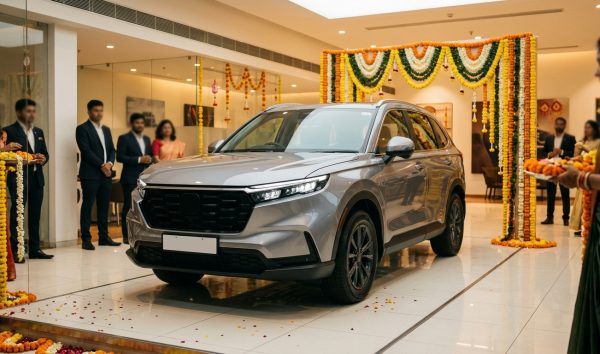
To understand the true car price in India, buyers must look beyond the sticker figure. The on-road price is the total amount you pay to legally drive a vehicle off the dealership floor. It combines the ex-showroom price with state road taxes, RTO fees, mandatory bundled insurance, FASTag, and statutory taxes.
As of September 2026, the final on-road price in Indian states typically ranges between 12% and 25% above the advertised ex-showroom price. This significant difference catches many first-time car buyers off guard when they receive their final booking quotation.
Ex Showroom vs On Road Price: Understanding the Baseline
The fundamental distinction in any new car price breakdown india is the contrast between the factory-gate retail price and the drive-away price. Advertisements and promotional brochures almost exclusively display the ex-showroom price to present an attractive figure.
What Is the Ex-Showroom Price?
The ex-showroom price represents the retail value of the vehicle before statutory registration and road-use permissions. It includes the automaker's manufacturing cost, the original equipment manufacturer (OEM) profit margin, and dealer commissions.
Crucially, this figure already includes central indirect taxes. Standard internal combustion engine (ICE) cars carry 28% GST plus an applicable GST Compensation Cess of 1% to 22%. Electric vehicles (EVs) carry a concessional GST rate of 5% with 0% cess. Freight from the plant to the regional dealership is also baked into the ex-showroom rate.
Common Mistake: Never assume the ex-showroom price gives you legal authority to drive on public roads. Driving an unregistered vehicle without road tax payment attracts heavy statutory penalties.
What Is the On-Road Price?
The on-road price is the comprehensive financial outlay needed to legally register and operate the car on Indian roads. It incorporates statutory levies charged by individual state governments and central regulatory bodies.
To transition an ex-showroom car into an on-road vehicle, you must pay Motor Vehicle Tax (MVT) for 15 years, RTO registration charges, mandatory bundled motor insurance, FASTag, High-Security Registration Plates (HSRP), and applicable direct taxes like TCS.
New Car Price Breakdown India: Mandatory Cost Components
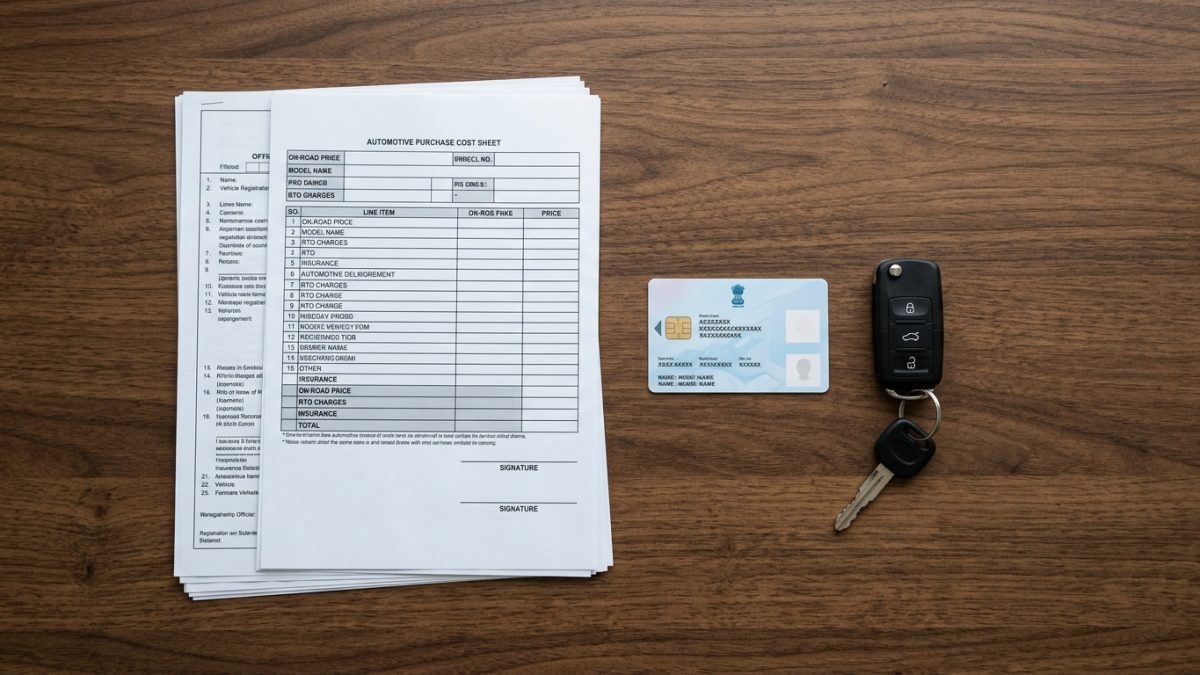
When reviewing a quotation, you must distinguish non-negotiable statutory fees from dealership markups. Here is how each mandatory component works under Indian motor vehicle regulations as of September 2026.
1. Statutory RTO Registration and Smart Card Fees
The Central Motor Vehicles Rules (CMVR), 1989 prescribe clear administrative charges for new vehicle registration. For private light motor vehicles (non-transport cars), these fees remain standardized nationwide:
- Registration Fee (Rule 81): ₹600 for light motor vehicles.
- Smart Card RC Issuance Fee: ₹200 for generating the digital registration certificate.
- Hypothecation Endorsement Fee: ₹1,500 under Form 34 if the car is financed through an auto loan.
- Postal Dispatch Charges: ₹50 to ₹100 for Speed Post delivery of the RC.
- Municipal Parking Charges: Cities like Delhi levy one-time parking charges (₹2,000 for cars up to ₹4 Lakh; ₹4,000 above ₹4 Lakh).
If you need to verify local regional authority contacts or processing details, you can locate your regional office via find your RTO office address and code.
2. FASTag and High-Security Registration Plates (HSRP)
Rule 138A of the Central Motor Vehicles Rules mandates a pre-affixed FASTag on every new four-wheeler at delivery. Dealerships charge a standard fee of approximately ₹500, which includes a ₹100 tag issuance fee, a ₹200 refundable security deposit, and ₹200 preloaded toll balance.
HSRP fitment is mandatory under Ministry of Road Transport and Highways (MoRTH) guidelines. The plates feature laser-etched permanent serial numbers and snap-locks. Statutory costs range between ₹400 and ₹600 and are either included in state registration or billed at notified rates.
3. Mandatory Motor Insurance Bundling
Under regulations from the Insurance Regulatory and Development Authority of India (IRDAI) and Supreme Court directives, all new private cars must be insured with a 1-year Own Damage (OD) and 3-year Third-Party (TP) bundled policy before delivery.
Dealerships routinely quote high premiums that include distributor commissions. You have the legal right to source insurance independently from licensed insurers by providing your engine and chassis numbers. Independent policies must include the mandatory Compulsory Personal Accident (CPA) cover of ₹15 Lakh (₹275 to ₹350 annually), which can be waived if you already hold an individual personal accident policy.
Buyer Tip: Compare external insurance quotes online using the exact variant and add-ons (such as Zero Depreciation and Engine Protect). Asking the dealer to price-match an external quote can save you ₹15,000 to ₹40,000.
RTO Road Tax on New Car Across Indian States
The single largest variable in the car price in india is the State Motor Vehicle Tax (MVT). Motor vehicle taxation falls under the State List, meaning each state legislature sets its own road tax rates and fuel slabs.
| State / Union Territory | Standard Individual Road Tax Rate | Fuel-Specific Surcharge | EV Policy Incentives |
|---|
| Karnataka | 13% to 18%+ (based on slab) | Standard slab applies | Select EV concessions |
| Kerala | 9% to 21% (based on invoice) | Standard slab applies | Standard slab variations |
| Telangana | 12% to 18% | 2% extra on second car | Policy-based waivers |
| Tamil Nadu | 10% to 15% | Standard slab applies | Concessional rates |
| Delhi | 4% to 10% (fuel & price slabs) | 2% higher on diesel | Up to 100% road tax waiver |
| Uttar Pradesh | 8% to 10% | Standard slab applies | Road tax exemptions under EV policy |
| Gujarat | 6% flat (individual) | Standard slab applies | Selective state incentives |
| Haryana / Chandigarh | 5% to 10% / 6% to 8% | Standard slab applies | EV registration rebates |
Road tax is calculated as a one-time upfront payment valid for 15 years for private personal vehicles. Most states calculate this percentage on the ex-showroom invoice, while a few assess it on the pre-GST base price.
If you register a vehicle under a corporate entity, LLP, or business PAN, expect to pay 25% to 100% higher road tax compared to individual registration. Furthermore, most states add a 2% surcharge on diesel engines to curb emissions.
You can verify current state transport tax rules directly on the central Parivahan Sewa Portal before finalizing your transaction.
TCS on New Car Purchase: Section 206C(1F) Explained
Buyers exploring vehicle pricing often ask about tcs on new car purchase when planning their financing. Tax Collected at Source is governed by Section 206C(1F) of the Income Tax Act, 1961.
Threshold and Percentage
TCS is mandatory at a flat rate of 1% on any motor vehicle sale where the single invoice value (ex-showroom price) exceeds ₹10,00,000. This provision applies to all passenger vehicle purchases regardless of whether the buyer pays by cash, bank transfer, or auto loan.
TCS is levied on the entire ex-showroom figure, not just the balance above ₹10 Lakh. For instance, on a vehicle with an ex-showroom price of ₹14,50,000, the 1% TCS equals ₹14,500.
Why TCS Is Not an Additional Expense
TCS is an advance tax collection, not an unrecoverable statutory surcharge. The dealership acts solely as a collection agent and deposits this amount directly with the Income Tax Department against your Permanent Account Number (PAN).
- Proof of Deposit: The dealer must issue an official Form 27D reflecting the deposited sum.
- Tax Credit: The amount appears in your Annual Information Statement (AIS) and Form 26AS.
- Tax Adjustment: You can adjust this 1% amount against your final income tax liability or claim it as a refund during annual Income Tax Return (ITR) filing.
Warning: Ensure the dealer enters your PAN accurately on the invoice. Any typo will prevent the TCS from reflecting in your Form 26AS, complicating your income tax return reconciliation.
Dealer Handling Charges Illegal in India: Spot Unlawful Add-Ons

When reviewing a dealer cost sheet, you will often spot inflated line items that dealers claim are mandatory. The most prevalent among these are handling or logistics charges.
| Dealership Line Item | Average Quoted Cost | Legal Status | Recommended Action |
|---|
| Handling / Logistics / PDI Fee | ₹5,000 to ₹35,000 | ILLEGAL under MoRTH orders | Demand immediate removal from invoice. |
| Basic Accessories Kit | ₹5,000 to ₹25,000 | OPTIONAL | Refuse bundled kit; purchase only needed items. |
| In-House Insurance Policy | ₹25,000 to ₹90,000 | MANDATORY POLICY, OPTIONAL SOURCE | Get external quotes and ask dealer to match. |
| Extended Warranty (EW) | ₹10,000 to ₹40,000 | OPTIONAL | Purchase before standard warranty expires. |
| Roadside Assistance (RSA) | ₹2,000 to ₹6,000 | OPTIONAL | Check if already included in OEM or insurance. |
| Teflon / Ceramic / Anti-Rust | ₹4,000 to ₹30,000 | OPTIONAL | Decline dealer application; modern cars are galvanized. |
To keep the car price in india fair, MoRTH and various state transport bodies—such as the Delhi Transport Department—have repeatedly issued circulars confirming that dealer handling charges illegal in india are strictly unauthorized. Dealership commissions already cover inward transit and storage costs.
Showrooms are designated as self-registering authorities on the Vahan portal. They are legally barred from levying document preparation charges, depot fees, or pre-delivery inspection fees on customers.
Bharat Series (BH) Registration: Lowering Upfront Acquisition Costs
The Bharat Series (BH) registration system, introduced under the Central Motor Vehicles Rules, offers a legal route to significantly lower your initial vehicle acquisition cost.
Eligibility for BH Registration
BH series registration avoids paying the traditional 15-year state road tax upfront. To qualify, you must belong to one of these groups:
- Central or State Government employees.
- Defence and Armed Forces personnel.
- Public Sector Undertakings (PSU) and nationalized bank staff.
- Private sector employees whose organization has registered offices or operational branches in at least 4 States or Union Territories (verified via official Form 60).
BH road tax is calculated on the pre-GST base invoice price of the vehicle, using three price slabs:
- Base Invoice below ₹10 Lakh: 8% tax rate.
- Base Invoice between ₹10 Lakh and ₹20 Lakh: 10% tax rate.
- Base Invoice above ₹20 Lakh: 12% tax rate.
- Fuel adjustments: Add 2% surcharge for diesel vehicles; deduct 2% for electric vehicles.
Instead of paying for 15 years, road tax is paid in 2-year cycles using this statutory formula:
2-Year Tax = (Calculated 15-Year Tax × 1.25 × 2) ÷ 15
On a vehicle costing ₹12 Lakh, conventional upfront road tax can range from ₹1,20,000 to ₹1,80,000. Under the BH series, your initial 2-year road tax payment is roughly ₹20,000 to ₹25,000. This dramatically reduces your initial down payment.
How to Calculate On Road Price of Car: Step-by-Step Guide
Using an on road car price calculator india or building your own cost estimate requires following a methodical sequence. Follow this practical verification flow before handing over a booking advance.
- Obtain the Itemized Proforma Invoice: Request a complete cost breakdown from the showroom separating the ex-showroom price, road tax, statutory registration fees, insurance, and individual add-ons.
- Eliminate Unlawful Markups: Inspect the proforma invoice for charges labeled "Handling," "Logistics," "Depot," "Administrative," or "PDI." Instruct the dealership in writing to remove these items.
- Verify Road Tax on Parivahan: Calculate the exact statutory tax on the official Vahan portal using your state's current slabs for your engine displacement and fuel type.
- Compare Motor Insurance Independently: Check quotes from licensed general insurers for identical coverage, including 1-year OD, 3-year TP, and preferred riders like Zero Depreciation. Present this figure to negotiate the showroom's quote.
- Confirm TCS Calculations: If the vehicle's ex-showroom price exceeds ₹10 Lakh, verify that the 1% TCS is calculated on the exact invoice total. Obtain Form 27D after delivery to reconcile your advance tax credit.
- Confirm Optional Accessories: Review any pre-selected accessory packs. Remove unwanted cosmetic items and choose only practical accessories, like floor mats and mud flaps, individually.
After completing registration and taking delivery, you can check that your registration details and insurance validity are updated correctly using the online tool to check RC and vehicle owner details.
Budgeting for Your New Vehicle Purchase
Knowing how to calculate on road price of car protects you from unexpected expenses during vehicle delivery. Always build a financial buffer of 15% to 20% above the listed ex-showroom price when planning your car budget.
If you are planning to finance your car, calculate loan terms using the exact on-road price minus your down payment, rather than the ex-showroom value. Financing only the base cost leaves you responsible for paying road taxes, insurance, and registration out of pocket.
If you are also tracking market trends or planning your purchase around upcoming automotive releases, you can check the latest models and price trends in our guide on the New Car Launch in India (September 2026).
Conclusion
Understanding the exact components of a car price in india allows you to budget accurately and prevents you from overpaying on unnecessary dealer charges. By separating non-negotiable statutory dues like state road taxes and mandatory insurance from optional add-ons, you can negotiate with confidence.
Always demand an itemized proforma invoice, reject unlawful logistics fees, and confirm road taxes on official transport portals before finalizing your booking.