Key Takeaways
- File a Lost Document Report or FIR immediately if your RC is lost or stolen.
- Submit Form 26 online through the Parivahan portal using your vehicle and chassis numbers.
- Statutory duplicate RC fees start at ₹150 for two-wheelers and ₹300 for private cars.
- A valid motor insurance policy and active PUC certificate are mandatory for online processing.
- Digital RCs on DigiLocker or mParivahan are legally valid for daily roadside traffic checks.
| Feature | Details |
|---|
| Applicable Rule | Rule 53 & Rule 81, Central Motor Vehicles Rules (CMVR) 1989 |
| Primary Application Form | Form 26 (Application for Duplicate Certificate of Registration) |
| Base Fee (Rule 81) | 50% of standard registration fee (₹150 bikes, ₹300 cars) |
| Smart Card & Postal Fees | ₹200 smart card fee plus ₹50 to ₹100 Speed Post delivery |
| Processing & Delivery Time | 15 to 30 working days (7 to 15 days in faceless RTOs) |
| Official Portal | VAHAN Citizen Services |
To apply for a duplicate rc online, file a police lost report or FIR, log in to the official Parivahan portal, authenticate with your registration and chassis numbers, and fill out Form 26. Upload your police intimation, valid motor insurance, and identity proof, pay the prescribed statutory fee, and submit your dossier online or at your jurisdictional RTO.
Before you begin the application, check your RC details and vehicle owner information to ensure your registered mobile number, engine number, and insurance validity are up to date on the national Vahan registry.
Legal Rules and Penalties for Driving Without an RC
Under Rule 53 of the Central Motor Vehicles Rules (CMVR), 1989, every vehicle owner must immediately notify the police and report to their registering authority if an RC is lost, destroyed, or mutilated. Driving without a valid Certificate of Registration violates Section 39 of the Motor Vehicles Act, 1988.
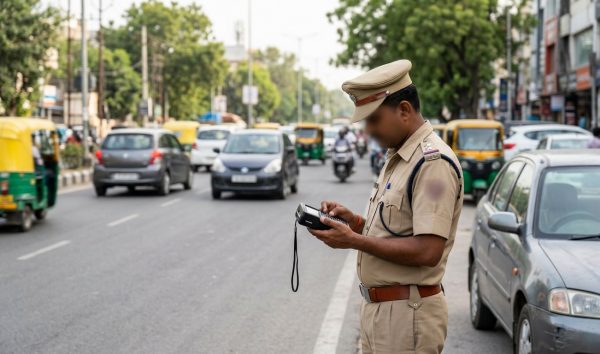
Driving an unregistered vehicle or failing to produce a valid RC during roadside verification carries heavy statutory penalties under Section 192 of the Motor Vehicles Act. Enforcement agencies treat missing documentation strictly unless presented through authorized government software.
| Offence Instance | Statutory Fine (Section 192 MV Act) | Additional Legal Action |
|---|
| First Offence | ₹2,000 to ₹5,000 | Vehicle impoundment warning |
| Second or Subsequent Offence | ₹5,000 to ₹10,000 | Imprisonment up to 1 year or vehicle seizure |
As of September 2026, Rule 139 of the CMVR and MoRTH guidelines allow drivers to present digital documents via DigiLocker or mParivahan. Under Section 4 and Section 9A of the Information Technology Act, 2000, these digital certificates carry legal standing equivalent to physical cards during enforcement checks.
A digital RC on DigiLocker protects you from roadside challans under Section 192, but you still need an official physical duplicate RC to sell the vehicle or transfer ownership.
When to Apply: Loss, Theft, or Damaged Smart Card
Understanding the exact reason for your application dictates whether you require police paperwork or a physical card surrender. The VAHAN system prompts you to select one of several service triggers during the initial workflow.
- Lost or Misplaced RC: Occurs when the document is misplaced at home or during travel. This requires a formal Lost Document Report (LDR) or Non-Cognizable Report (NCR).
- Stolen RC: If your vehicle documents are stolen along with a wallet, bag, or vehicle parts, lodging a criminal First Information Report (FIR) at the local police station is mandatory.
- Torn, Soiled, or Mutilated Smart Card: If the chip is damaged, the card is snapped, or paper laminate is illegible, no police complaint is necessary. You must surrender the damaged physical document to the RTO.
To avoid processing delays, confirm that your vehicle has no pending judicial matters or unpaid enforcement actions by running a vehicle e-challan status check before filing Form 26.
Documents Required for Duplicate RC Application
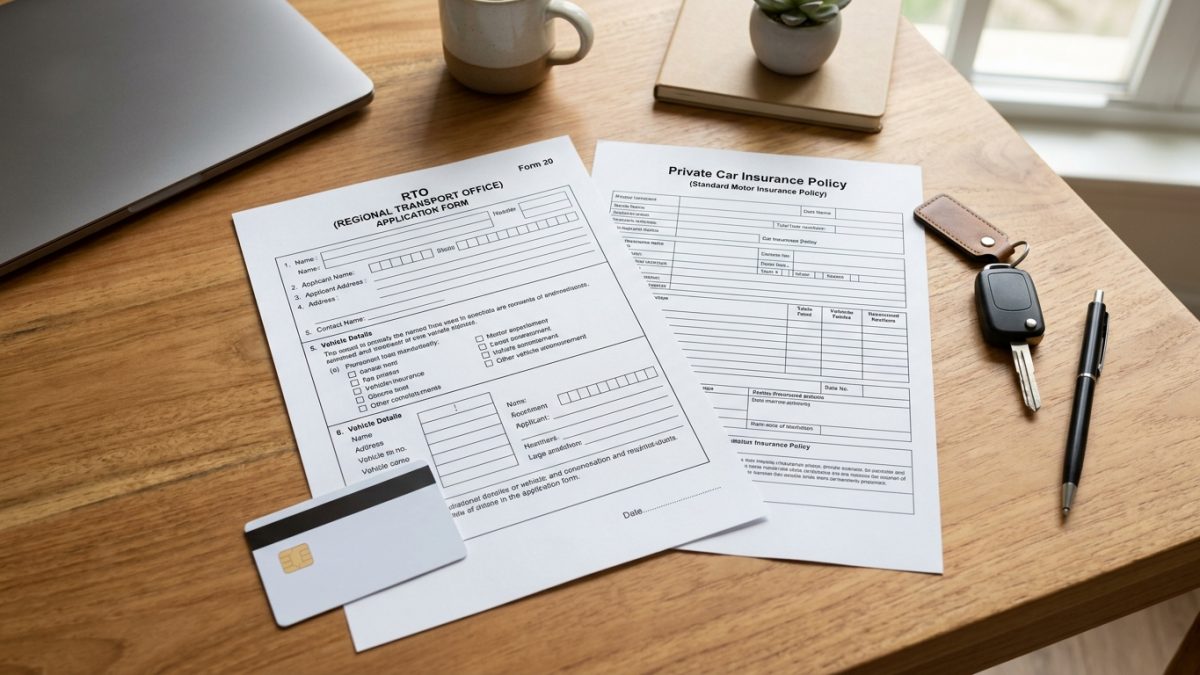
Organising your paperwork in advance prevents application rejections at the scrutiny stage. All uploaded files on the Parivahan portal must be clear PDF scans, legible, and match your active Vahan records.
- Form 26: The statutory application form under Rule 53 of CMVR 1989, downloaded from the portal and signed by the registered owner.
- Police Intimation Report: A digitally signed Lost Document Report (LDR), Non-Cognizable Report (NCR), or an FIR for stolen documents.
- Valid Motor Insurance Certificate: An active third-party or comprehensive insurance policy linked to the vehicle.
- Valid Pollution Under Control Certificate (PUCC): Active emission record verified automatically online via the Vahan network.
- Proof of Identification and Address: Self-attested copy of Aadhaar card, Voter ID, Passport, or utility bill.
- Financier No-Objection Certificate (NOC): Required on Form 26 if the vehicle is currently financed under hire-purchase or hypothecation.
- Original Damaged RC: Mandatory only if the duplicate card is requested due to physical damage or mutilation.
| Document Name | Lost / Stolen RC | Mutilated / Torn RC | Financed Vehicle |
|---|
| Form 26 | Mandatory | Mandatory | Mandatory (Financier Signed) |
| Police LDR / FIR | Mandatory | Not Required | Mandatory |
| Original RC Card | Not Applicable | Mandatory (Surrender) | Not Applicable |
| Financier NOC | If under loan | If under loan | Mandatory |
| Insurance & PUCC | Mandatory | Mandatory | Mandatory |
If your vehicle is under an active bank loan, your duplicate RC application will be rejected unless the bank endorses Form 26 or provides a formal No-Objection Certificate.
Step-by-Step Guide: Duplicate RC Online Apply on Parivahan

Applying through the central portal streamlines the replacement process across most Indian states. Follow these steps to complete your how to apply for duplicate rc online submission accurately.
- Access Portal: Open the official VAHAN Citizen Services Portal on your web browser.
- Enter Vehicle Details: Enter your vehicle registration number, choose your state and local registering authority from the dropdown, agree to privacy terms, and click Proceed.
- Select Service: Navigate to the main dashboard, locate Online Services or Basic Services, and select the option to Apply for Duplicate RC.
- Authenticate Identity: Enter the last 5 digits of your chassis number, click Validate Regn_no/Chasi_no, generate an OTP to your registered mobile number, and enter it to access the application.
- Fill Service Details: Choose the application reason such as Lost, Theft, or Torn/Mutilated. If reporting a loss, enter your police complaint or LDR number, police station name, and complaint filing date.
- Verify Insurance Coverage: Review the active policy number and expiry dates pulled from the database, or update the details manually if your latest policy is not reflecting.
- Upload Required Documents: Upload clear PDF copies of your police report, motor insurance certificate, address proof, and bank NOC if the car or bike has an active hypothecation.
- Pay Fee Online: Review the calculated charges, select Bharatkosh or your state payment gateway, and pay the duplicate RC fees using UPI, Net Banking, or a Debit Card.
- Download Application and Receipt: Save and print the pre-filled Form 26 alongside the fee transaction receipt, both displaying your unique application reference number.
- Complete Submission: In faceless RTO jurisdictions, your application moves straight to officer scrutiny. In conventional RTOs, visit your designated office to submit the physical docket.
If you are applying for a two-wheeler replacement, the bike duplicate rc online apply process follows the exact same verification screens on Parivahan.
Duplicate RC Fees Across Vehicle Categories

Statutory replacement fees are regulated under Rule 81 of the Central Motor Vehicles Rules, 1989. The base fee for a duplicate registration certificate is fixed at exactly half (50%) of the standard registration fee listed under Serial No. 4 of the rule, alongside smart card personalization fees.
| Vehicle Category | Base Duplicate Fee (Rule 81) | Smart Card Charge | Estimated Total Cost |
|---|
| Two-Wheeler / Motorcycle | ₹150 | ₹200 | ₹350 to ₹450 |
| Light Motor Vehicle (Private Car / SUV) | ₹300 | ₹200 | ₹500 to ₹600 |
| Commercial LMV (Cab / Goods) | ₹500 | ₹200 | ₹700 to ₹800 |
| Medium Goods / Passenger Vehicle | ₹500 | ₹200 | ₹700 to ₹850 |
| Heavy Commercial Vehicle (Truck / Bus) | ₹750 | ₹200 | ₹950 to ₹1,100 |
| Imported Motor Vehicle | ₹2,500 | ₹200 | ₹2,700 to ₹2,850 |
Final payable amounts vary slightly across states due to automated postal charges for India Post Speed Post delivery (ranging from ₹50 to ₹100) and local IT infrastructure surcharges. Always check your calculated receipt amount before authenticating your payment gateway transaction.
Form 26 is the legal instrument mandated by Rule 53 of the CMVR, 1989 for intimating document loss and requesting a duplicate certificate. The official document can be downloaded directly from the Parivahan Form 26 PDF repository.
When completing the form manually or reviewing your auto-generated version, verify that the following sections are complete:
- Vehicle Particulars: Ensure registration number, make, model, chassis number, and engine number match your vehicle records exactly.
- Circumstances of Loss: State clearly whether the certificate was lost, stolen, or damaged, matching the narrative in your police report.
- Financier Endorsement: If the vehicle is purchased on an active loan, the financier must sign and seal the declaration segment on the form.
- Chassis Pencil Imprint: In non-faceless states requiring physical document submission, trace a pencil stencil of your vehicle chassis number into the designated box on the physical paper.
Never leave the financier declaration section blank if your vehicle has hypothecation. The RTO will instantly reject Form 26 without the bank's signature or a separate NOC.
State-Wise Rules: Faceless RTOs vs Physical Submission
The processing workflow for a duplicate RC depends on administrative digitization in your home state. Understanding whether your registered RTO operates on contactless delivery saves unnecessary physical visits.
In states like Delhi, Uttar Pradesh, Maharashtra, and Karnataka, duplicate RC processing runs on a contactless framework. If your Aadhaar is linked to your registered mobile number, document verification occurs online without an office visit.
Once the dealing clerk and Motor Vehicle Inspector approve the paperwork, the automated system prints the smart card and dispatches it directly to your registered address via Speed Post. You can read our detailed guide on faceless RTO services on Parivahan for state-specific instructions.
States with Independent Portals or Physical Verification
Telangana and Andhra Pradesh do not process basic vehicle services through the central Vahan dashboard. Vehicle owners in these states must use their independent state transport department portals to file for duplicate vehicle documentation.
Additionally, specific regional transport offices in states such as Tamil Nadu, Kerala, or West Bengal may mandate an in-person chassis stencil verification. If your RTO requires offline physical verification, you must book an online appointment slot and submit your signed Form 26 docket at the designated counter. If you need driving licence updates at the same time, check your driving licence status and validity to ensure all your motoring credentials match.
Common Issues and How to Avoid Rejection
Applications for a duplicate RC are frequently stalled due to simple administrative errors. Review these critical checkpoints before applying online:
- Outdated Mobile Number: The online OTP verification relies strictly on the mobile number linked to your vehicle record. If you have changed numbers, update your mobile number on Parivahan before starting the duplicate RC process.
- Unmatched Address: Speed Post cards require an adult signature upon delivery. If you have shifted residences without filing an official change of address, the card will bounce back to the RTO.
- Pending Traffic Challans: Unpaid compoundable or court challans frequently place an automated administrative freeze on the vehicle record. Clear pending fines beforehand to prevent service blocks.
- Unclear Scans: Uploading low-resolution, blurred photographs of your police report or insurance paper leads to document scrutiny failure by the RTO clerk.
If you are planning to sell your car soon after receiving your replacement smart card, review our detailed guide on RC transfer online and required documents to avoid further processing delays.
Before booking any counter appointment, check your local RTO office address and jurisdiction code to ensure you submit your dossier to the correct registering authority.
Conclusion
Securing a duplicate rc online is a straightforward process once your police complaint and identity documents are prepared. Initiating your Form 26 application promptly on Parivahan safeguards you against hefty penalties under Section 192 of the Motor Vehicles Act and restores your official vehicle ownership records.
Before you make your online payment, run a quick check on your vehicle RC and registration details to verify that your insurance, engine number, and personal credentials match the transport database perfectly.