The car insurance claim process in India involves immediately notifying your insurer after an incident, taking photographic evidence, and submitting your car for surveyor assessment before repairs begin. You can choose a cashless settlement at an authorized network garage or seek reimbursement after paying upfront at an independent workshop.
Before filing any claim, make sure your motor insurance policy is currently active. You can quickly check your vehicle insurance expiry date using your registration number to confirm coverage details. As of September 2026, claims across India adhere to the Insurance Regulatory and Development Authority of India (IRDAI) guidelines, ensuring standardized timelines and preventing insurers from demanding arbitrary documents.
Immediate Steps: How to Claim Car Insurance After Accident
The first two hours following an accident are critical. Acting systematically ensures personal safety and prevents complications during the claim verification stage.
- Prioritize Safety and Medical Help: Move passengers to safety immediately. In case of bodily injury, dial emergency services (112 or 108) without delay.
- Document the Scene: Capture 360-degree photos and videos showing the overall incident, damaged sections, road conditions, registration plates, and any third-party vehicles involved. Do not move the vehicle unless it blocks traffic.
- Notify Your Insurer: Learn how to file car insurance claim online by using your insurer's official mobile application, web portal, or toll-free helpline within 24 to 48 hours. Secure your Claim Reference Number or Ticket ID.
- Avoid Unauthorized Dismantling: Never instruct a mechanic to dismantle or repair the vehicle before the official insurance inspection. Starting repairs prematurely can invalidate your claim.
Cashless Car Insurance Claim Process
The cashless car insurance claim process is the smoothest settlement method, provided you take your vehicle to an authorized network garage affiliated with your insurance company.
- Vehicle Towing and Intimation: Tow or drive the vehicle to the nearest network workshop and submit your Claim Reference Number.
- Repair Estimate Submission: The network garage drafts a detailed estimate of spare parts and labour, transmitting it alongside damage photographs to the insurance company.
- Surveyor Assessment: Under IRDAI rules, the insurer assigns a surveyor within 24 hours. For vehicle losses under ₹50,000, insurers frequently utilize automated AI self-inspection tools for instant assessment.
- Approval and Repair: Once the surveyor issues a digital work order, the garage commences repair and part replacements.
- Delivery and Settlement: The insurer settles the approved repair bill directly with the workshop. You only pay standard deductibles, non-covered consumables, and depreciation if you lack relevant add-on covers.
Car Insurance Reimbursement Claim Process
If you repair your car at an independent workshop outside the insurer's network, you must follow the car insurance reimbursement claim process.
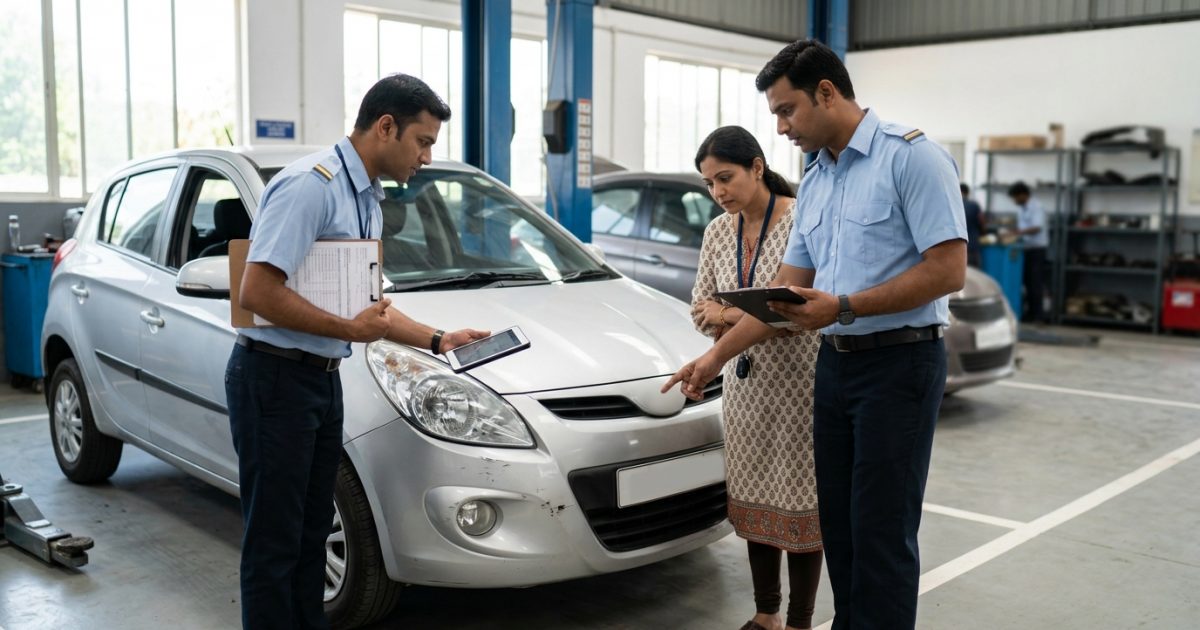
- Pre-Repair Survey: Intimate the insurer immediately and request a spot survey. An IRDAI-licensed surveyor must inspect and photograph the vehicle at the non-network garage before any work starts.
- Upfront Payment: You must approve the job card and bear 100% of the repair, replacement, and labour charges out of pocket.
- Document Collection: Obtain original tax invoices, cash payment receipts, and part replacement bills signed by the garage manager.
- Claim Submission and Payout: Submit the physical invoices, claim form, and a cancelled cheque within 7 to 15 days of repair. Following bill verification, the insurer transfers the approved amount directly to your bank account via NEFT.
Documents Required for Car Insurance Claim
IRDAI's Master Circular strictly prohibits insurers from rejecting claims for documents that were already verified during underwriting. Ensure you have these incident-specific documents required for car insurance claim processing ready:
- Claim Form: Duly filled and signed, containing the date, time, exact location, and clear description of the incident.
- Registration Certificate (RC): Self-attested copy or a digital copy verified through mParivahan or DigiLocker.
- Driving Licence (DL): Valid licence of the individual driving the vehicle during the mishap. Always verify driving licence status beforehand to ensure it is unexpired.
- Active Insurance Policy Copy: Schedule page highlighting own-damage coverage and selected add-on covers.
- KYC Documents: Copy of Aadhaar card or PAN card of the registered owner.
- Repair Bills and Receipts: Original tax invoices and payment receipts (mandatory for reimbursement claims).
- Bank Details: Cancelled cheque or bank passbook copy displaying the account number and IFSC code.
- Police Report (FIR / GD Entry): Required for theft, fire, or third-party liabilities.
Is FIR Mandatory for Car Insurance Claim?
Whether you require a police report depends entirely on the nature of the damage. Many policyholders mistakenly assume an FIR is needed for every minor dent.
When an FIR is NOT Required:
- Minor dents, scratches, bumper cracks, or windshield damage sustained by hitting static objects like walls or gates.
- Single-vehicle mishaps where no outside property was damaged and no third party was injured.
- Damage caused by natural calamities like floods, cyclones, or falling tree branches.
When an FIR is Strictly Mandatory:
- Vehicle Theft: Filing an FIR is compulsory. Final claim settlement also requires an "Untraced Vehicle Report" from the police.
- Third-Party Bodily Injury or Death: Mandatory under the Motor Vehicles Act and Section 154 of the criminal procedure code.
- Major Road Collisions: Incidents involving significant third-party property damage or hit-and-run charges.
- Arson or Vandalism: Total loss caused by intentional fire or riot damage requires police verification to rule out fraud.
Deductibles and Material Depreciation Rates
When settling a claim, insurers deduct standard compulsory charges and apply depreciation on replaced parts under IRDAI regulations, unless you hold a Zero Depreciation add-on.
| Vehicle Category / Component Material | Deductible or Depreciation Applicable |
|---|
| Private cars up to 1,500 cc (Compulsory Deductible) | ₹1,000 per claim |
| Private cars exceeding 1,500 cc (Compulsory Deductible) | ₹2,000 per claim |
| Rubber, nylon, plastic parts, tyres, and batteries | 50% depreciation |
| Fiberglass components | 30% depreciation |
| Glass parts | 0% (Nil depreciation) |
| Metal parts: Vehicle age up to 6 months | Nil depreciation |
| Metal parts: Vehicle age 1 to 2 years | 10% depreciation |
| Metal parts: Vehicle age 2 to 3 years | 15% depreciation |
| Metal parts: Vehicle age over 10 years | 50% depreciation |
Common Car Insurance Claim Rejection Reasons
Understanding frequent car insurance claim rejection reasons can help you protect your claim from repudiation:
- Driving Without a Valid Licence: Claims are dismissed if the person driving held an expired licence or lacked the correct vehicle class endorsement. If your licence has lapsed, check the DL renewal online guide to update it.
- Driving Under the Influence: Operating a vehicle with blood alcohol levels exceeding 30 mg per 100 ml results in immediate claim denial.
- Consequential Damage (Hydrostatic Lock): Restarting an engine submerged in floodwaters forces water into cylinders, causing mechanical breakdown. This is excluded under standard policies unless you possess an Engine Protect add-on.
- Commercial Use of Private Vehicles: Using a private registration car for commercial transport or ridesharing violates policy terms.
- Discrepancies and Misrepresentation: Concealing facts or submitting fabricated incident timelines will lead to rejection.
Claim Settlement Timelines and Grievance Escalation
According to the regulatory framework highlighted by the Press Information Bureau, insurers must adhere to strict turnaround times. Surveyors must be assigned within 24 hours and file their report within 15 days. The insurer must settle the approved payment within 7 days of receiving this report, or pay penal interest (Bank Rate plus 2%).
If your claim is unfairly delayed or rejected, follow this escalation ladder:
- Grievance Redressal Officer (GRO): Approach your insurer's internal GRO, who must respond within 15 days.
- IRDAI Bima Bharosa Portal: Escalate unresolved complaints through the IRDAI Bima Bharosa Portal or toll-free helpline (155255).
- Office of the Insurance Ombudsman: Approach the Insurance Ombudsman for independent dispute resolution for claims up to ₹50 lakh.
Conclusion
Following the correct car insurance claim process ensures that accidental damage does not turn into an out-of-pocket financial burden. By documenting the accident scene, notifying your insurer promptly, and submitting the right paperwork, you can secure hassle-free settlement at network or non-network garages.
Before you take your vehicle on the road, always confirm that your vehicle documents and policy terms are up to date. You can verify your RC and insurance details on VahanX within seconds.